

First: grief, not speculation. A high-speed rail collision that kills dozens is a human catastrophe. Families have lost mothers and fathers, children, partners, and friends. Survivors will carry the consequences for life. Nothing written below is meant to diminish that suffering. It is written in the spirit of careful inquiry—because when a system fails this badly, society owes the dead more than slogans and the living more than guesswork.
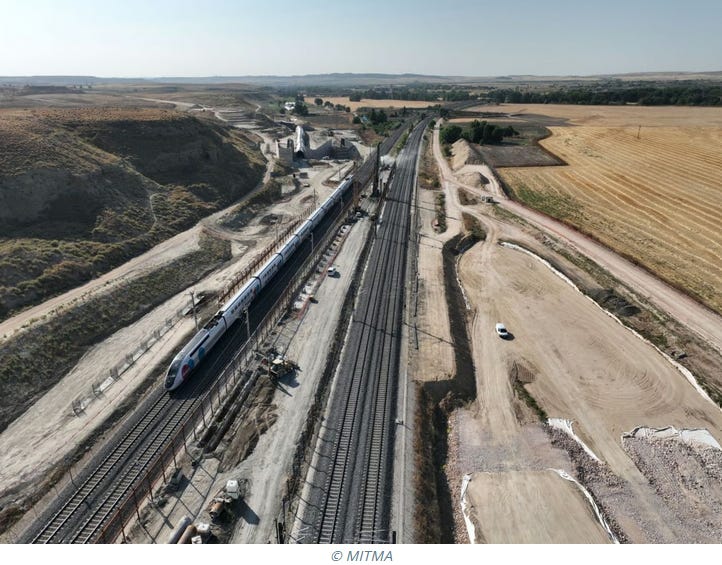
Initial reporting describes a sequence that experienced railway professionals themselves have called “extremely strange” and “baffling.” A Madrid-bound train derailed on a reportedly straight stretch of track near Córdoba, crossed onto the opposing line, and collided with an oncoming train. Critically, early accounts indicate the derailment involved the rear portion of the first train—two carriages—rather than the front.
Subsequent reporting has suggested a broken rail as the initial focus of investigators. As a complete explanation, however, that account sits uneasily with the known sequence. On straight high-speed plain line, a broken rail typically affects the first axle to encounter it, producing a lead-vehicle derailment with predominantly longitudinal dynamics. That is not what has been reported here. The front of the train appears to have passed without incident, with derailment beginning in the rear carriages and expressing immediately as lateral fouling of the opposing line. A broken rail is also temporally indifferent: it cannot explain why the derailment occurred precisely when an oncoming train was present. At most, such a defect could be contributory or secondary—for example, damage resulting from a guidance or geometry failure that manifested during traversal—rather than the initiating cause. Treating a broken rail as dispositive risks resolving the investigation’s mechanical question while leaving its timing paradox unexplained.
That detail matters. Under ordinary rail mechanics, a static defect on plain line—something simply “there,” such as a gross track discontinuity—tends to affect the first axle that encounters it. Rear-only derailments are not impossible, but they narrow the field. They suggest either a condition that expresses only under trailing-vehicle dynamics, or a guidance state that changes during the train’s passage, after the lead vehicles have already traversed the critical area.
From there we arrive at the central anomaly: timing.
Most derailments, even catastrophic ones, kill because the derailed train strikes terrain, structures, or its own interior becomes lethal. Train-to-train collisions caused by derailment are rarer, because they require a second coincidence: an oncoming train must be present in the conflict envelope at the same moment the derailed vehicles foul the opposing line. In other words, two low-probability events must align—a derailment that produces immediate lateral obstruction, and an opposing movement occupying that space at precisely that time.
This is the timing paradox. The analytical question is not only “what caused the derailment?” but “why did it occur within such a narrow encounter window?”
There are only two broad ways that paradox resolves.
The first is coincidence: an extraordinary mechanical or infrastructure failure happened at exactly the wrong moment, and an opposing train was there. That is possible. Rare events do occur.
The second is that the variables were not independent. If the derailment timing was not independent of opposing traffic position—if, in some way, the system state governing guidance and routing became coupled to knowledge of train positions—then what appears as coincidence may instead be structured convergence.
This is where one particular hypothesis becomes analytically interesting: a points or interlocking integrity failure that expresses during traversal.
Points (switches) and their associated interlocking logic exist to prevent precisely the scenario rail engineers dread: a guidance-state change while a train occupies critical geometry. In modern networks, points are locked, monitored, and inhibited under occupancy. The design philosophy is fail-safe. But such systems are complex, combining physical machines, sensors, software state, and signalling authority. When coherence is lost, the physical outcome can look like an ordinary derailment—wheel-rail mechanics behaving exactly as they do when guidance geometry becomes incompatible—while the context remains inexplicable. The failure looks mechanically authentic, but the “why then?” does not.
This hypothesis also fits the rear-only detail better than a plain-line defect. If lead vehicles traversed normally and a guidance-state discontinuity occurred mid-passage, trailing vehicles can be the first to encounter a geometry they cannot follow. The result can be a derailment that is sudden, lateral, and immediate—precisely the kind that can foul the adjacent line with little warning.
If investigators were to conclude that derailment timing was not independent of opposing train movement, the scope of inquiry would necessarily widen. That would not imply intent or wrongdoing, but it would require examining whether any safety-critical system behaved inconsistently with its design invariants. In modern rail networks this includes not only physical components but also the signalling and interlocking layers that govern routing, locking, and occupancy. Investigators would therefore look for state inconsistencies, unexplained overrides, credential misuse, or mismatches between logged system states and physical reality. Such examination is standard practice in complex system failures and presumes neither sabotage nor negligence; it reflects the reality that access-mediated failures can leave few obvious traces.
Does this imply deliberate interference? Not necessarily. A points or interlocking integrity failure can be mechanical, electrical, or software-related. Complex systems do fail in complex ways. But the hypothesis has one uncomfortable feature: it naturally accommodates the timing anomaly. If a system that knows where trains are is also the system that governs guidance and routing state, then—at least in logic—the derailment event could become temporally coupled to the presence of an opposing train. That coupling could arise from ordinary failure, from malicious interference, or from some combination of latent vulnerability and triggering condition. At this stage, none of those can be asserted as fact.
What can be asserted is the proper investigative focus. If the rear-carriage detail holds, and if experts remain publicly “baffled,” then the investigation should not be satisfied with a single-cause story that ignores timing. It should ask: did the guidance state remain invariant throughout traversal? Do physical point positions, sensor indications, and control logs agree? Was any state transition observed that should have been inhibited under occupancy? Were there upstream anomalies that reduced the randomness of train co-location? Does the derailment pattern match known passive failure modes on plain line, or does it resemble a mid-passage guidance discontinuity?
These are not sensational questions. They are the questions that honour the dead: questions that treat a “baffling” event as something to be explained, not merely endured.
Finally, a note on restraint. In the age of instant reaction, the temptation is to leap to confident blame—human error, corporate negligence, sabotage, or conspiracy. That impulse is understandable, but it is not analysis. Analysis means holding competing hypotheses open, weighting them by fit, and letting discriminating evidence do the work.
If this incident proves to be a tragic coincidence, that should be said plainly when the evidence compels it. If it reveals an uncomfortable vulnerability in safety-critical control systems, that should be faced as well. Either way, the measure of seriousness is not the confidence of our accusations, but the discipline of our reasoning.
May the injured recover. May the families of the dead be surrounded by care. And may the investigation be worthy of the lives that were lost.