

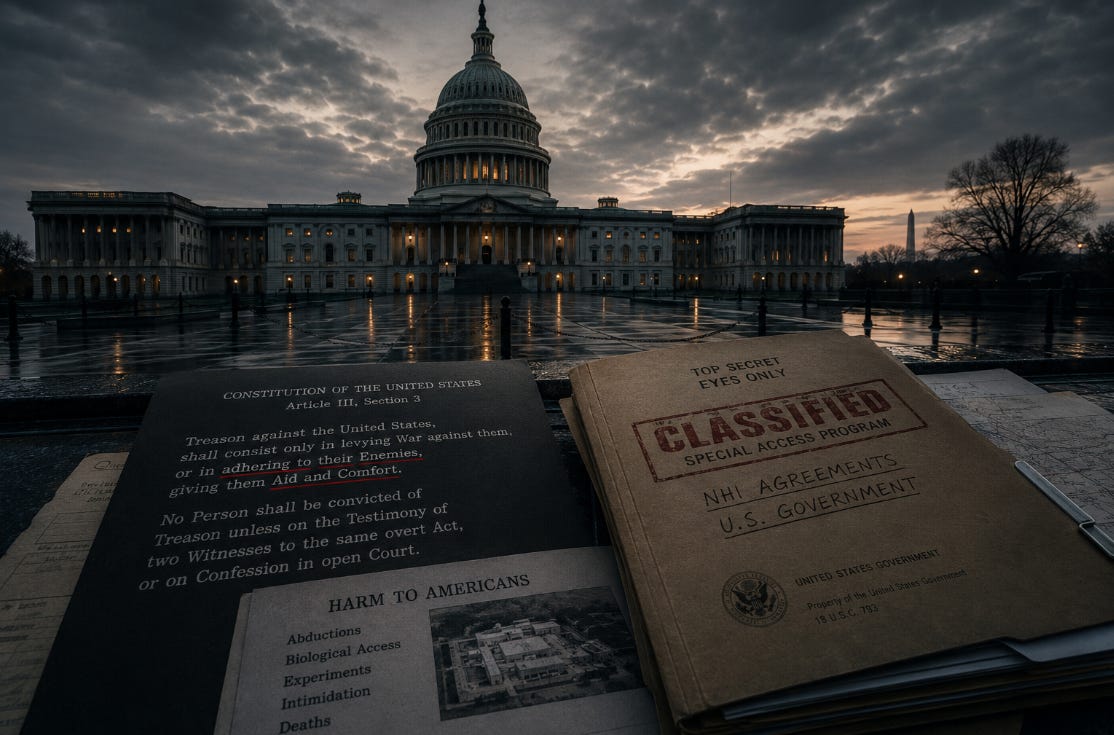
The most dangerous word in the public UAP record is not craft. It is not biologics. It is not reverse engineering. It is agreements.
A craft can be recovered, hidden, studied, or transferred into private custody. A body can be concealed. A technology can be buried inside a defense contractor. A program can be kept beyond ordinary congressional supervision. All of that would be grave. But an agreement is different. An agreement means parties, terms, exchange, obligation, breach, renewal, enforcement, and authority. It means someone did not merely observe a non-human intelligence. Someone claimed power to bargain with it.
That moves the issue beyond disclosure. The legal center is what the government may have done, who authorized it, what was exchanged, and whether anything belonging to the American people was pledged without their knowledge or consent.
The prior essay Disclosure Without Resolution: The UFO Issue as Institutional Containment examined the modern UAP process as a widening of acknowledgment without a corresponding widening of explanation. UAP means unidentified anomalous phenomena, the government’s current term for what was traditionally called UFOs. Since 2017, military footage has been acknowledged, hearings have been held, and new offices have been created. Yet the public still has no integrated account of recovered material, contractor access, human consequences, or legal authority. The public is permitted to know that something serious exists while institutions retain control over what that admission is allowed to mean.
An agreement would be the concealed hinge beneath that process. The government can survive admitting that some objects remain unexplained. It can survive another hearing or carefully limited report. What it cannot easily survive is proof that officials, agencies, or contractors entered arrangements with a non-human power, hid those arrangements from Congress, and used classification to conceal what was exchanged.
The related essay The Intelligence State and the UFO Problem argued that unusual evidence changes character when it enters the intelligence system. It becomes a security problem, a custody problem, a classification problem, a technological opportunity, a witness-management problem, and a source of institutional liability. A civilian asks what the evidence means. An intelligence organization asks who else knows, what material can be captured, what capabilities may be gained, what programs may be exposed, and what consequences may follow if the truth is admitted.
That is the proper setting for the agreement issue. Sightings are one thing. Custody is another. Agreements belong to custody. They would be the legal structure beneath the concealment.
David Grusch is the public hinge because his testimony did not arise from ordinary UFO folklore. He was an intelligence officer, Air Force major, and National Geospatial-Intelligence Agency official who worked on UAP analysis. In his sworn House statement, he said he became a whistleblower after receiving information from credentialed military and intelligence personnel about UAP programs operating above lawful congressional oversight. He said the information supplied to him included photographs, official documents, and classified testimony. He described his action as a duty to uphold the Constitution and protect the American people.
In open testimony, Grusch stated that programs existed beyond congressional oversight, that funds had been misappropriated, that defense contractors were involved, that non-human biologics had been reported by people with direct knowledge, and that supporting documents would have to be discussed in a secure setting.
His testimony also introduced a criminal dimension. Asked whether people had been harmed or injured in efforts to conceal the technology, Grusch answered yes. Asked about murder, he said he had directed people with such knowledge to the proper authorities. A secret technology program is one legal category. A secret program connected to retaliation, injury, and possible murder is another.
The hearing did not prove every underlying fact. It placed Congress on notice through sworn testimony that hidden UAP programs may involve denied oversight, contractor participation, misuse of funds, human injury, and possible murder. Congress was no longer receiving rumor. It was receiving testimony through a lawful constitutional process.
The agreement issue sharpened the problem further. In an interview with Ross Coulthart, Grusch was asked about an internal document referring to “agreements that risk putting our future in jeopardy.” Coulthart framed the issue as agreements between the United States and non-human intelligences. Grusch did not reject the premise. He said national leadership needed to get to the bottom of it.
The interview had been reviewed by the Defense Office of Prepublication and Security Review, usually called DOPSR. That office reviews material proposed for public release by people who have held security clearances. Its approval does not establish that a claim is true or endorsed by the Department of Defense. It means only that the material was cleared for public discussion. The significance is narrower: a former intelligence officer already inside the congressional UAP process was publicly asked about agreements with non-human intelligence and did not dismiss the subject.
Matthew Brown supplies a second whistleblower line. Brown identifies himself as the author of the Immaculate Constellation report. He says he met with staff of the Senate Select Committee on Intelligence in August 2023 and discussed information involving Special Access Programs.
A Special Access Program, or SAP, is a classified program protected by restrictions beyond those applied to ordinary classified information. Access is limited to specifically approved individuals, and even senior officials may be excluded. An Unacknowledged Special Access Program, or USAP, goes further: its existence may itself be concealed.
Brown says he learned that none of the special access programs he described had been officially disclosed to Congress and that the programs he reported were later confirmed to be illegal. He says he prepared the Immaculate Constellation report, obtained approval for public release, and arranged for it to be delivered to Congress for the November 2024 House UAP hearing.
Michael Shellenberger’s congressional testimony placed the broader allegation into the public record. He described a whistleblower report alleging that the Executive Branch had managed UAP and non-human intelligence matters without congressional knowledge or authorization, possibly for decades. His testimony also described Immaculate Constellation as a central unacknowledged program collecting UAP information. It included the allegation that the program was controlled from the White House but administered through the Department of Defense in a manner designed to avoid ordinary military oversight.
Brown later alleged that multiple independent sources had told him of classified executive orders and agreements, sometimes described as treaties, signed by previous presidents without congressional knowledge or approval. He said these secret instruments restrain the elected president’s ability to enforce the law in relation to UAP. If accurate, they would operate as clandestine law inside the Executive Branch.
The public record does not establish that Brown briefed Congress specifically on those treaty-like instruments. That distinction matters. But Brown is not an outside commentator. He is a named whistleblower who says he took classified program information to Senate intelligence staff, whose report entered the congressional record, and who later alleged secret executive instruments restraining presidential authority. Congress cannot reasonably dismiss that as internet folklore.
The official counter-position comes from the All-domain Anomaly Resolution Office, or AARO, the Department of Defense office created to investigate UAP. Its 2024 historical review reported no verified evidence of extraterrestrial technology, no confirmed recovery or reverse-engineering program, and no evidence that such information had been illegally withheld from Congress.
That position must be acknowledged, but it is not conclusive. AARO is not a court, not an independent civilian commission, and not a congressional investigation exercising compulsory powers. It is a Defense Department office operating inside the military and intelligence structure whose conduct is being questioned.
That location matters. If the allegation is that programs were hidden for decades inside highly restricted classifications, private contractors, limited-access channels, concealed budgets, oral briefings, or secret executive instruments, then a military office operating within that same system cannot settle the question merely by reporting that it did not find the concealed record. The whistleblower claim itself is that access was denied and oversight was evaded. Grusch’s decision to go to inspectors general and Congress rather than treat AARO as final judge was therefore not evasive. It was the lawful route for a whistleblower who believed the military control system was part of the problem.
The modern evidence therefore has a clear structure. Grusch places hidden programs, human harm, and possible murder before Congress. Brown places illegal classified programs and treaty-like executive restraints into the public record. Shellenberger places long-term Executive Branch concealment into congressional testimony. AARO supplies the official Defense Department denial. Older accounts of alleged agreements may show that the pattern has circulated for decades, but they do not carry the legal argument. The modern case rests on whistleblower testimony, congressional notice, official denial, classified structure, and constitutional law.
The modern testimony did not arise in a vacuum. It enters a much older record of alleged contact, negotiation, exchange, and human consequence. In a 1954 letter to early UFO researcher Meade Layne, Gerald Light claimed that he had visited the Muroc/Edwards Air Force Base installation and witnessed officials confronting the presence of non-human craft. Later accounts developed around a so-called Greada or Grenada Treaty involving official contact and negotiated terms. Charles Hall, a former Air Force weather observer stationed on the Nevada ranges, described sustained military interaction with the beings he called the Tall Whites. Phil Schneider, who described himself as a geologist and explosives engineer involved in underground military construction, claimed that he survived a violent encounter with non-human beings beneath a facility near Dulce, New Mexico. Around these accounts lies a much wider experiential record: reports of abduction, implanted objects, reproductive and biological procedures, animal mutilations, surgically removed tissue, unexplained injuries, and craft allegedly containing biological material or human remains. The modern whistleblowers did not invent the themes of contact, exchange, non-interference, concealment, and human cost. They moved an older pattern into modern congressional and constitutional channels.
A parallel record concerns institutional conduct around the subject and what happened to some of the people who approached it. Paul Bennewitz was a civilian electronics engineer who observed unusual activity near Kirtland Air Force Base and attempted to report what he believed he had discovered. The Air Force Office of Special Investigations, or AFOSI—the Air Force agency responsible for criminal investigation and counterintelligence—became involved. Former participants later acknowledged that fabricated documents and false information were fed into the Bennewitz case while his psychological condition deteriorated. James Forrestal, the nation’s first Secretary of Defense, died in 1949 after falling from a window at Bethesda Naval Hospital. His death was treated as suicide, but persistent later allegations connected it to classified knowledge of the UFO issue and a possible wish to disclose it. Amy Eskridge, an advanced-propulsion researcher and co-founder of the Institute for Exotic Science whose work involved unconventional physics, died in 2022; her death has since drawn renewed scrutiny. These cases do not establish a single mechanism. They do show that the subject has long been surrounded not merely by secrecy, but by disinformation, psychological interference, disputed death, and institutional silence.
The disappearance of retired Major General William Neil McCasland adds a current and unusually consequential case. McCasland was an astronautical engineer, a former commander of the Air Force Research Laboratory, and a senior figure in space research, acquisition, and classified aerospace work. His connection to the modern UFO-disclosure effort is documented rather than speculative. In a 2016 email to John Podesta, Tom DeLonge wrote that he had been working with McCasland for four months, had given him a four-hour presentation on the project, and that McCasland had helped assemble his advisory team. McCasland disappeared from his Albuquerque home in February 2026 and remains missing. No causal conclusion about his disappearance is asserted here. But his case now sits within a broader cluster of deaths and disappearances involving people connected to sensitive aerospace, nuclear, and scientific work—serious enough to prompt the House Committee on Oversight and Government Reform to seek briefings from the FBI, NASA, the Pentagon, and the Department of Energy. No common cause has yet been established. The significance is cumulative: the modern congressional testimony exists within a much larger evidentiary field marked by contact allegations, biological harm, official disinformation, retaliation, unexplained death, disappearance, and persistent institutional refusal to provide an integrated account.
That classified structure was examined in Compartmentalization and the Structure of Classified Power. Secrecy does more than hide information from the public. It can fragment knowledge inside government itself. One office sees funding. Another sees technical work. Another sees security. A contractor holds the material. A committee receives only a partial briefing. Each participant may understand a narrow task while almost no one sees the whole.
Congress can therefore possess formal authority while lacking practical knowledge. Rank does not guarantee access. Constitutional office does not guarantee visibility. When access becomes more important than office, a narrower system of power forms inside the visible government. If an agreement with non-human intelligence exists inside that structure, concealment is not merely a decision made after the fact. It is built into the arrangement.
That is why another hearing or limited report is not enough. Disclosure without integration simply repeats containment. The required inquiry is direct. Does any agreement, memorandum, executive order, compact, side letter, protocol, renewal, or operational arrangement exist involving non-human intelligence, recovered technology, biological material, abduction, non-interference, facilities, contractors, or restraints on presidential authority? If so, who authorized it? What was exchanged? Was Congress informed? Was the Senate asked to consent? Were Americans affected? Was classification used to prevent lawful scrutiny?
These are constitutional questions.
The Constitution allows the President to make treaties only with the advice and consent of the Senate, provided two-thirds of senators present concur. No intelligence agency, military faction, defense contractor, secret program, or private consortium has authority to bargain away the rights of the American people. Even a lawfully approved treaty cannot override constitutional protections. A secret agreement purporting to authorize access to citizens, abduction, biological exploitation, experimentation, surveillance, territorial use, or enforced silence would be void because no official possesses authority to grant those things.
The American people are not collateral. They are not consideration. They cannot be secretly pledged.
This is where The Classified Security State becomes directly relevant. A security system remains legitimate only while it is constrained, accountable, and directed toward protecting the innocent. It becomes something else when it can act behind walls the public cannot see, impose consequences the public must bear, and then invoke national security to prevent meaningful judgment.
If Americans were harmed, abducted, biologically accessed, intimidated, experimented upon, or killed while classified systems protected an agreement, secrecy was not protecting the public. It was protecting the arrangement.
This is where treason enters, and the term must remain precise. Article III of the Constitution defines treason as levying war against the United States or adhering to their enemies, giving them aid and comfort. It also provides that no person may be convicted unless two witnesses testify to the same overt act, or the defendant confesses in open court.
The two-witness rule is a safeguard governing conviction. It does not require the public to produce two cleared witnesses before Congress investigates. If the alleged structure exists, the difficulty is not necessarily a shortage of witnesses. It is that witnesses, documents, programs, contractors, victims, signatories, and overt acts may be concealed by classification. The evidentiary problem is extraction from the concealed system.
The Supreme Court’s decision in Cramer v. United States (1945) established that treason cannot rest on suspicion, association, or disloyal thought alone. The prosecution must prove an overt act giving aid and comfort to the enemy, and the constitutionally required witnesses must testify to that act. Applied here, the relevant acts would be concrete: signing or renewing an agreement, providing facilities, directing non-interference, concealing victims, suppressing witnesses, misleading Congress, or maintaining unlawful restrictions that protect the relationship.
Haupt v. United States (1947) held that acts appearing innocent in isolation can become treasonable when their purpose and surrounding circumstances show that they supported an enemy mission. In that case, assistance such as shelter, transportation, and employment support took on a different legal character because it aided a saboteur. The same principle would apply to a funding decision, contractor arrangement, security order, false briefing, or classification decision whose actual purpose was to sustain a hostile compact.
Kawakita v. United States (1952) upheld a treason conviction arising from brutal treatment of American prisoners by a United States citizen working with the enemy abroad. The case confirms that allegiance follows the citizen and that conduct directly harming Americans while serving an enemy can satisfy the constitutional offense. If Americans were harmed while officials knowingly preserved a hostile relationship, the issue would extend beyond secrecy to enemy-aligned conduct with identifiable victims.
Gillars v. United States (1950), involving the broadcaster known as Axis Sally, established that communications and propaganda can provide aid and comfort when knowingly used to advance an enemy’s purposes. Ordinary error or bureaucratic denial is not treason. But deliberate falsehoods intended to preserve a hostile agreement, suppress victims, defeat oversight, or prevent lawful resistance could become part of the aid itself.
A formal declaration of war is not necessarily required. The central questions are whether a hostile power exists and whether a person knowingly adheres to it through acts giving aid and comfort. If a non-human power was abducting Americans, exploiting them biologically, injuring them, interfering with military systems, or operating against American sovereignty, the legal question would be whether officials knew of that hostility and nevertheless protected the relationship.
If the counterparty is neutral or benevolent, treason does not automatically follow. But the witness record described here is not benign. It includes denied oversight, retaliation, misuse of funds, possible injury and murder, concealed biological material, and alleged agreements said to place the future in jeopardy.
A hostile non-human power would be an enemy in the ordinary constitutional sense. A court might eventually have to decide whether Article III’s word enemies includes a non-human force, but the Constitution does not become inoperative because the adversary is unfamiliar. Enemy is a functional term. It describes a hostile power acting against the United States or its people.
In my legal opinion, if the facts asserted by Grusch, Brown, and related witnesses are true, the conduct qualifies as treason. Not metaphorical treason. Treason in the constitutional sense: knowing adherence to an enemy through acts that protect, sustain, or conceal the hostile relationship.
The public cannot be required to prove from outside the classified wall what the wall was allegedly built to hide. Classification may delay public proof, but it cannot alter the legal character of the conduct concealed. A system cannot bury agreements, witnesses, victims, funding, contractors, and overt acts and then argue that the public has failed to produce evidence.
Classification also does not legalize criminal conduct. Executive Order 13526, which governs the classification system, prohibits classification intended to conceal violations of law or prevent embarrassment. Classification may protect lawful national-security information. It cannot convert kidnapping, illegal experimentation, murder, or treason into protected policy.
If unlawful classification preserves a hostile relationship, obstructs investigators, or conceals crimes against Americans, it may become part of the criminal structure itself. Treason would be the constitutional apex, but other possible offenses could include conspiracy, obstruction of Congress, misuse of funds, retaliation against witnesses, kidnapping, illegal detention, human experimentation, accessory liability, and murder.
Congressional silence therefore carries serious weight. Not every member knows the same facts, and individual culpability would have to be proved separately. But congressional notice is no longer speculative. Public hearings and classified briefings have occurred. Whistleblower material has gone to committees and staff. The issue has been raised by Grusch under oath, by Brown as a named whistleblower, and by Shellenberger in congressional testimony. The unresolved questions are what Congress has received, who received it, what evidence accompanied it, and why the testimony has not been released, summarized, tested, subpoenaed, or acted upon.
If Congress possesses classified testimony identifying programs, agreements, witnesses, contractors, injuries, funding, or executive restraints, it cannot indefinitely tell the public that the allegations are unproven while refusing to expose or test the evidence. Procedure may explain delay. Classification may explain caution. Neither can justify permanent burial of evidence that may establish treason or other crimes.
No specific senator is accused here. The public record does not establish which senator, if any, possesses the full knowledge described below. The legal principle nevertheless matters. A senator who receives credible classified evidence of a hostile agreement, American deaths, and unlawful concealment is not in the same position as an ordinary security-clearance holder.
The Speech or Debate Clause of the Constitution protects senators and representatives from being prosecuted or questioned elsewhere for legislative speech made in Congress. Its purpose is to protect the Legislature from intimidation by the Executive Branch and the courts. A senator may fear political retaliation, removal from a committee, censure, expulsion, or destruction of a career. But fear of executive criminal prosecution is not an adequate explanation for silence on the Senate floor.
If classification is being used to preserve treason, classification is not the senator’s superior duty. The oath is.
On those facts, silence could give aid and comfort if it knowingly preserves the hostile relationship. The senator would not be liable merely for receiving classified information. The legal danger would arise from understanding that the information describes a hostile compact causing American deaths and then acting, or refusing to act, in a way that protects its continuation.
Congress and the courts are not the source of sovereignty. They exercise authority delegated by the American people. Their legitimacy depends upon fidelity to the Constitution. If unauthorized officials bargained with a hostile power, exposed Americans to harm, and then used classification to prevent constitutional institutions from acting, the injury would extend beyond individual victims. It would be an injury to popular sovereignty itself.
The American people would not be lawfully bound by such an agreement. They did not consent. They were not informed. They were not represented. A hidden bargain made by unauthorized actors cannot bind the people whose rights were traded away.
This is the Natural Law principle beneath the constitutional one. No agent can lawfully consent to the violation of another being’s sovereignty. No ruler can sell the people. No military faction can make a population collateral. No intelligence service can convert citizens into consideration. No contractor can receive technology in exchange for human access. Government cannot secretly authorize what it has no lawful power to give.
That is why agreements matter more than craft. A craft asks what was recovered. An agreement asks who bargained. A craft asks what technology exists. An agreement asks what was exchanged. A craft asks what the government knows. An agreement asks what the government did.
If it knowingly aided a hostile non-human power against the American people, the legal name of the betrayal is treason.
The necessary inquiry would locate every agreement, executive order, memorandum, compact, renewal, protocol, and operational arrangement involving non-human intelligence. It would identify the parties, signatories, contractors, facilities, consideration, victims, classification authority, funding, enforcement mechanisms, and legal opinions. It would determine who obstructed oversight and who protected the arrangement after its human consequences were known.
If Congress is said to lack clearance to know, constitutional government has already been displaced. If agreements exist but cannot be disclosed, the public is being governed by hidden instruments outside lawful authority. If Americans were harmed as part of those arrangements, disclosure alone is not the remedy. Criminal accountability is.
The lawful course is process: compel the record, test the witnesses, identify the overt acts, and determine who knew, acted, concealed, funded, misled, and protected. If the facts establish treason, treason should be charged. If they establish murder, kidnapping, conspiracy, obstruction, illegal experimentation, or witness retaliation, those offenses should be charged as well.
The first duty is not to secrecy. It is to the Constitution. Then to the people. Then to the truth. Any structure that reverses that order has ceased to be lawful.
I am shocked that this comentary does not currently have a much larger audience. As a lifetime consumer of expert UFO analysis I consider the Teesdal contribution to fill a critical void in the current landscape of disclosure authors, advocates and experts. His combined knowledge of legal and IC analysis is invaluable. I very much hope that Teesdal continues his work and eventually reaches an opportunity to advise Congress and influence public policy and future legislation.
- Teesdal for Congress!