

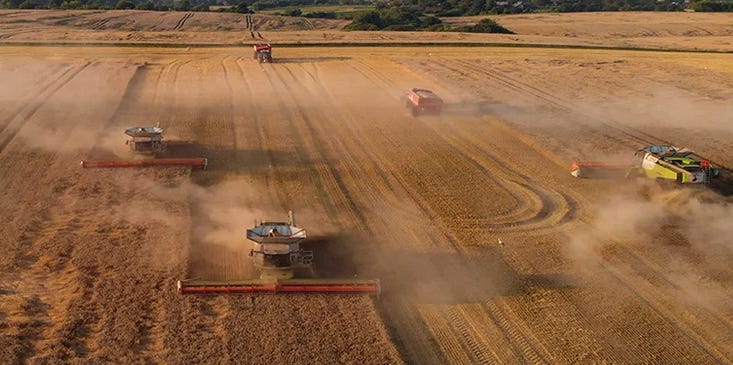
Modern food production appears abundant, distributed, and resilient. Supermarkets remain stocked, supply chains adjust to seasonal variation, and agricultural output has expanded steadily over decades. This surface stability obscures a structural reality: the modern food system is not independent. It is a downstream function of a tightly coupled chain of dependencies, most notably energy and fertilizer inputs, global logistics networks, and concentrated production geographies. The system operates efficiently under stable conditions, but its architecture concentrates risk rather than dispersing it.
At its foundation, modern agriculture is an energy conversion system. Mechanized farming depends on fuel for planting, harvesting, irrigation, and transport. More critically, fertilizer production—particularly nitrogen fertilizer—is directly dependent on natural gas through the Haber–Bosch process. Approximately 70–80% of global ammonia production costs are tied to natural gas input, establishing a primary dependency: food production is not merely influenced by energy availability, but structurally bound to it. When energy markets tighten or fragment, fertilizer production becomes constrained, input costs rise, and agricultural output is directly affected. The relationship is not indirect or long-term; it is immediate and mechanical. Constraints at the energy level propagate directly into fertilizer availability and, in turn, into food production, reflecting the same dependency structures observed in The Global Supply Chain System, where continuous inputs are required to sustain output.
This energy-to-fertilizer linkage extends into a second layer of dependency: geographic concentration. Fertilizer production is not evenly distributed. It is concentrated in regions with access to cheap natural gas or specific mineral deposits, such as potash and phosphate reserves. Similarly, large-scale agricultural output is concentrated in a relatively small number of regions optimized for climate, soil, and infrastructure. This creates a system in which both inputs and outputs are geographically narrow. Disruptions in a small number of locations—whether due to conflict, trade restrictions, or environmental conditions—propagate rapidly across the global food system.
The third layer of dependency is logistical. Modern agriculture does not rely on large inventories or localized self-sufficiency. Instead, it depends on continuous flows: seeds, fertilizers, machinery components, and harvested crops move through international transport networks with minimal buffering. Ports, shipping lanes, rail systems, and storage facilities form the operational backbone of food distribution. Any disruption to these systems—whether through geopolitical conflict, infrastructure failure, or regulatory constraint—interrupts not only distribution but production itself, as inputs fail to arrive in time for planting cycles. This dynamic corresponds directly with the structural fragility described in The Efficiency Trap: How Optimization Eliminates System Resilience, where continuous flow architectures replace redundancy with efficiency.
These layers—energy, fertilizer, geography, and logistics—do not operate independently. They reinforce one another. An energy disruption reduces fertilizer output; reduced fertilizer availability lowers crop yields; lower yields increase price volatility; and logistical strain amplifies distribution inequality. The system does not fail in a single point of collapse. Instead, it degrades across multiple dimensions simultaneously, producing outcomes that appear disconnected but are structurally linked.
The connection to broader systemic stability is direct. Food systems operate as a baseline condition for social and political order. When food availability becomes uncertain or prices rise sharply, the effects extend beyond agriculture into labor markets, migration patterns, and political legitimacy. Historical patterns demonstrate that food instability frequently precedes broader social disruption. This is not a function of scarcity alone, but of volatility. Systems that are stable but limited can persist; systems that are abundant but unpredictable generate stress.
Within this framework, the modern agricultural system exhibits characteristics of structural fragility. Efficiency has been prioritized over redundancy. Production has been optimized for yield rather than resilience. Supply chains have been extended rather than localized. These choices are rational within a system that assumes continuity of inputs and stability of global networks. They become vulnerabilities when those assumptions are no longer reliable. A system responsible for sustaining human life carries an implicit obligation toward stability, continuity, and protection of the population it serves. Where structural design prioritizes efficiency at the expense of resilience, that obligation is weakened, and the system’s capacity to fulfill its foundational function becomes conditional rather than assured.
The interaction with geopolitical dynamics further intensifies this fragility. Energy markets are shaped by geopolitical relationships and conflict. Fertilizer exports can be restricted or redirected as instruments of national policy. Agricultural commodities themselves become tools of leverage. The system, therefore, does not operate in isolation from political structures; it is embedded within them. Decisions made in energy policy, trade agreements, or conflict zones have immediate downstream effects on food production and distribution.
From a structural perspective, the key observation is that modern food production is not a self-contained system. It is a dependent system operating at the end of a chain: energy enables fertilizer, fertilizer enables yield, yield enables distribution, and distribution enables stability. Each link is necessary. Weakness in any link propagates through the entire chain.
For individuals within the system, these structural dependencies are not immediately visible. Food availability is experienced as a constant, not as a contingent outcome. When disruptions occur, they are often perceived as isolated events—price increases, temporary shortages, or supply delays—rather than as expressions of underlying system architecture. The lived experience is one of inconvenience or concern, but the structural cause remains obscured.
The analytical question is not whether the system can produce sufficient food under stable conditions. It demonstrably can. The question is whether the system can maintain continuity under conditions of stress across multiple dependency layers simultaneously. The architecture suggests that it cannot do so without significant volatility.
This does not imply imminent failure, nor does it require speculative assumptions about intent or coordination. It reflects observable structural characteristics: concentration, dependency, and lack of redundancy. These characteristics are not anomalies; they are the result of design choices made over time to maximize efficiency and output.
Within the broader analytical framework, agricultural systems therefore occupy a critical position. They translate upstream dependencies into downstream consequences that directly affect human stability. The chain is not abstract. It is continuous and operational: energy → fertilizer → food → stability. Understanding this chain does not require access to restricted information or complex modeling. It requires recognition of how modern systems are constructed and how dependencies accumulate within them.
In this sense, agricultural fragility is not a separate issue. It is an extension of the same structural patterns observed in energy systems and global supply chains. The system does not fail because it is poorly designed in isolation. It becomes fragile because it is tightly integrated into a broader architecture in which multiple points of dependency must remain stable simultaneously.
The conclusion follows directly from the structure. A system that depends on continuous inputs, concentrated production, and uninterrupted logistics can function at high levels of output but cannot absorb sustained disruption without consequence. The appearance of abundance should not be confused with resilience. The former reflects current conditions; the latter reflects structural capacity.