

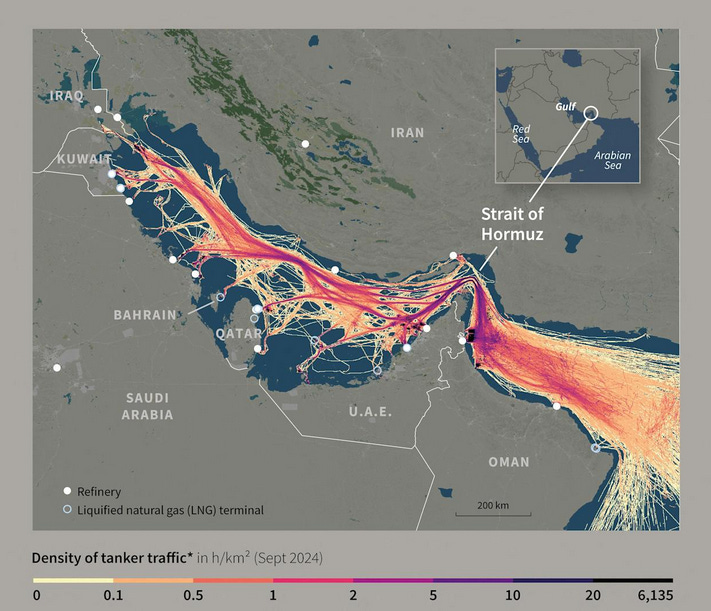
The Strait of Hormuz is usually discussed as a vulnerability of the global economy. That description is true, but incomplete. A chokepoint like Hormuz is not merely a place where commerce can be disrupted. As argued in Energy Chokepoints and Global Vulnerability: The Strait of Hormuz, its significance lies in the structural fact that modern industrial systems depend on uninterrupted passage through a narrow corridor whose disruption propagates outward almost immediately through shipping, insurance, and price formation. It is also a place where war can be converted into policy. Once the waterway closes, even temporarily, the effects are immediate and legible: oil prices surge, shipping is disrupted, maritime panic becomes global, and governments acquire a ready-made rationale for military presence, emergency coordination, and expanded security authority. The war is then described as a crisis to be managed. What matters less, in official language, is how neatly the crisis produces outcomes that strengthen the same structures that dominate the response.
That pattern is now plainly visible. Since the war began on February 28, Iran had sharply restricted access to Hormuz after U.S.-Israeli airstrikes, while the United States enforced a blockade on Iranian ports. By April 17, after Iran and the United States announced that the strait was open to commercial vessels again, France and Britain were already moving to organize a multinational maritime mission to restore and secure freedom of navigation, with more than a dozen countries reportedly prepared to contribute and military planners due to meet in London next week. Even where the language is diplomatic and the mission is described as defensive, the basic result is unmistakable: war has opened the way to a thicker external security architecture around one of the central energy passages of the world.
The economic logic of the crisis was equally clear. Hormuz carries roughly a fifth of the world’s oil flows. When the strait was effectively choked, markets responded exactly as such systems always do. Brent crude surged toward $120 during the crisis. When the reopening was announced on April 17, oil fell sharply. The point is not that markets overreacted. The point is that war around an energy chokepoint produced a sudden and highly profitable shock in one direction, followed by a rapid relief move in the other, with the entire episode reinforcing the strategic centrality of the passage and the importance of those claiming the authority to secure it.
Meanwhile, the budgetary and industrial logic moved in parallel. As argued in War and Budgetary Expansion, modern conflict often fails in the language used to justify it while succeeding in the surrounding structures of appropriations, replenishment, industrial contracts, and permanent readiness claims. That is precisely the pattern visible once munitions expenditure, stockpile strain, and extraordinary new budget requests begin to move together. The White House has been pushing a fiscal 2027 defense request of about $1.5 trillion, framed as a historic expansion tied to military rebuilding, missile defense, shipbuilding, and the replenishment of weapons used in recent conflicts including Iran. Once munitions are expended at scale, replenishment ceases to be an abstract possibility and becomes a practical demand. Destruction on the battlefield is translated into procurement language, inventory language, readiness language, and industrial-capacity language. The dead do not return, but the purchase orders do.
This is the point at which analysis must remain morally lucid. A war killed large numbers of people across Iran, Lebanon, Israel, Gulf states, and U.S. forces. It also generated a commodity shock, justified another enormous defense spending push, burned through expensive munitions, strained inventories, and produced a new multinational security rationale around the strait. Those are not disconnected facts. They are the integrated outputs of a system that repeatedly converts destruction into authority, fear into coordination, and human death into strategic and industrial renewal. To describe that process in sterile language alone would not be restraint. It would be evasion. When a war leaves bodies in its wake, jolts energy markets, enlarges military budgets, and thickens the architecture of control around a vital passage, it is not enough to call the outcome tragic. The system has extracted value from the blood in the waterway, and it has done so in the oldest language of all: security, stability, and the restoration of order.
None of this requires the fantasy that officials privately confess the real purpose of such wars. Systems are not understood primarily through confession. They are understood through outputs. That point was already implicit in Strategic Intent Analysis and the Iran War, which argued that where regime change was structurally implausible, the more reliable consequence, and therefore the more revealing analytical starting point, was an energy shock tied to Hormuz rather than the public objective used to justify the war. Here the outputs are unusually legible. A conflict described as necessary and temporary has produced a familiar sequence: coercive action, market panic, rearmament pressure, and a more durable security structure around a strategic corridor. The fact that the mission is presented as multinational and defensive does not alter the underlying function. Formal sovereignty and practical control are not the same thing. In the contemporary Western order, a European-branded security framework often operates within a larger American perimeter of intelligence, logistics, naval power, and escalation dominance. Even when Washington does not formally front the mechanism, the strategic architecture remains recognizably its own.
What emerges, then, is not an aberration but a systemic function. The war did not merely threaten the global economy and then require an emergency response. It produced a chain of consequences from which the dominant military and security structures are now positioned to emerge enlarged. The passage will reopen, but on terms increasingly shaped by external force, coordinated surveillance, mine-clearing capacity, escort logic, and a standing justification for continued presence. The oil shock recedes, but the security rationale remains. The bombs are spent, but the replenishment cycle begins. The public is told that order has been restored. In reality, the disorder has been metabolized into a stronger mechanism of control.
That is why Hormuz matters beyond shipping. It reveals the business model of permanent crisis in compressed form. A strategic chokepoint is disrupted by war. The disruption is converted into economic shock. The shock becomes the rationale for military coordination. The war consumes inventories. The depleted inventories justify procurement. The resulting architecture is then described not as expansion but as protection. What disappears in that sequence is the human meaning of the original act. Iranians were killed. Others were killed with them. Lives were broken, cities were destabilized, families were displaced, and the entire event was rapidly translated into the language of lanes, flows, security missions, budgets, and supply chains. That is not accidental. It is how institutional systems protect themselves from the moral reality of what they produce.
The deeper obscenity is not only that war kills. It is that modern security systems have learned to make those deaths functionally productive. They generate just enough chaos to authorize a new layer of control, just enough scarcity to justify industrial expansion, and just enough fear to launder strategic consolidation through the language of necessity. The Strait of Hormuz is therefore not only a waterway. It is a demonstration. It shows how blood, oil, and military power are joined inside a system that repeatedly turns crisis into structure and then calls the result peace.