

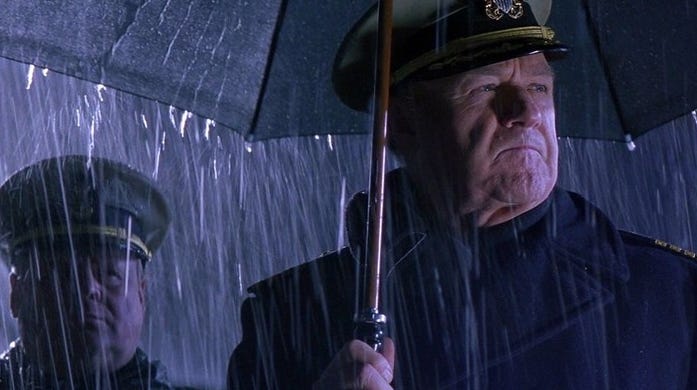
The 1995 film Crimson Tide is usually remembered as a moral standoff: decisiveness versus restraint, command versus doubt, the warrior against the lawyer. On first viewing it looks like a hard ethical question under pressure. With a legal lens, it becomes something else entirely: an accidental study of how hierarchical systems protect themselves when one of their own nearly commits the unthinkable.
Captain Ramsey is entrusted with nuclear weapons. His conflict with his executive officer, Hunter, is framed as a disagreement over whether to proceed after communications from higher authority become compromised. The film invites us to see two principled men locked in a tragic clash of judgment.
That framing does not survive scrutiny.
Once a second Emergency Action Message is known to exist—even partially received—the legality of executing the earlier launch order collapses. Nuclear command and control is built on one principle: no irreversible action under uncertainty. Authority does not persist by default when higher command is demonstrably attempting to speak again. At that moment, execution must halt until intent is verified. This is not hesitation. It is lawful control.
From that point forward, Ramsey is no longer exercising command judgment. He is attempting to act without lawful authority.
The film then crosses a bright line. Ramsey assaults his executive officer. He escalates again in the weapons bay. He initially threatens the Weapons Officer, but realizes—mid-countdown—that this officer is the only person who can access the safe with the launch trigger. Killing him would make launch impossible. So Ramsey pivots and threatens an entirely uninvolved junior crew member instead, placing a pistol to the person’s head and counting down unless the trigger safe is opened.
This is not “forceful command.” It is hostage-taking by threat. It is calculated: he selects a target he can threaten precisely because that person is not operationally indispensable. It is not a snap. It is instrumental intimidation in service of an act that has already lost lawful executory force.
Legally, there is no ambiguity here. Pointing a firearm at someone’s head and threatening to kill them is aggravated assault. Threatening to kill an innocent third party to compel compliance is coercion at gunpoint and unlawful confinement at minimum, and it supports an attempted-murder analysis because conditional intent is still intent. However one labels it, the core point is simple: Ramsey is no longer acting under color of command. He is committing serious offenses to force compliance.
And that means something equally simple about Hunter. Hunter is not “defying command.” He is doing what the law demands when authority becomes dangerous: interrupting it.
If Crimson Tide were a story about law, it would end with relief of command, arrest, court-martial, and removal. It does not. Instead, it ends quietly. Ramsey departs with dignity. Hunter is vindicated, but the institution moves on as if the episode can be absorbed.
At first glance this looks like Hollywood evasion. But there is a more disturbing reading, and it fits how large hierarchies behave when legitimacy is threatened.
Institutions of this kind do not exist primarily to surface truth. They exist to preserve stability, continuity, and confidence in the structure. When an event reveals that command authority fractured internally and came within seconds of catastrophic execution, the instinct is not full exposure. It is containment.
Not always by crude conspiracy. By procedure.
Facts are classified. Testimony is filtered. Language is sanitized. The record is narrowed to what can be admitted without destabilizing the system. “Attempted murder” becomes “extreme pressure.” “Assault” becomes “a physical confrontation.” “An unlawful attempt to compel launch” becomes “a disagreement over interpretation.” Reality is not denied. It is translated into institutional speech.
This is why Ramsey, in the world the film actually depicts, would not be publicly destroyed. He is dangerous in the abstract, but structurally he embodies what hierarchies recognize and reward: decisiveness, certainty, loyalty to the chain, readiness to act. He is also, unmistakably, a psychopath—someone willing to threaten the life of an innocent subordinate to force compliance with an unlawful order.
Hunter represents something far more unsettling to a command culture: lawful interruption. He proves authority can be stopped from within—by procedure, verification, restraint. That is not merely inconvenient. It is destabilizing.
The inquiry scene makes this visible. The Admiral signals that Ramsey is so trustworthy that his testimony alone could suffice, and that they are prepared to proceed without even hearing Hunter. Hunter expresses unease, then relaxes when he learns Ramsey has recommended him for command. The film presents this as professionalism. But it cannot be the full record.
If the actual facts were on the table—that Ramsey assaulted his XO, threatened to kill an innocent junior crew member at gunpoint, and attempted to force execution of an order that had lost lawful authority—Ramsey would not be treated as a reliable narrator. He would be confined and facing charges. Which means the ending is not “justice delayed.” It is a narrative already managed. What survives is not the truth of what occurred, but the version the institution can afford to acknowledge.
This is not a flaw in the sense of inaccuracy. It is the film’s most honest revelation.
A man like Ramsey does not become a public criminal. He becomes a quiet liability. He is moved out of the spotlight, his record protected, his reputation preserved. Early retirement. Full pension. The file closed.
Not because the system approves of what he did, but because it cannot afford to indict the personality it itself selects.
The missiles nearly launch. That is the central horror. Close behind it is something more disturbing: the recognition that the structure is predisposed to elevate, protect, and retain exactly the kind of psychopath most likely to make that happen again.