

Modern states speak constantly about discipline, reform, and eventual normalization. They promise that emergency spending will recede, debt burdens will come under control, and fiscal balance will return once the crisis passes. Yet across much of the developed world the pattern runs the other way. The shocks change, the explanations change, and the rhetoric changes, but the underlying movement remains the same. Borrowing rises, obligations accumulate, and the range of realistic exit options narrows. What appears to be repeated temporary deviation is better understood as a structural condition. The system is no longer moving away from fiscal excess. It is operating inside a trap from which ordinary politics cannot easily depart.
The problem is not simply that governments spend too much. It is that modern states have built expenditure systems that are far easier to expand than to reverse. Debt service, entitlements, military commitments, administrative overhead, industrial subsidy, emergency backstops, and crisis-era precedents all accumulate in one direction. Each may be defended on its own terms. Together they create a fiscal structure in which retreat becomes politically, socially, and institutionally harder than continuation. Governments do not merely overspend in a temporary sense. They inherit systems whose internal logic makes persistence more likely than correction.
Public debate still treats debt as though it were mainly a problem of discipline. The assumption is that states could restore balance if leaders were more serious, voters more patient, or bureaucracies more efficient. That description is too shallow. In many cases the state cannot normalize because normalization would require simultaneous reductions in functions that large parts of the public now experience as basic expectations, elite structures experience as institutional necessities, and financial systems experience as stabilizing supports. The issue is not simply a failure of will. The surrounding order has been built to punish restraint.
Debt becomes especially difficult to reverse once it stops funding discrete projects and begins to support the operating assumptions of the system itself. At that point borrowing is no longer an exceptional bridge between revenue and expenditure. It becomes a continuity device. It preserves state function, absorbs political pressure, postpones distributional conflict, and delays open recognition that promises and resources have drifted out of proportion. Instead of forcing a visible choice between commitments that can be kept and commitments that cannot, debt allows governments to defer the confrontation. It keeps the structure moving while ensuring that the unresolved contradiction grows larger with time.
That pattern has been visible for years. After the 2008 financial crisis, emergency interventions presented as temporary did not lead back to a cleaner baseline. They helped stabilize the immediate shock, but they also normalized a deeper dependence on central-bank support, low rates, and prolonged public backstopping of fragile systems. Much of Europe then spent the following decade caught between weak growth, high debt, and persistent political reluctance to impose the kind of correction that would have made the underlying imbalance unmistakable. Japan provides an even longer example. For decades it has remained functional, orderly, and advanced while operating inside a condition of persistent debt dependence from which no normal exit has appeared. None of these cases is identical. Together they show that long-duration fiscal trapping is not theoretical.
That is why rising debt so often coexists with official claims of stability. Borrowing can preserve surface order for a long time. Salaries are paid. Pensions continue. Procurement pipelines remain intact. Benefits are maintained. Debt is rolled over. Markets remain open. Nothing in that sequence proves health. It may simply show that the system still has access to financing and still retains enough credibility to postpone adjustment. Continuity is not the same as resolution. It may only mean that the trap has not yet forced an open break.
The trap is reinforced by democratic incentives. Political systems are organized around short horizons, while fiscal deterioration unfolds across longer ones. The benefits of spending are immediate, concentrated, and legible. The benefits of restraint are delayed, diffuse, and often invisible. A government that cuts sharply imposes pain now for gains that may not become clear for years and may be claimed by successors if they arrive at all. A government that borrows can preserve near-term peace, avoid explicit confrontation, and maintain the appearance of responsible management. Under those conditions, even leaders who understand the long-run danger are drawn toward continuation. The system does not require uniquely corrupt actors to produce the result. Ordinary incentives are enough.
Monetary conditions deepen the same pattern. Once a state becomes heavily indebted, higher rates stop functioning merely as a disciplining signal. They become a direct pressure point on the fiscal structure itself. Debt service rises, refinancing becomes more dangerous, and the state’s room for maneuver contracts further. That creates pressure for monetary accommodation, inflation tolerance, financial repression, or some combination of the three. None resolves the underlying problem. Each redistributes the cost in a form less visibly described as fiscal adjustment. The burden moves through the currency, through distorted asset prices, through suppressed real returns, or through the slow erosion of purchasing power. The public still pays. It simply pays through channels that feel less explicit than formal retrenchment.
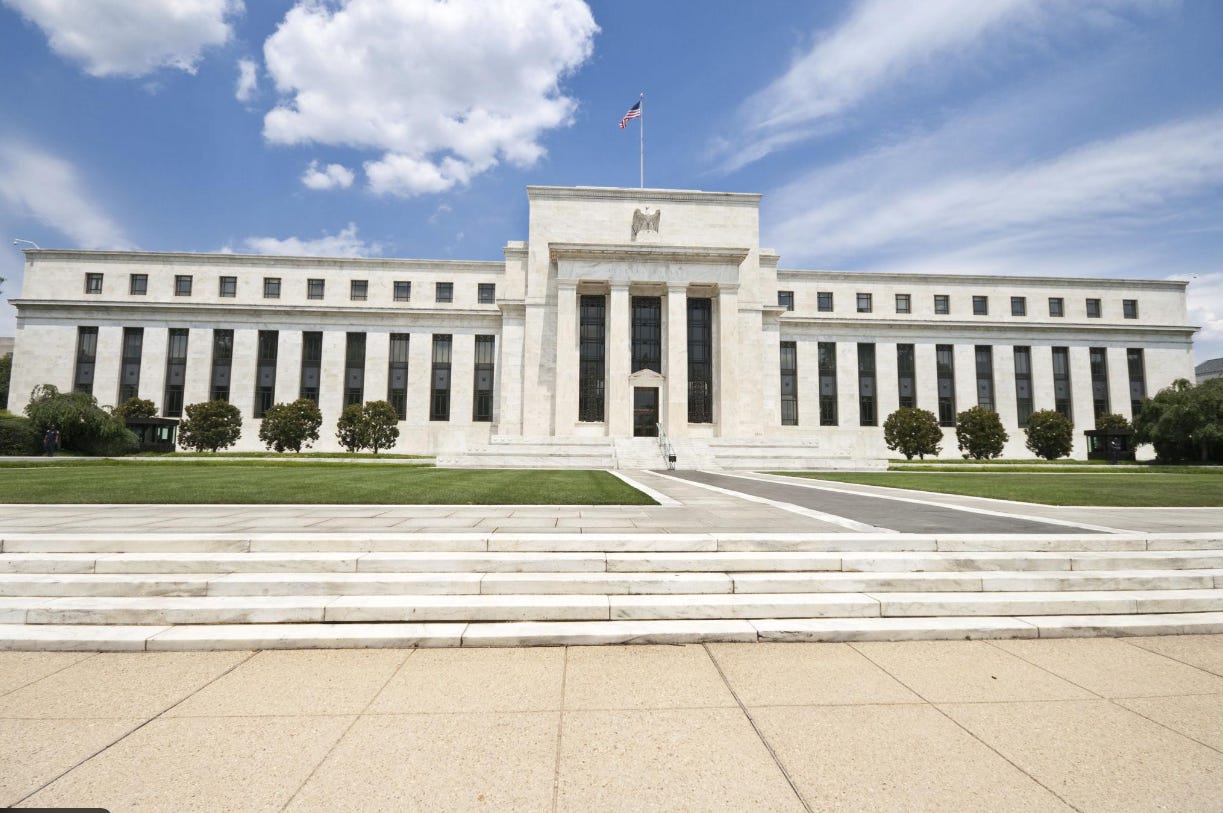
This is where The Federal Reserve Is Different — and That Difference Is the Error becomes a useful companion. That essay examines the monetary architecture that allows states to operate at a greater distance from ordinary fiscal constraint than public language usually admits. The connection matters because the fiscal trap is not only about spending persistence. It is also about the institutional structure that makes prolonged continuation possible, even after the original conditions of balance have been lost. The debt trap and the monetary structure are not identical, but they reinforce one another.
The result is that modern states often become trapped between two forms of instability. If they continue borrowing, debt grows, interest burdens expand, and long-term resilience weakens. If they attempt serious correction, growth slows, politically protected constituencies react, and the risk of social or electoral disruption rises. The choice is therefore not between comfort and discipline. It is often between deferred instability and immediate instability. Under those conditions, governments usually choose delay. That choice is rational within the incentives of the system, but the accumulation of rational delay produces an irrational aggregate outcome.
There is also a deeper reason normalization becomes difficult. Much state spending now functions not only as provision but as containment. It absorbs shocks that would otherwise force more direct recognition of economic fragility, class conflict, regional imbalance, demographic pressure, or strategic overreach. Subsidy, transfer, credit support, emergency intervention, and deficit-financed continuity all help prevent open rupture. That makes them attractive even when they worsen long-term balance. The state is no longer simply financing services. It is financing social manageability. Once debt performs that role, reducing it becomes harder because the question is no longer merely economic. It becomes a question of how much instability the system is willing to permit in order to restore honesty to its accounts.
This is one reason fiscal debate often feels detached from lived reality. Citizens are told that debt is unsustainable, yet the system continues. They are told that restraint is necessary, yet spending expands. They are told that emergency measures are temporary, yet they harden into baseline expectation. The contradiction creates confusion because the formal language of public finance still describes a world in which states retain normal exit paths. In practice many do not. They retain management options, delay options, concealment options, and redistribution options, but not necessarily a clean return to prior balance.
The phrase normalization itself may therefore mislead. It assumes there is an earlier fiscal condition to which the system can return. In many cases that condition depended on demographics, growth rates, industrial structure, geopolitical position, and monetary credibility that no longer exist in the same form. Governments are not merely trying and failing to restore balance. Many are attempting to preserve older commitments inside newer constraints. Debt is the instrument that makes that mismatch temporarily survivable. It is not the only source of the problem, but it is the mechanism through which the mismatch is financed.
War spending is one of the clearest examples of this process because it expands quickly, embeds itself institutionally, and is rarely unwound in proportion to public failure. The United States after September 11 is an obvious case. The emergency frame changed over time, particular wars rose and faded, and public confidence in the underlying projects often weakened, yet the broader expenditure base, procurement logic, and security architecture did not simply return to an earlier level. Costs became structural. That is why War and Budgetary Expansion fits naturally beside this essay. That piece shows how military expenditure can keep rising even when wars do not produce the stated outcomes used to justify them. The relevance here is direct. Fiscal trapping is not driven only by welfare systems or domestic political promises. It is also driven by cost structures that expand through conflict, remain after the emergency frame fades, and become part of the permanent expenditure base.
A similar continuity logic appears in The Global Financial Crisis and the Architecture of System Protection. That essay explains how losses were pushed outward while institutional continuity was preserved at the center. The same structural instinct appears in fiscal policy more broadly. When direct correction becomes politically dangerous, the system does not necessarily solve the problem. It redistributes it, delays it, or moves it into less visible channels. The post-2008 world offers a clear example. Major institutions were stabilized, but large parts of the cost were dispersed across the wider public through suppressed returns, slower real recovery, balance-sheet expansion, and longer-term fiscal strain. Debt is one of the main tools by which that transfer occurs.
Seen in this light, the fiscal trap is not merely a matter of numbers becoming too large. It is the loss of a credible route back. A state enters the trap when debt ceases to be an occasional response to disruption and becomes a standing requirement for maintaining institutional continuity at politically acceptable levels of pain. Once that point is reached, every additional strain matters more. War matters more. Recession matters more. Demographic aging matters more. Energy shocks matter more. Interest-rate shifts matter more. Each is absorbed by a structure already carrying obligations it cannot easily reduce and promises it cannot easily reform.
This does not mean immediate collapse. States can persist in trapped conditions for long periods, especially where they retain reserve-currency advantages, deep capital markets, geopolitical reach, or public tolerance for gradual erosion. But persistence is not resolution. A system may survive for years while becoming less flexible, less honest, and less capable of genuine correction. It may continue functioning while losing resilience. That is often the better description of the modern fiscal condition. Not sudden failure, but managed deterioration.
The deeper danger is that prolonged fiscal trapping changes the character of the state itself. As room for open correction narrows, political energy shifts away from reform and toward explanation. Leaders spend more time describing present costs as exceptional, current borrowing as prudent, future growth as restorative, and visible signs of strain as manageable. Procedure begins to replace correction. The system protects continuity first. Recognition arrives without meaningful exit. Public finance becomes another domain in which exposure changes little because the structure is built to preserve itself before it restores balance.
The result is a state that remains operational but loses the ability to choose freely among fiscal paths. It can borrow, reprice, inflate, defer, and repackage. It can announce frameworks, targets, reviews, and medium-term plans. What it cannot easily do is return to a durable structure in which obligations, revenues, and core functions stand in realistic proportion. That is the real significance of modern debt expansion. The danger is not only that the total keeps rising. It is that the state becomes less able to leave the system that requires it.
So the fiscal trap of modern states is not simply irresponsibility at scale. It is a condition in which debt has become the bridge between political expectation and structural reality, even as the bridge grows weaker with every crossing. Governments continue because they must preserve continuity. They cannot normalize because normalization would require a level of contraction, reprioritization, and institutional honesty that the present order is not built to withstand. The costs keep rising because the deeper problem is no longer excess alone. It is dependency without exit.