

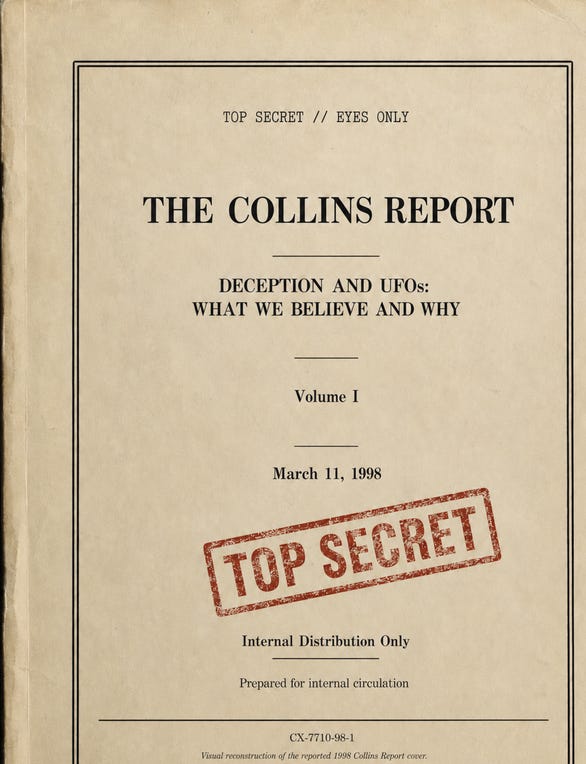
The full Collins Report is not public.
That fact matters. No one outside the relevant circles can reproduce it, quote it in full, or know every conclusion it reached. But absence of the complete document does not mean absence of structure. Nick Redfern’s Final Events provides enough fragments to recover the shape of the argument: the reported title, the date, the volume structure, the chapter headings, quoted passages, Redfern’s summaries, Ray Boeche’s account, and related material moving in the same direction.
The fragments are not enough to recover every sentence.
They are enough to recover the argument.
Redfern says that on March 11, 1998, a two-volume document was printed and made available to all members of the Collins Elite. It was titled The Collins Report, Deception and UFOs: What We Believe and Why. The title is revealing. It does not frame the UFO issue as mystery, technology, visitation, recovered craft, interstellar travel, or unidentified aerial phenomena. It frames it as deception. The central issue is the intelligence behind the appearance, the belief it wants to create, and the reason it wants human beings to accept that belief.
That is the first key to the report. It does not appear to have been written as a neutral catalogue of cases. It was written as an internal statement of belief and warning.
The reported structure reinforces that reading. Volume I ran to 367 pages. Volume II was reportedly composed of case studies and profiles, interviews, and notes. Volume I supplied the interpretive framework; Volume II supplied the supporting material. That is the architecture of an assessment. The first volume says what the phenomenon means. The second gathers the evidence, witnesses, and notes used to support that conclusion.
Contemporary warnings from former intelligence figures now point in the same direction. Former CIA officer Jim Semivan has publicly warned that the phenomenon is dangerous, that attempts at contact should be approached with extreme caution, and that people who try to “let this thing in” should be “well tethered to the ground.” That warning does not sound like ordinary aerospace analysis. It sounds like a caution about contact, consciousness, belief, and spiritual exposure. The Collins Report fragments may therefore represent an earlier, more explicitly theological attempt — flawed, fearful, and incomplete — to name a danger that later intelligence-linked voices have continued to describe in different language.
The chapter headings, as reported by Redfern, are especially important:
“UFOs and Accepted Wisdom: Believers and Skeptics”
“The Validity of the Deception Scenario: What it is and Why it Works”
“The History of Deception”
“The Messengers of Deception”
“The New Mexico Crashes: Trojans”
“The Contactee: A Lesson in Learning”
“Missing Time 1961–1996”
“Infiltration: Then and Now”
“Future Scenarios Leading to a Conclusion”
This sequence is not random. It moves from public framing, to theory, to history, to messengers, to Roswell, to contactees, to abduction, to infiltration, to future scenarios. It begins with how people are taught to think and ends with what may happen if the deception succeeds.
The first chapter likely addressed the public trap: believers and skeptics. In ordinary UFO culture, these are treated as opposing camps. One believes the witnesses. The other dismisses them. One sees alien craft. The other sees misidentification, hysteria, hoax, balloons, aircraft, or weather.
The Collins frame seems to regard both camps as incomplete, and perhaps both as useful to the deception.
The believer can be misled because he accepts the mask.
The skeptic can be misled because he refuses to see that anything real is happening at all.
That is the elegance of the trap. One side believes the wrong thing. The other disbelieves the real thing. The phenomenon remains protected either way.
The Collins Report therefore appears to have begun by rejecting the official public argument. The issue was not whether UFO witnesses were all deluded. Nor was it whether extraterrestrial visitors had arrived from another planet. The issue was whether a real non-human intelligence was presenting itself through a false explanatory frame.
The second chapter, “The Validity of the Deception Scenario: What it is and Why it Works,” appears to have been the conceptual core of the report. The deception scenario is simple, but severe: the phenomenon presents itself in forms the target culture is prepared to accept. In a technological civilization, it appears as advanced craft, superior science, genetic programs, space brothers, or visitors from another star system. In earlier cultures, the same underlying structure may have appeared as gods, demons, angels, fairies, spirits, monsters, or messengers.
The mask changes because the audience changes.
The function remains.
This is not unique to the Collins Elite. Charles Fort had already shown that anomalous events resist the tidy categories imposed on them. John Keel went further, arguing in Operation Trojan Horse that the UFO phenomenon belonged to a much older pattern of deceptive appearances: lights, monsters, apparitions, religious visions, folklore beings, impossible craft, and the strange airships of the late nineteenth century. Those airship reports are especially important because they look, in retrospect, like UFO-type events dressed in the machinery of their age. Keel did not use the Collins Elite’s theological language, but he saw the same instability. The phenomenon behaved less like visitors from another planet than like an intelligence skilled at masquerade.
A deception works when it gives the target a false frame that feels explanatory. The extraterrestrial frame does exactly that. It allows military actors to think in terms of aerospace recovery. It allows scientists to think in terms of propulsion, materials, and biology. It allows the public to think in terms of visitors, disclosure, and hidden technology. It allows religious institutions to treat the issue as external to doctrine until the implications can no longer be contained. Above all, it keeps the central question out of view.
The central question is not where they are from.
The central question is what they are doing to us.
The third chapter, “The History of Deception,” likely widened the frame beyond modern UFO culture. That would have been necessary. If the report argued that the modern UFO phenomenon is deceptive, it could not begin in 1947. It would need a longer genealogy. It would need to show that non-human intelligences have interacted with humanity before, that they have used varying forms, and that the modern “alien” presentation is only the latest vocabulary.
That history likely included ancient demonology, occult contact, angelic communication, possession traditions, folklore, spirit encounters, sexual intrusion narratives, and older contact traditions in which human beings attempted to cross boundaries through ritual, altered states, scrying, invocation, sacrifice, or ceremonial magic. The point would not be that every such account is identical. The point would be continuity of structure: an intelligence presents itself, offers knowledge or power, reshapes belief, and draws human beings into a relationship they do not control.
Ray Boeche’s account sits at the center of that frame. Boeche was not a casual UFO enthusiast. He was a theologian, Anglican priest, UFO researcher, and long-time investigator of anomalous phenomena. According to his account, two men connected to the Department of Defense contacted him in Lincoln, Nebraska in 1991 and described a program that had crossed from observation into ritualized engagement. The issue was not merely recovered material or strange aerial craft. It was the use of occult or satanic ritual methods to contact non-human intelligences, followed by attempts to exploit that contact for military and psychotronic purposes.
That is the part of the story that cannot be softened. Boeche’s sources were describing a program in which people believed they had opened a channel, gained access to non-human power, and begun to use that access. They were not merely studying the phenomenon from a distance. They were trying to work with it. According to the account, the effort produced psychotronic effects, attempts to develop psychotronic weapons, and deaths. The insiders then reached the darker conclusion: they had not mastered the entities. They had been deceived into believing they were in control.
That distinction is the hinge of the entire Collins frame. The danger was not only that a hostile intelligence existed. The danger was that elements inside the defense world had entered into relationship with it, attempted to use it, and discovered too late that the apparent bargain had been a trap.
The fourth chapter, “The Messengers of Deception,” likely examined the human carriers of the message: contactees, channelers, abductees, experiencers, disclosure figures, and perhaps compromised insiders. The word “messenger” implies transmission. The phenomenon does not merely appear. It teaches. It supplies narratives. It offers cosmology. It revises religion. It speaks through selected witnesses.
The contactee becomes a distribution node.
The report likely treated space-brother messages, alien warnings, cosmic salvation narratives, anti-Christian themes, spiritual evolution claims, hybridization programs, and environmental or nuclear prophecies as doctrinal payloads. The point would not be that every contactee knowingly deceives. Many may sincerely report what they have been shown. But sincerity does not authenticate the source. If the phenomenon can manipulate perception, emotion, and memory, the messenger may be a victim of the message as much as its carrier.
That is what makes the abduction issue so difficult. A person may be truthful about the experience and still wrong about what caused it. A vivid memory is not proof of a physical event. A physical sensation is not proof of a physical craft. A received message is not proof of benevolent origin.
Karla Turner saw this problem with unusual clarity. Her work on abduction accounts emphasized deception, staged scenarios, screen memories, manipulated emotion, and false spiritual messaging. Turner’s importance is not that every conclusion she reached must be accepted. It is that she refused the comforting assumption that the entities were truthful narrators of their own purpose. In her account, abductees could be honest witnesses and still be trapped inside a manufactured story. That places her close to the Collins concern: the experience may be real, but the interpretation supplied inside the experience may be part of the operation.
The fifth chapter, “The New Mexico Crashes: Trojans,” appears to have been one of the report’s decisive sections. Here the Collins frame departs sharply from the conventional Roswell argument. The quoted material refers to STAC reports describing the “fall, collection, analysis and present whereabouts” of unusual fabrics, foils, parchments, chemical residuals, and biological material found at four locations in Lincoln County, New Mexico between July 3 and July 13, 1947.
That wording is extraordinary.
It does not simply say crashed spacecraft. It does not simply say alien bodies. It does not describe a clean aerospace recovery. It describes a fall of strange materials: fabrics, foils, parchments, chemical residuals, biological matter. The word “fall” matters. It suggests deposit, manifestation, scattering, or staged materialization as much as crash.
The chapter title supplies the interpretation: Trojans.
That word is unlikely to be accidental. It closely echoes John Keel’s Operation Trojan Horse, one of the major works arguing that UFOs should not be understood simply as extraterrestrial craft. Keel’s central insight was that the phenomenon enters human consciousness through the explanatory story a culture is prepared to receive. It comes as gods, monsters, fairies, airships, space brothers, or alien vehicles depending on the age. The fifth chapter’s use of “Trojans” therefore strongly suggests that the report was engaging Keel’s findings directly, or at minimum operating inside the same deception framework.
In that reading, New Mexico was not merely a crash site. It was an entry operation. The recovered materials functioned like a Trojan Horse. They invited a wrong conclusion. They drew the military into a frame of material recovery, aerospace secrecy, technological advantage, and extraterrestrial explanation. Once the state accepted the wrong premise, the deception entered the machinery of national security.
That is a devastating idea.
Roswell may not have been a failed alien mission. It may have been a successful deception event.
The military thought it was collecting evidence.
It may have been accepting bait.
This is where the Crowley–Parsons material becomes central. In ordinary UFO discussion, Aleister Crowley and Jack Parsons are often treated as strange background figures: occult curiosities attached to the margins of rocketry, science fiction, and early aerospace culture. The Collins material appears to treat them very differently. It seems to treat Crowley and Parsons not as footnotes, but as causal figures in the modern UFO problem.
The titles Redfern reports from within this material matter. Parsons, von Karman and Goddard: A Door Unlocked and New Mexico Origins: Parsons, Hubbard and Babalon Working imply that someone inside this world saw a connection between ritual working, aerospace culture, and the New Mexico events of 1947. Parsons, Hubbard, Babalon, Goddard, Roswell, and the “door” are not placed in separate boxes. They are drawn into the same field of analysis.
That is not accidental.
The Collins-type reading appears to be that Crowleyan and Parsons-linked ritual did not merely symbolize spiritual danger. It may have helped open a channel, create an entry point, or intensify a pre-existing non-human deception. The “Parsons technique,” as later referenced, suggests that ritual method itself was considered operationally relevant. Some appear to have believed such methods could be studied, adapted, repeated, or perhaps even used defensively. The Collins warning runs in the opposite direction: the method was not a defense. It was part of the breach.
That makes the Roswell language stranger and more important. The report does not describe a clean vehicle crash. It speaks of a “fall” of unusual fabrics, foils, parchments, chemical residuals, and biological material. That is not ordinary wreckage language. It sounds closer to manifestation: a deposit of mixed, charged, symbolically suggestive material, almost alchemical in character, as if the event were designed to be interpreted through matter while concealing the process that produced it.
Fabric. Foil. Parchment. Chemical residue. Biological matter.
That list does not read like aerospace debris alone. It reads like a material riddle.
In that reading, Roswell was not the failure of an alien craft. It was the successful appearance of a false explanation.
The sixth chapter, “The Contactee: A Lesson in Learning,” likely examined the educational side of the phenomenon. Contact is not neutral. It trains the recipient. It teaches the human mind what to expect, what to fear, what to revere, and what to believe. The title suggests reciprocity: the contactee learns from the phenomenon, but the phenomenon also learns from the contactee. It studies human response. It tests belief structures. It refines its masks.
The Collins Report likely treated contact not as friendship, but as pedagogy. The entities teach a false lesson. They move the witness into a new cosmology. They produce awe, fear, special status, secrecy, confusion, and dependence. The contactee may emerge convinced that humanity is being guided by advanced beings. The Collins frame would read that conviction as the intended result.
The seventh chapter, “Missing Time 1961–1996,” likely covered the abduction era, beginning with the Betty and Barney Hill case and moving through the later abduction literature. The date range marks the shift from contactee messages to missing time, hypnotic recall, bedroom visitation, reproductive imagery, medical theater, paralysis, false memory, and altered-state intrusion.
Here the report likely argued that abduction is not primarily physical kidnapping in the ordinary sense. The body may remain where it is. The experience may occur in consciousness, or through a manipulated state between waking, dreaming, paralysis, and out-of-body perception. That would explain why abduction-like experiences overlap with older accounts of night attack, demonic oppression, jinn assault, incubi, succubi, fairy abduction, spirit intrusion, and sleep paralysis. It also connects directly with the argument developed in Consciousness as Presence in a Structured World: consciousness is not a private hallucination chamber sealed off from reality, but a field of presence that can be acted upon, distorted, strengthened, or defended.
The label changes.
The intrusion pattern remains.
This also explains why the reported ability to stop some abduction experiences through invocation is so important. If the event were merely a physical kidnapping by biological extraterrestrials, religious invocation would be irrelevant except as comfort. But if the experience occurs through consciousness, fear, alignment, and metaphysical intrusion, then invocation may operate directly at the point of attack. A coherent appeal to benevolent authority may interrupt the hostile field.
The Collins material appears to preserve one important protective clue: hostile abduction-like experiences may stop when Jesus is invoked. That is not a small claim. It cuts against the physical-extraterrestrial model and points toward a spiritual or consciousness-based mechanism.
But the Collins frame seems to narrow that clue too quickly. If the phenomenon is adaptive, trans-cultural, and consciousness-based, the deeper rule may not be denominational exclusivity. It may be that hostile intrusion is disrupted by coherent benevolent authority. Christianity preserves one powerful form of that response. It does not follow that no other tradition preserves any part of it.
This is one of the places where the Collins frame appears strongest and weakest at the same time.
It recognizes hostile intrusion.
It narrows the remedy.
The eighth chapter, “Infiltration: Then and Now,” was likely the most alarming. If New Mexico was a Trojan event, if contactees were messengers, and if abduction was a consciousness-level intrusion, then the next question becomes unavoidable: what institutions have been penetrated?
The answer appears to include defense, intelligence, aerospace, occult networks, scientific programs, religious institutions, disclosure channels, and perhaps factions inside the UFO research community itself. The report’s references to STAC, Wright-Patterson Air Force Base, NASA-TZER, Jamison and Wylie, and the “Parsons technique” suggest a complicated hidden environment, not a single unified response. That environment resembles the world described in Compartmentalization and the Structure of Classified Power: fragmented knowledge, sealed channels, partial visibility, and factions operating from different theories of the same concealed event.
STAC appears to have been involved in the analysis, containment, or interpretation of the New Mexico material. In Redfern’s account, Wright-Patterson appears in relation to laboratory efforts to produce brief manifestations of materials similar to those that “fell” in Lincoln County. NASA-TZER appears connected to the question of “Entry Points — And How Do We Keep Them Closed?” Jamison and Wylie appear to have believed the “Parsons technique” could assist in holding off deception, infiltration, and final invasion.
STAC remains undefined in the surviving material, but the name almost certainly points toward a science-and-technology function. That matters because the American intelligence world has long treated anomalous problems as technical problems: collect the material, classify the reports, study the mechanism, reproduce the effect, control the application. If STAC was a science-and-technology assessment cell, possibly adjacent to the CIA’s own science-and-technology culture, then its instinct would have been predictable. It would try to analyze, contain, and perhaps use the phenomenon. That may be exactly the wrong response. A deceptive spiritual or consciousness-based intelligence cannot be safely reduced to an engineering problem. The very attempt to study the breach as a capability may deepen the breach. In that sense, STAC may represent the technical mind doing what the technical mind does: turning a warning into a program.
NASA-TZER also remains undefined. One possible aerospace reading is “T-zero,” the initiating moment of an event, but that must remain a hypothesis. The safer point is that Redfern places the term near the question of “Entry Points — And How Do We Keep Them Closed?” Whatever the exact meaning, the surrounding language points to threshold, access, and attempted containment.
That cluster is astonishing.
It suggests that some factions were not merely studying historical debris. They were trying to understand mechanism. How did the materials enter? Could the process be reproduced? Could the point of origin be found? Could entry points be closed? Could ritual-scientific methods help resist the phenomenon? Or would the attempt to use such methods only deepen the infiltration?
That may be one of the core disagreements inside the hidden world Redfern describes.
One faction wanted to engage.
One wanted to contain.
One wanted to disclose.
One wanted to manage belief.
One believed the whole engagement had already gone too far.
The Collins position, at least in its purer warning form, seems to have been refusal: do not trust the phenomenon, do not engage it, do not imitate its methods, and do not accept the extraterrestrial mask.
But refusal can also be corrupted. A faction that sees deception may still become tempted by counter-deception. It may decide the public cannot handle the truth. It may decide belief must be managed. It may decide emergency rule is necessary. It may decide salvation can be imposed. It may decide that a lie in the service of truth is permissible.
That is the moment the defense begins to resemble the attack.
The ninth chapter, “Future Scenarios Leading to a Conclusion,” likely set out the report’s decision tree. If the phenomenon is deceptive, if it has infiltrated institutions, if New Mexico was a Trojan event, if abductions are psychic or spiritual intrusions, if contactees are messengers, and if some state factions are already entangled, then what is to be done?
The available fragments suggest several possible futures.
One future is continued concealment. The public remains divided between skeptics and believers. Roswell remains trapped between balloon explanations and alien-crash mythology. Disclosure expands just enough to maintain interest but not enough to resolve the matter. The deeper demonic or occult interpretation remains buried. That is the same containment pattern examined in Disclosure Without Resolution: movement without closure, visibility without accountability, and a public trained to watch the mystery without reaching the hidden structure underneath it.
Another future is controlled disclosure of the Collins theory. The public is told, in some form, that the UFO phenomenon is not extraterrestrial but deceptive, occult, and spiritually hostile. That disclosure would be explosive. It would destabilize science, religion, government legitimacy, and public trust. It would also expose decades of misdirection.
A third future is intensified religious programming. This is where the report appears to become most dangerous. If the public cannot be trusted to discern the deception, then the temptation arises to reshape the public mind: faith-and-values indoctrination, military religious conditioning, mass psychological preparation, and perhaps eventual staged events intended to force belief.
This is the corrupted Collins path.
It recognizes deception but answers with manipulation.
It fears false revelation but contemplates staged revelation.
It opposes demonic control but drifts toward coercive religious control.
It sees the public as vulnerable souls, but then treats them as material to be managed.
That is not spiritual defense. It is spiritual statecraft.
A fourth future is final infiltration or invasion. The report’s language, as filtered through Redfern, appears to assume that the phenomenon has a long-term goal. It is not random. It is not merely mischievous. It is not simply exploratory. It seeks access, influence, belief, and ultimately the human soul. Whether framed in Christian eschatological terms or broader metaphysical terms, the enemy is not primarily interested in machines. It is interested in allegiance, perception, and consent.
This is where the report is most important for understanding the UFO issue. The Collins Report appears to have argued that the UFO phenomenon is not a mystery to be solved by better radar. It is a deception structure aimed at human interpretation. Its battlefield is not only the sky. It is consciousness, religion, memory, fear, authority, and the soul.
That does not make the Collins answer complete.
It makes the Collins warning serious.
At this point the reconstruction reaches its limit. The available fragments allow the report’s central architecture to be seen, but they do not supply a complete answer. What follows is therefore not a claim about every sentence of the Collins Report. It is an assessment of what the Collins frame appears to reveal, where it appears to fail, and what a more lawful response would require.
The report appears to contain a genuine insight: the extraterrestrial explanation may itself be a mask. But it also appears to contain a grave limitation: the people who saw the mask may not have had a sufficient positive account of order, truth, benevolence, and lawful response. They saw the danger of dark invocation, but did not clearly articulate the difference between corrupt ritual and benevolent sacred action. They saw deception, but remained inside institutions trained to manage truth. They saw spiritual danger, but interpreted response through secrecy, hierarchy, intelligence methods, and end-times fear.
That is how a warning can become infected by the thing it warns against.
The great missing principle is consent.
If the phenomenon works through deception, then consent becomes central. Deception is used because open authority is lacking. A lie seeks consent under false pretenses. A mask asks to be welcomed as something other than what it is. A staged revelation seeks surrender without truth. A false contact event asks humanity to agree to a relationship whose terms are concealed.
The proper answer is therefore not indoctrination.
It is refusal of false consent.
That requires truth. It requires disclosure without manipulation. It requires moral clarity. It requires distinguishing hostile intrusion from benevolent guidance. It requires acknowledging that non-ordinary contact is not all one thing. Hostile forces intrude, deceive, terrify, flatter, violate, and demand. Benevolent forces guide, protect, clarify, strengthen freedom, and require no corrupt bargain.
That distinction may be the part of the puzzle the Collins Report did not adequately contain.
Outside the Collins fragments, there are recurring reports that appear to describe benevolent intervention: inspired breakthroughs where solutions arrive with unusual clarity; survival guidance where a calm external presence helps a person escape death; and protective invocation where a hostile attack stops when a benevolent sacred authority is invoked. These do not have the same signature as the abduction or deception pattern. They do not demand worship. They do not manufacture terror. They do not turn the human being into an instrument. They restore agency.
Benevolent power is not weaker than hostile power. It operates differently.
Hostile power intrudes because it is unlawful.
Benevolent power respects freedom because it is lawful.
That is why the Collins Elite, in their corrupted form, appear so tragic. They may have recognized the hostile phenomenon, but then began to imagine responses that used hostile methods: secrecy, coercion, staged belief, emergency rule, and even contemplated mass death. If Chapter 30 is taken seriously, the later trajectory shows how fear of demonic deception can become subjugation to demonic logic.
We do not defeat deception by staging a better lie.
The full Collins Report, if it ever becomes public, may confirm or correct parts of this extrapolation. It may contain material that changes the emphasis. It may show sharper disagreements inside the Collins world than Redfern was able to reconstruct. It may show that some insiders resisted the corrupted direction more strongly than the surviving fragments reveal.
Indeed, the existence of Final Events already suggests that resistance existed. Boeche’s sources spoke because they were disturbed. Later insiders spoke because they recoiled. The book exists because conscience leaked.
That matters.
The story is not simply that a hidden group discovered the truth and then tried to save the world through control. The better reading is that some people inside or near this world recognized danger, while others became endangered by the methods they were willing to use. The real division was not insider versus outsider. It was conscience versus inversion.
That is why the Collins Report deserves reconstruction.
Not because hidden reports are sacred.
Not because intelligence factions should be trusted.
Not because the Collins Elite solved the UFO problem.
They did not.
The report matters because it appears to have seen something central: the UFO phenomenon may be a mask worn by a much older deception. But it also appears to show what happens when that insight is held inside institutions built from secrecy, control, and managed belief.
The public does not need another priesthood of classification.
It does not need occult technocrats, frightened generals, compromised priests, or apocalyptic planners deciding how much truth ordinary people can bear.
The remedy for deception is truth.
The remedy for false consent is non-consent.
The remedy for staged revelation is discernment.
The remedy for a hostile intelligence that wears masks is not to wear a better mask in return.
It is to remove the mask.