

This essay sits alongside Truth Has a Coherent Structure and Humans Require Social Permission as a continuation of the same structural inquiry. The first establishes that truth stabilizes through correspondence rather than force: when an account aligns with reality, it remains coherent under repetition, scrutiny, and time. The second explains why humans often fail to align publicly with what they privately recognize, not because truth is unclear, but because social cost constrains expression. Together, those essays describe how coherence operates when conditions are permissive, and how silence emerges when conditions are not.
What remains to be examined is what occurs when silence is no longer sufficient—when systems themselves intervene to manage perception. This essay addresses that condition. It argues that deception is not evidence of power, intelligence, or strategic superiority, but a structural signal that alignment has failed and can no longer be sustained through coherence alone.
Deception is commonly treated as a marker of advantage. It is often framed as a tool of the capable: a sign that a system is sophisticated enough to shape perception rather than submit to it. That interpretation does not survive structural examination. Across domains, deception appears not as strength, but as a compensatory behavior that emerges when correspondence with reality can no longer be maintained.
Truth has a coherent structure. Where a description corresponds with what is the case, it stabilizes without effort. It does not require rehearsal, reinforcement, or protection. It persists because it fits. A true account can be approached from multiple angles without distortion and remains legible under scrutiny. Its endurance does not depend on timing, secrecy, or control.
Humans, however, do not always align publicly with what they recognize privately. Social cost introduces hesitation. Individuals may remain silent when the price of speaking exceeds their tolerance, even when the underlying structure is clear to them. This silence is often mistaken for confusion or agreement. Structurally, it is neither. It is restraint under constraint. The individual preserves internal coherence while delaying external alignment.
Institutional deception is different. It does not arise from hesitation, but from incapacity. When a system deceives, it is acting because delay, dissent, or unforced evaluation would expose misalignment its structure can no longer absorb without failure. Deception appears where a system can no longer tolerate direct contact with reality without destabilizing.
This distinction matters because the consequences diverge. Individual silence preserves coherence under constraint; systemic deception converts misalignment into ongoing operational burden.
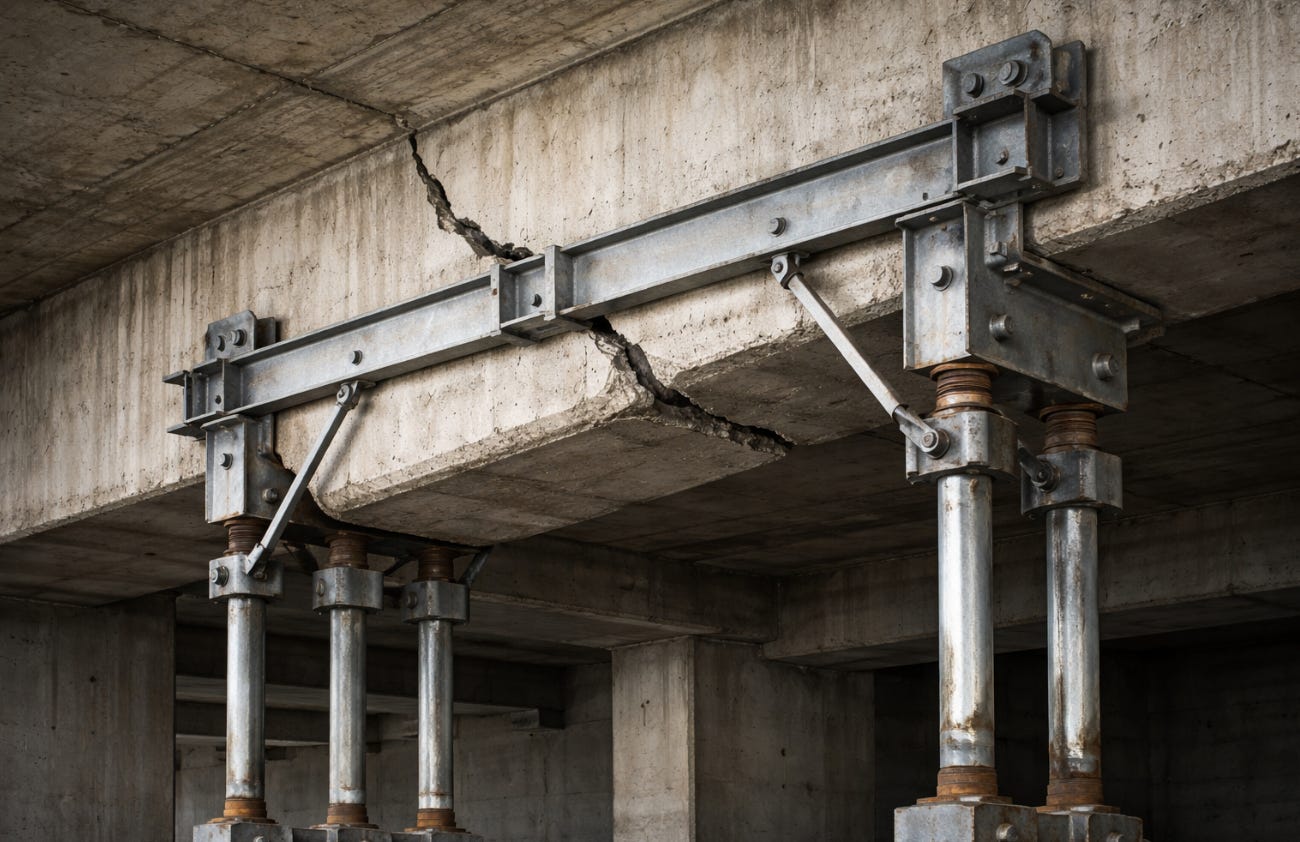
In engineering, a structure that carries load through form requires no additional intervention. Stress is distributed according to geometry and material limits. When alignment is correct, stability emerges naturally. When alignment fails, compensations are introduced—bracing, damping, overrides. Each addition increases complexity and maintenance cost. The system becomes more fragile, not more capable. Failure is deferred, not resolved.
In control systems, the same pattern appears. A well-designed system remains stable through feedback that reflects actual conditions. When the underlying model no longer matches reality, control logic grows increasingly aggressive: tighter tolerances, faster corrections, higher gain. Oscillation replaces stability. The system becomes sensitive to noise and prone to failure, not because control exists, but because control is compensating for a model that no longer fits.
Deception functions the same way. It introduces noise where signal would suffice, control where fit has failed, and enforcement where voluntary alignment has broken down. Each deceptive layer requires energy to maintain: coordination, repetition, monitoring, correction. The system must remember what it has said, suppress contradictions, and manage drift. What was once a stable structure becomes an ongoing operational burden.
Organizational behavior shows the same pattern. Where objectives correspond with outcomes, autonomy emerges. Oversight remains light. As misalignment grows, reporting multiplies. Messaging replaces measurement. Eventually, the organization expends more effort maintaining its internal narrative than interacting with its environment. At that point, deception is no longer optional. It is required to preserve the appearance of function.
Historical patterns reinforce this structure. Systems confident in their correspondence with reality permit inspection. They tolerate delay. They absorb criticism without immediate response. Systems that deceive cannot afford these conditions. They accelerate decision cycles, compress evaluation windows, and preempt dissent. Urgency becomes a substitute for validity. Speed replaces coherence.
Where truth is coherent, it does not require enforcement. Where humans hesitate, it is often due to social cost rather than uncertainty. Where systems deceive, it is because they cannot tolerate exposure to unforced reality. The behavior is not clever. It is brittle.
Strength, structurally, is the capacity to remain coherent without concealment or force. Weakness is not error or uncertainty, but the inability to bear truth without distortion. Deception marks the point at which a system can no longer rely on structure to carry load, and must intervene continuously to prevent exposure of that failure.