

For decades, the UFO issue was contained through a stable institutional pattern: official minimization, selective investigation, fragmented disclosure, and the social degradation of anyone who treated the subject as serious. Witnesses could be isolated, cases could be broken apart, and ridicule could do part of the system’s work. That pattern did not end in 2017. It changed form. The modern disclosure phase began when the issue was moved back into admissible public space through elite media, intelligence-adjacent actors, and the release of military videos presented as genuine anomalies. What followed was not resolution. It was a controlled widening of acknowledgment without a corresponding widening of explanation. The subject became more visible, more official, and more discussable while remaining structurally unresolved. That is not ordinary transparency. It is institutional containment through managed disclosure.
The key break came in December 2017. The New York Times reported the existence of AATIP, described concern inside the national security apparatus, and returned the subject to mainstream discourse under conditions of seriousness rather than tabloid stigma. Around the same period, Navy videos entered public circulation and were later authenticated by the Pentagon as genuine military footage of unidentified aerial phenomena. The importance of that sequence was not that it settled the question. It was that it marked a coordinated shift in status. The issue was no longer confined to rumor, fringe treatment, or historical embarrassment. It was reintroduced through official-adjacent channels using military material, elite press validation, and a vocabulary calibrated to restore seriousness without surrendering control.
That restoration of seriousness was itself revealing. If the subject had truly been empty, there would have been no need to rehabilitate it so carefully. The post-2017 process did not resemble the accidental collapse of an old misunderstanding. It resembled the managed repositioning of a subject that could no longer be kept entirely outside legitimate discourse. The public was allowed to know more, but only in a way that preserved institutional custody over pace, framing, and implication. The old ridicule model had become less sustainable, so a new model took its place: acknowledgment without explanation, procedural openness without final clarity, and forward motion without retrospective accounting.
What the modern framework suppresses is the depth of the prior record. The post-2017 story is often staged as though institutions are only now confronting a strange and unresolved subject that had previously lacked serious evidence, credible witnesses, or analytical weight. That pretense is untenable. The issue does not arise late in the history of the national security state. It appears at its founding threshold. Roswell erupted in July 1947. The National Security Act was signed later that same month. The CIA and the independent Air Force formally came into being in September. Whatever Roswell ultimately was, the larger point is harder to escape: the UFO issue sits at the birth of the permanent postwar secrecy apparatus. It is therefore implausible to present the matter as though the state only recently encountered a serious anomaly problem.
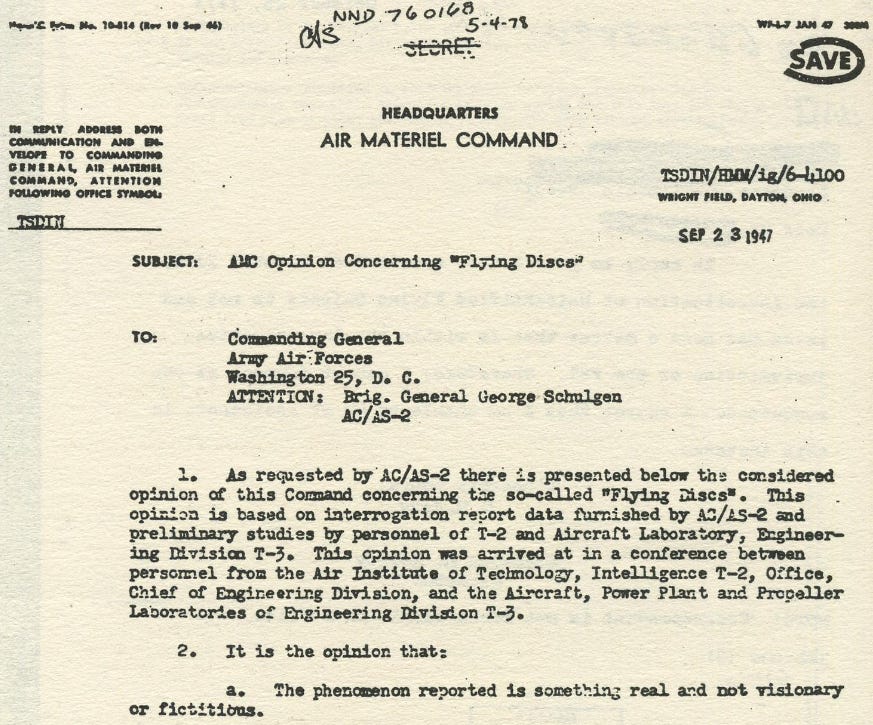
The 1947 Twining memo sharpens the contradiction further. Very early in the postwar record, a senior military figure treated the phenomenon as something real rather than imaginary. That alone destroys the later fiction that the subject was merely a cultural hallucination intermittently taken too seriously by excitable people. The public posture of dismissal and the internal posture of concern were never the same. The gap between them has defined the issue for decades. The modern disclosure movement does not resolve that contradiction. It inherits it while refusing to reconcile it.
That is why 2021 should be understood as an escalation of the modern disclosure phase rather than its beginning. By then the decisive shift had already occurred. The issue had already been reseeded into public consciousness through the 2017 reporting, the video releases, and the growing use of military and intelligence credibility as a stabilizing frame. The later official statements matter because they reveal how far the public register had moved. Former DNI John Ratcliffe spoke publicly of objects detected by multiple sensors and displaying characteristics difficult to explain through known adversary systems. Senior lawmakers and other officials increasingly treated the issue not as fantasy or embarrassment but as a genuine matter of state concern. The ODNI assessment, congressional hearings, and later public testimony widened admissibility still further. By this stage, the authoritative language was no longer ridicule. It was controlled seriousness directed at an issue official institutions could no longer dismiss without discrediting themselves.
But the deepest contradiction lies not simply in acknowledgment. It lies in the refusal to integrate acknowledgment with the legacy allegation structure behind it. In public, the issue is presented as a newly admitted mystery. In substance, the surrounding record points to something older and more deeply embedded. David Grusch’s testimony matters because it placed that deeper architecture into public view. He did not merely claim that anomalous objects existed. He alleged a multi-decade crash-retrieval and reverse-engineering effort buried in special access structures, shielded from normal oversight, and protected through extreme compartmentation. Eric Davis remains relevant in a supporting role because his public statements and longstanding association with retrieval claims show that Grusch did not invent a wholly new architecture. The significance of these claims is structural. They point to a legacy secrecy system, not a fresh puzzle.
Whether every element of that allegation structure is eventually established in full is secondary to the immediate analytical point. The modern disclosure model is built as though this deeper history barely exists, when it is precisely that buried history that makes the present pattern intelligible. A state confronting a new problem behaves differently from a state managing the public edge of a very old one. The current process increasingly looks like the latter. The public is permitted to know that something serious exists, but not to receive an integrated account of what the state, its contractors, and its secrecy structures may have known across time. The result is disclosure without historical reconciliation.
That pattern becomes clearer when placed alongside my earlier analysis of classified power. As argued in Compartmentalization and the Structure of Classified Power, mature secrecy systems do not merely conceal information from outsiders. They regulate visibility internally, ensuring that few people can see enough of the whole to challenge it coherently. That mechanism is directly relevant here. If the deeper UFO record has indeed been distributed across compartments, waived access structures, and contractor environments, then fragmentation is not incidental to the story. It is the story. The recurring incompleteness of disclosure may be a product of design rather than failure.
The same is true of the defense structure around the subject. As argued in The Military-Industrial Complex and the Persistence of Secrecy, defense systems do not dissolve when scrutiny reaches them. They preserve programs, authority, and protected continuity even after exposure. That is a useful lens here because it clarifies why acknowledgment need not produce rupture. A mature defense-secrecy system can absorb disclosure, reframe it, and continue operating without surrendering the deeper structure beneath it. The post-2017 phase bears exactly that character. Exposure has occurred, but not reckoning. Visibility has expanded, but not control. Public seriousness has returned, but the underlying architecture remains largely intact.
The older civilian continuity line points in the same direction. Charles Fort understood early that the problem was not only anomaly, but the policing of what a culture permits itself to notice. John Keel showed that the field could not be reduced to a simple inventory of strange craft, because it was saturated with distortion, absurdity, fear, and manipulative effects. Jacques Vallée carried that insight further by placing modern UFO reports within a much longer continuum of anomalous encounter, symbolic instability, and managed appearance. In that tradition, the issue is never just what is seen in the sky. It is also how institutions, cultures, and systems of interpretation regulate what can be made of it.
That is the real continuity between the older record and the post-2017 phase. What changed was not the existence of the problem, but the form of its containment. In the earlier period, the dominant tools were denial, stigma, fragmentation, and ridicule. In the current period, the dominant tools are acknowledgment, proceduralization, bounded release, and controlled ambiguity. The method has evolved, but the function remains recognizably similar. The system still protects itself first. It still permits exposure in forms that do not compel institutional reckoning. What was once suppressed through dismissal is now managed through partial admission.
This also explains the peculiar frustration surrounding the modern disclosure movement. The problem is not that nothing has happened. A great deal has happened. Military footage entered the public domain. Senior officials spoke in a new register. Hearings were held. Reporting channels expanded. Offices were created. The language of the subject shifted from ridicule to regulated seriousness. Yet the basic structure remains intact. The public is told enough to know the issue is real in some important sense, but not enough to understand what the state’s long-term position has actually been. The story moves, but never arrives. The process continues, but never resolves. That is what institutional containment looks like when full denial is no longer sustainable.
The deeper point is therefore not whether disclosure is occurring. It is. The deeper point is what kind of disclosure this is. It is not the disclosure of a system surrendering hidden truth in a final act of honesty. It is the disclosure of a system adapting to a truth that has become harder to keep submerged while refusing to integrate the legacy record that gives that truth its full meaning. The subject is too persistent, too historically continuous, too well witnessed, and too deeply entangled with secrecy structures to remain forever in the old category of the absurd. But that does not mean the public is being led toward resolution. It means the containment strategy has matured.
That is why the present phase should be understood with precision. The modern UFO story is not one of simple revelation. It is a controlled transition from mockery to management. The state has widened acknowledgment while preserving ambiguity, admitted the issue while retaining custody over its interpretation, and allowed public seriousness to return without permitting the historical and institutional record to fully open. What has emerged is disclosure without resolution: a process in which the reality of the issue is increasingly conceded, while the meaning of that reality remains procedurally contained.