

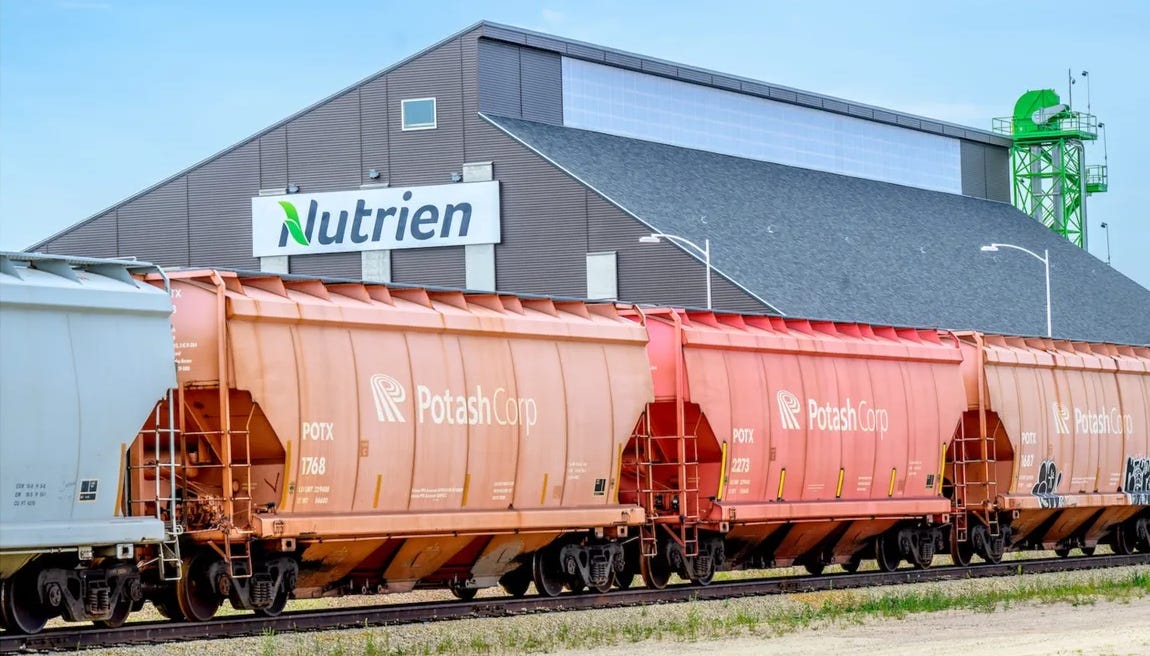
Modern food production is commonly described in biological terms. Crops require soil, water, sunlight, and labor. All of this is true, but it is no longer sufficient as an explanation of how the system actually functions at scale. Modern agriculture is also an industrial process, and one of its most important industrial inputs is fertilizer. Fertilizer is not peripheral to food production. It is one of the primary mechanisms through which industrial energy and extracted minerals are converted into agricultural output.
This is clearest in nitrogen fertilizer. Nitrogen is essential for plant growth, but the modern food system does not obtain usable nitrogen primarily through traditional ecological cycles. It obtains it through industrial fixation. The Haber–Bosch process converts atmospheric nitrogen into ammonia using hydrogen derived mainly from natural gas. This means that natural gas is not simply an external cost affecting fertilizer plants. It is embedded in the production process itself. A substantial share of modern crop output therefore depends directly on continued access to gas, both as energy source and as chemical feedstock.
That relationship matters because it makes food production structurally sensitive to energy disruption. When natural gas prices rise sharply, ammonia production becomes more expensive and in some cases uneconomic. Production is reduced, plants idle, fertilizer prices increase, and farmers respond by cutting application rates, changing crop choices, or accepting lower expected yields. The chain is neither speculative nor distant. It is immediate and mechanical. Stress in energy markets is transmitted directly into agricultural capacity.
Nitrogen is only part of the picture. Modern agriculture also depends heavily on phosphate and potash. These are not manufactured from atmospheric inputs but extracted from mineral deposits that are geographically concentrated and operationally intensive. Their availability depends on mining capacity, transport systems, export access, and political stability in a relatively small number of producing regions. This creates a second dependency structure alongside nitrogen. Even where energy supply remains available, disruptions in mining, refining, shipping, or export policy can constrain fertilizer supply and place pressure on agricultural production.
Taken together, these inputs reveal something important about the real structure of food production. Modern yields do not depend only on weather, land quality, and farming skill. They depend on the uninterrupted flow of industrial inputs into the farm system. Fertility, in this context, is no longer only a property of land. It is increasingly the result of externally manufactured and transported inputs applied on schedule and in sufficient quantity. The farm remains biological. The system supporting it is industrial.
That is why fertilizer is best understood as a keystone layer within a broader infrastructure chain. As examined in The Global Supply Chain System modern production depends on continuous logistics rather than local self-sufficiency. Fertilizer is part of that same architecture. It must be produced in large facilities, moved through transport networks, distributed through commercial channels, and delivered within narrow seasonal windows. Delays or disruption at any stage can affect the ability of farmers to plant or maintain expected yield levels. Fertilizer is therefore not only a chemical input. It is also a logistical dependency embedded in the timing structure of modern agriculture.
The relationship becomes even clearer when viewed from the other direction. As explored in Agricultural Systems and Structural Fragility in Food Production, food systems have become vulnerable because they rely on a small number of concentrated inputs and processes. Fertilizer is one of the most important of these because it links upstream industrial dependency to downstream food output with unusually little buffering capacity. When fertilizer availability is impaired, the food system does not have an easy substitute. It cannot rapidly regenerate the lost input through local adaptation at scale. The dependency is too deeply built into the production model.
The human effects of this structure are obvious once the mechanism is understood. Higher fertilizer prices increase production costs and reduce margins. Lower application rates reduce yields. Crop switching can alter output mixes and local food availability. Regions with less capital, weaker distribution systems, or greater import dependence feel these pressures first. But the structure itself is global. Wealthier regions may be insulated longer, yet they are not operating under a different system. They are operating under the same dependency with greater temporary purchasing power.
This is what makes fertilizer systems strategically important. They sit at the point where energy markets, mining systems, transport infrastructure, and food production converge. They do not merely influence agricultural output; they condition it. The apparent resilience of modern food production therefore rests on a narrower foundation than is often assumed. When fertilizer flows are stable, the system appears productive and reliable. When they are interrupted, the hidden architecture becomes visible.
The broader lesson is not limited to agriculture. It is a feature of modern infrastructure more generally. Systems built for efficiency tend to reduce slack, concentrate production, and rely on uninterrupted throughput. These features increase output under normal conditions but make disruption more consequential when it occurs. Fertilizer systems follow exactly this pattern. Their strength is derived from scale, concentration, and industrial intensity. Their fragility is derived from the same features.
Food production is therefore not simply a natural process supported by industrial society at the margins. In a substantial and increasingly unavoidable sense, it is an industrial process resting on energy conversion, mineral extraction, and continuous logistics. Fertilizer is one of the clearest places where this reality can be seen. It is the mechanism that turns upstream industrial continuity into downstream biological yield. Once that is understood, the vulnerability of modern food production becomes easier to see, and much harder to dismiss.