

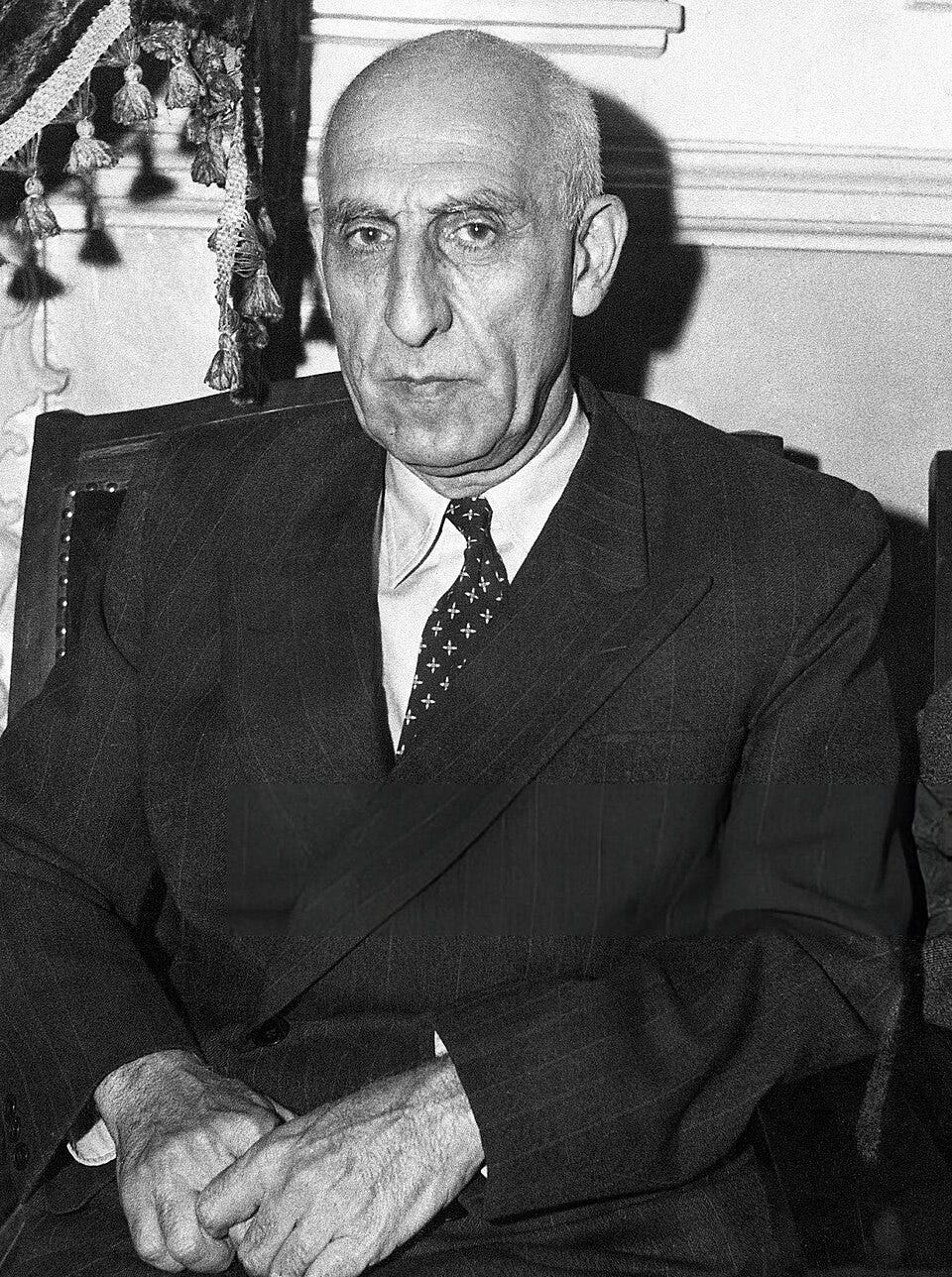
Mohammad Mosaddegh, Prime Minister of Iran, 1951–1953.
In 1953, the West destroyed a functioning democracy in Iran. It did so quietly, carefully, and in secret. The historical record is now clear: Iran’s prime minister, Mohammad Mosaddegh, was removed because he nationalised oil profits that Western companies believed were theirs by right.
Mosaddegh was not a demagogue or a strongman. He was an eccentric, aristocratic intellectual — legalistic, austere, and deeply committed to parliamentary process. He believed, perhaps naively, that democratic legitimacy and international law would protect Iran’s right to control its own resources.
They did not.
Britain, whose crown jewel was the Anglo-Iranian Oil Company, led the effort to reverse Iran’s oil nationalisation. When London failed alone, the United States joined. Not chiefly out of Cold War ideology, but because a precedent had been set: a sovereign state had reclaimed control over oil profits. That precedent could not be allowed to stand.
The operation — known as Operation Ajax in Washington — succeeded. Mosaddegh was removed. The Shah was restored. And then the oil was reorganised.
In 1954, Iran’s petroleum industry was placed under an international consortium. Forty percent of future profits went to U.S. oil majors, forty percent to British interests, and the remainder to European firms. Iran retained formal sovereignty. The profits, however, were once again safely allocated.
This was not chaos. It was redistribution.
The consequences are well known. The Shah’s regime hardened into repression. Iranian resentment deepened. Trust in Western intentions collapsed. A quarter century later, the Islamic Revolution swept the entire structure away, producing outcomes far more destabilising than the original nationalisation ever threatened.
That is the long cost of Operation Ajax.
Fast forward to Venezuela.
Neither Hugo Chávez nor Nicolás Maduro resemble Mosaddegh personally. Chávez was a populist. Maduro is widely regarded as authoritarian and corrupt. The comparison is not moral, intellectual, or personal.
It is structural.
Venezuela’s oil industry was formally nationalised beginning in the 1970s and was expanded under Chávez. Assets and concessionary arrangements held by companies such as ExxonMobil and ConocoPhillips were brought under state control, with foreign firms either reduced to minority partners or forced out entirely. Under international law, subsoil resources belong to the state. What was taken back were profit streams — concessionary rights, pricing power, and long-term cash flows previously enjoyed by foreign firms.
Once again, it was not extraction that was threatened.
It was who profits from extraction.
The recent U.S. operation involving Venezuela is notable not only for its scale, but for its openness.
Unlike 1953, there is no attempt at deniability. The action is framed publicly as law enforcement. Custody is claimed openly. And almost immediately, President Donald Trump spoke explicitly about oil — not in abstract terms, but operational ones: restoring production, involving U.S. companies, and taking control of Venezuelan output. In subsequent remarks, he went further, stating that Venezuela would supply the United States directly with tens of millions of barrels of oil, discussing transfers in the range of 30–50 million barrels as part of what would follow.
Trump on Venezuelan oil: “We’re going to take it… 30 to 50 million barrels.”
That specificity matters.
What once required secrecy is now stated aloud. Power no longer feels obliged to disguise its economic logic. Legitimacy is asserted after the fact. Law follows force.
This posture is not confined to Venezuela. In parallel statements, the same administration has openly framed strategic territory in military and resource terms rather than diplomatic ones — including remarks about Greenland that described its importance in terms of security, control, and national interest rather than alliance or treaty.
Trump on Greenland: “We need it for national security.”
The pattern is consistent: where access, geography, or material advantage is considered essential, the language has shifted from stewardship to possession.
Latin American governments have responded with the language of sovereignty and international law. That language is careful, collective, and restrained — not because the message was missed, but because it was understood without being named.
The demonstration was not merely Venezuelan. It was hemispheric.
The lesson of Iran was that overturning democratic control of resources produces long memories and delayed consequences. The lesson being signalled now is different: alignment that challenges profit control is no longer treated as a negotiation problem, but as an enforcement problem.
This is not a message delivered through doctrine or treaties.
It is delivered through precedent.
History does not repeat mechanically, but when oil profits are involved, the logic is remarkably consistent. Removal, restructuring, allocation — first quietly, now openly.
The question for the Americas is not whether sovereignty exists in theory. It is whether sovereignty that interferes with expected profit flows is treated as operative — and on whose terms.
History suggests the answer rarely changes.