

This is not an argument against rebuilding Gaza. It is an argument about causation, responsibility, and the moral dishonesty of pretending that administration can substitute for truth.
The destruction of Gaza did not arise from a mystery. It followed a border breach and hostage-taking operation that could not plausibly have occurred without either catastrophic tolerance or deliberate allowance across one of the most intensively surveilled and militarized borders on earth. That event became the trigger, but it was not an unknowable surprise. From the moment it occurred, the subsequent response was predictable: an act framed as existential threat, followed by overwhelming force granted broad moral cover. What followed was not restraint giving way to excess, but a sustained campaign whose effects were known, visible, and repeatedly chosen.
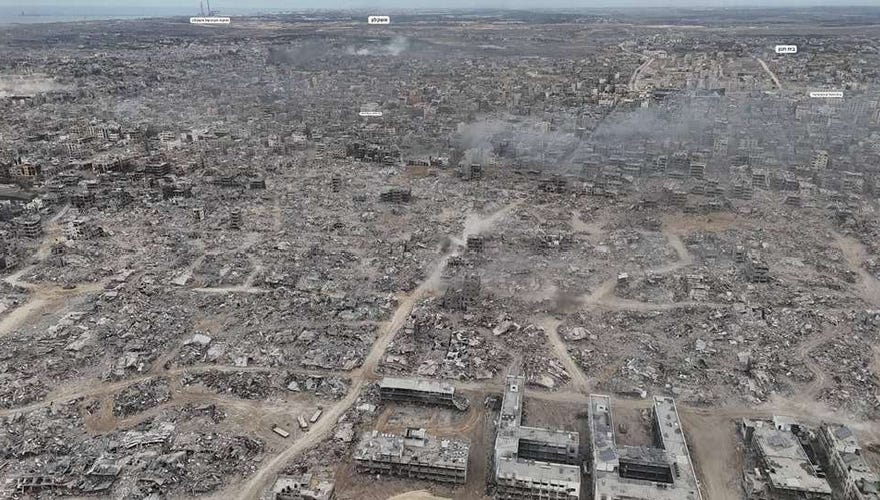
Hamas was not held to account. Its leadership remains largely intact, degraded but not eliminated. The perpetrators of the triggering crime were not systematically dismantled. Instead, the punishment fell overwhelmingly on civilians who neither planned nor authorized the violence that preceded it. Entire neighborhoods were erased. Hospitals were struck or rendered inoperable. Water systems, power grids, food distribution, universities, housing, and civil infrastructure were dismantled at scale. These were not incidental losses on the margins of combat. They were the terrain of the war itself.
When civilian life is destroyed comprehensively while the stated enemy survives, the claim that such destruction was merely collateral ceases to be credible. At that point, devastation is no longer an accident of war; it is an accepted outcome. Deliberateness does not require secret meetings or written plans. It is established by persistence, scope, repetition, and predictability. When the consequences are known and the conduct continues, intent is no longer ambiguous.
What followed confirms this. Almost immediately, the language shifted. Boards were formed. Envoys appointed. Funds pledged. Reconstruction frameworks announced. The vocabulary changed from war to management with remarkable speed and confidence. Governance capacity-building. Capital mobilization. Stabilization forces. These are not the words of mourning or accountability. They are the language of project completion.
This sequence matters. Reconstruction announced before accountability is not reconciliation; it is consolidation. It signals that the destructive phase has ended and that administration may now proceed. Peace, in this framework, is not justice or dignity or self-determination. It is compliance. It is the absence of resistance. It is stability measured by silence rather than repair.
Long before the war, proposals circulated envisioning Gaza as a Mediterranean asset: resorts, hotels, commercial corridors, leisure developments, a “revitalized” coastline integrated into regional capital flows. These ideas were politically infeasible while Gaza remained densely populated, impoverished, and resistant. After the war, they reappear as opportunity. This is not proof of premeditation. It is evidence of alignment. The destruction that occurred happens to resolve problems that development schemes had long faced. Ruins clear land more effectively than negotiations. Displacement alters demographics more decisively than diplomacy.
Hospitals reduced to rubble are not easily rebuilt by the people who depended on them. Populations rendered homeless are easier to manage than populations rooted in place. Reconstruction under external authority allows outcomes that were impossible through consent. When devastation conveniently produces conditions required for long-discussed redevelopment, skepticism is not extremism. It is basic reasoning.
What is most striking is what is absent. There is no independent accounting of how the war was allowed to begin. No serious inquiry into how a triggering operation could occur under such surveillance. No examination of why civilians bore the punishment while perpetrators largely escaped it. No acknowledgment that permitting an initial atrocity can be as decisive as committing one. These questions are not central to the reconstruction narrative. That omission is not accidental.
Rebuilding without truth is not healing. It is erasure. It allows mass death to be folded into process and forgotten beneath concrete, investment flows, and governance documents. It converts atrocity into a prelude rather than a scandal. The dead are mourned abstractly while the conditions that produced their deaths are declared resolved by force.
True rebuilding would begin elsewhere. It would begin with acknowledgment of loss that does not hurry toward closure. It would begin with accountability that treats civilian life as something more than collateral damage. It would begin with the humility to admit that some wounds cannot be fast-tracked through administration or neutralized by capital.
Without that, reconstruction functions as moral laundering. Destruction is rendered acceptable by what follows it. Administration replaces justice. Order replaces truth. And peace becomes a managerial achievement rather than a moral one.
To say this is not radical. It is the minimum requirement of honesty. When innocent people are slaughtered, hospitals are destroyed, and a land is rendered ripe for redevelopment, one is entitled—indeed obligated—to ask whether the war was merely reacted to, or whether it was allowed, exploited, and completed with the future already decided.