

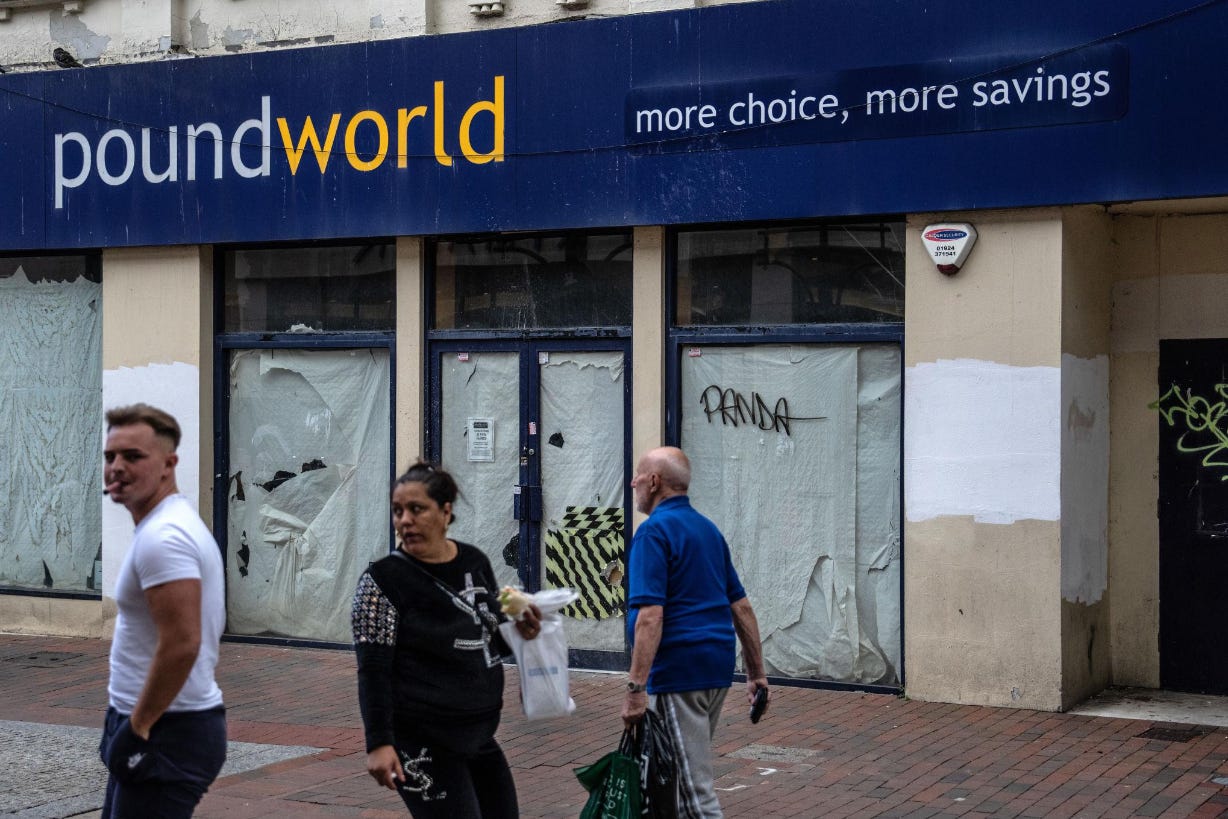
Travel through its old industrial towns and the pattern becomes difficult to miss. The high street is still there, but the economic grammar has changed. Where there were once local employers, banks, pubs, department stores, workshops, civic buildings, and thick layers of ordinary commercial life, there are now empty units, vape shops, charity shops, pound shops, betting shops, metal shutters, graffiti, discount chains, temporary signage, and the exhausted visual language of managed decline.
This is not nostalgia. It is evidence.
A country’s productive base is not just an economic category. It is the material foundation of civic life. It determines whether towns have wages, whether families have continuity, whether local institutions can survive, whether young people remain, whether infrastructure is maintained, and whether the state can govern without becoming predatory. When production disappears, everything downstream changes.
England shows what that process looks like after several decades.
Germany shows what it looks like at the point of political choice.
For much of the postwar period, Germany was the industrial center of Europe. Its strength rested on skilled labor, manufacturing depth, export capacity, engineering culture, stable energy, and a political settlement that still understood industry as a national asset. Germany was not merely rich. It was productive. Its wealth was embodied in factories, machinery, supply chains, technical competence, and the disciplined transformation of energy and materials into valuable goods.
That is why Germany matters.
If Germany loses its industrial base, Europe changes. Not cosmetically. Structurally.
England’s decline offers the clearest warning because it has already passed through the sequence Germany is now approaching. The language was always respectable. Deindustrialization was not usually presented as destruction. It was called modernization, transition, liberalization, competitiveness, environmental responsibility, or adaptation to a new economy. The vocabulary changed, but the direction remained the same. Productive capacity weakened. Energy became more expensive. Local industries disappeared. Finance rose above manufacturing. The state expanded as the real economy thinned. Towns lost function before they lost population. Eventually the visible landscape caught up with the policy.
That is what managed decline looks like.
Managed decline does not mean nothing is managed. It means decline is administered rather than reversed. It means the system learns to process deterioration, describe it, regulate it, subsidize it, police it, monitor it, and explain it, while failing to restore the conditions that would make recovery possible.
The first-hand record is now everywhere. One does not need a government report to see it, although the reports exist. Hundreds of ordinary videos show the condition of Britain’s towns with a clarity that official language often avoids. People walk through streets that once carried industrial and civic confidence and now appear hollowed out. The camera passes boarded fronts, discount retail, vape shops, charity outlets, empty banks, tired public spaces, shuttered pubs, broken paving, betting shops, and the strange silence of places that still exist geographically but have lost much of their economic reason for being.
These videos matter because they restore the visual evidence. They show what statistical categories often conceal. A town can still have employment, shops, schools, transport links, and public services, yet no longer feel economically alive. It can function administratively while decaying structurally. That distinction is central. Decline is often advanced before collapse is officially admitted.
The same pattern appears in official language when one looks closely. Parliamentary discussion has recognized the proliferation of vape shops and charity shops in town centers. Public and policy material has tracked the closure of local services, the weakening of high streets, the concentration of low-quality retail in poorer communities, and the difficulty of restoring resilient town centers once commercial life has thinned out. The visible record and the official record point in the same direction: the high street has become one of the places where structural decline is easiest to see.
The cameras belong in this picture, but not merely as street furniture.
CCTV and public-space surveillance are not just visual signs of ugly decline. They are evidence of selective state capacity. Government after government did not restore the productive base of damaged towns, but the state did build systems for monitoring, recording, regulating, and managing the social consequences of deterioration. The United Kingdom formalized public-space surveillance through statutory structures, codes of practice, commissioners, and administrative oversight. That does not mean every camera is sinister or unnecessary. It means surveillance became part of the architecture through which decline was governed.
This changes the analysis. The state did not lack capacity. It applied capacity selectively. It did not rebuild the local economic foundation with comparable seriousness. It built monitoring systems around the consequences of not rebuilding it.
That is the relationship between cameras and managed decline.
In UK Immigration: Policy Failure or System Direction?, I applied the same structural test in a different policy field. When a trajectory continues across governments, parties, warnings, and negative feedback, the relevant question is no longer whether officials described it as failure. The question is whether the system continued moving in the same direction after the consequences were known. That essay also identified the expansion of surveillance, data collection, and regulatory enforcement as evidence of selective state capacity rather than simple institutional weakness.
The same test applies here.
If the weakening of the productive base had been accidental, correction would have followed recognition. Instead, the consequences became visible, were documented, were debated, and were then administered. When policy repeatedly damages the productive base after the consequences are known, the resulting decline cannot be treated as accidental. It becomes operationally deliberate.
Germany is not England. It retains far more industrial depth, technical skill, manufacturing prestige, and export capacity. But that is precisely why the comparison matters. England shows the outcome after productive capacity has been sacrificed. Germany shows the same logic while the choice is still visible.
Germany’s danger begins with energy.
Modern industry is not sustained by slogans. It requires abundant, reliable, affordable energy. Chemical production, steel, glass, machinery, automotive manufacturing, logistics, heating, data systems, and precision engineering all depend on stable energy flows. A country cannot remain an industrial power while treating energy as an ideological afterthought. Energy is not a policy accessory. It is the enabling constraint.
As I argued in Energy Sovereignty: The Precondition for Freedom, almost everything of economic value is energy-derivative. Production is energy applied to matter. Logistics is energy moving matter. Finance is a claim on future energy use. Political legitimacy survives only while energy flows remain predictable and tolerable.
Germany’s decision to turn against its own energy foundations therefore cannot be treated as a minor policy error. It sits at the center of the crisis.
The green transition was sold as modernization, but for an industrial state it carried a deeper danger. If environmental policy raises costs, destabilizes supply, reduces dispatchable generation, increases dependence, and forces productive industry into jurisdictions with cheaper energy and looser constraints, then it does not abolish industrial harm. It exports industry. It weakens the domestic productive base while preserving the moral language of responsibility.
This is one of the central errors of contemporary politics: mistaking the relocation of production for the resolution of production’s consequences.
England did this in one form. Germany is doing it in another. Both countries were told, in different vocabularies, that the future required moving beyond the old industrial base. But countries do not move beyond the need to produce. They either produce for themselves, or they become dependent on those who do.
Nord Stream made the German case more severe.
The destruction of Nord Stream was not simply an attack on pipelines. It was an attack on Germany’s strategic energy optionality. It removed, or at minimum permanently damaged, a major pathway by which German industry accessed relatively cheap energy. In After Nord Stream: Risk in a World of Irreversible Loss, I described the central lesson as option removal: a major civilian energy asset was permanently removed, actors adjusted around the loss, and the system absorbed the new condition as final.
That is what happened to Germany. The loss of Nord Stream did not simply raise prices. It narrowed the future. It made German industry more dependent on substitute arrangements, more exposed to global energy competition, and more vulnerable to shocks elsewhere in the system.
Those shocks are not hypothetical. Europe now sits inside an energy trap. In The European Energy Trap, I described the convergence: Europe’s industrial economy developed around stable energy flows, particularly in Germany and Central Europe; Nord Stream’s destruction removed a major part of that structure; pipeline gas was replaced by LNG competition; renewable intermittency increased the need for dispatchable backup; nuclear and coal capacity were reduced; and energy-intensive industry began examining or undertaking relocation toward jurisdictions with lower and more stable energy costs.
The Iran war sharpens this point.
If conflict around Iran threatens the Strait of Hormuz, energy markets do not respond in theory. They respond in price, shipping, insurance, supply routing, and industrial cost. The issue is not only whether tankers stop moving. The issue is that industrial economies must plan around the possibility that they might. A risk premium can be absorbed for a while. A physical supply shock cannot. In Strategic Intent Analysis and the Iran War, I argued that a conflict unlikely to achieve regime change may still reliably produce energy disruption. For Europe, and especially for Germany, that distinction is not abstract. It is the difference between an economy under pressure and an economy being structurally compressed.
Recent German industrial warnings fit the same pattern. German industry has faced sustained pressure from high energy costs, weak industrial output, bureaucracy, taxation, external shock risk, and declining competitiveness. These are not marginal complaints from one sector. They are the industrial base warning that the conditions of production are being lost.
England’s decline was slower, more dispersed, and more financialized. Germany’s could be faster because modern systems are more tightly coupled. Industry today depends on complex supply chains, concentrated inputs, just-in-time logistics, energy pricing, financing costs, regulatory compliance, skilled labor, and export markets. When several of those pressures move together, decline can accelerate suddenly.
This is why the German situation is so serious.
Germany is not merely facing recession, inflation, political fragmentation, or business frustration. It is facing the possible unraveling of the material structure that made modern Germany possible. If energy remains expensive, if regulation continues to thicken, if taxation punishes the productive sector, if mandated energy unreality overrides industrial physics, if export markets weaken, and if political leaders refuse to defend manufacturing as a civilizational asset, then Germany will not remain Germany in any meaningful postwar sense.
It may remain administratively intact. It may still have courts, ministries, universities, elections, broadcasters, and official commitments. But the substance will change. England proves this. A country can preserve the forms of national life while losing the material base that gave those forms vitality.
This is the danger of managed decline. It rarely announces itself as decline. It appears as policy. It arrives through reports, targets, regulations, fiscal measures, planning frameworks, consultation processes, climate obligations, security commitments, trade adjustments, and budgetary necessities. No single decision has to say that the productive base is being destroyed. The direction is visible in the cumulative effect.
At some point, continuation becomes intent in structural form.
That does not mean every official intends national decline. Most probably do not. Many believe they are managing complexity, balancing priorities, protecting the environment, supporting allies, reducing emissions, defending democracy, or maintaining fiscal discipline. But strategic intent does not require every participant to understand the whole pattern. Systems reveal direction through repeated choices made despite visible consequences.
If policy predictably weakens the productive base, and the damage is visible, and the warnings are documented, and the policy continues, then the system has chosen the damage.
England has already made that choice. Its towns show the result. The decline is not only economic but atmospheric. The built environment changes. The shopfronts change. The public mood changes. Trust changes. Work changes. The relationship between citizen and state changes. When productive life thins out, the state does not become smaller. It often becomes more intrusive, more extractive, and more managerial. Cameras replace confidence. Compliance replaces prosperity. Administration replaces civic energy.
This is why the vape shop and the camera belong in the same picture.
They are not equivalent. The vape shop is a sign of what fills the commercial space after durable productive life has withdrawn. The camera is a sign of how the state prepares to manage the consequences. The charity shop replaces ordinary commerce. The pound shop replaces local wealth. The betting shop monetizes despair. Graffiti marks the weakening of shared custody over place. The camera records the disorder without explaining why the order was lost.
Together, they form a landscape.
Germany should study that landscape carefully.
The question is not whether Germany will become England in every detail. It will not. Germany has different institutions, different towns, different industrial structures, and a different political culture. The question is whether Germany is now repeating the deeper error: allowing policy to turn against the productive base while official language continues to describe the process as necessary, responsible, and modern.
That is the warning.
No country survives the destruction of its productive base unchanged. It may remain wealthy for a time. It may borrow. It may subsidize. It may import. It may expand bureaucracy. It may manipulate statistics. It may preserve prestige institutions. But the center does not hold indefinitely once production has been subordinated to ideology, finance, administration, and external dependency.
England is what industrial decline looks like after several decades.
Germany is what it looks like at the moment of choice.
The tragedy is that the evidence is already visible. The more serious tragedy is that the language of policy still makes the choice sound respectable.