

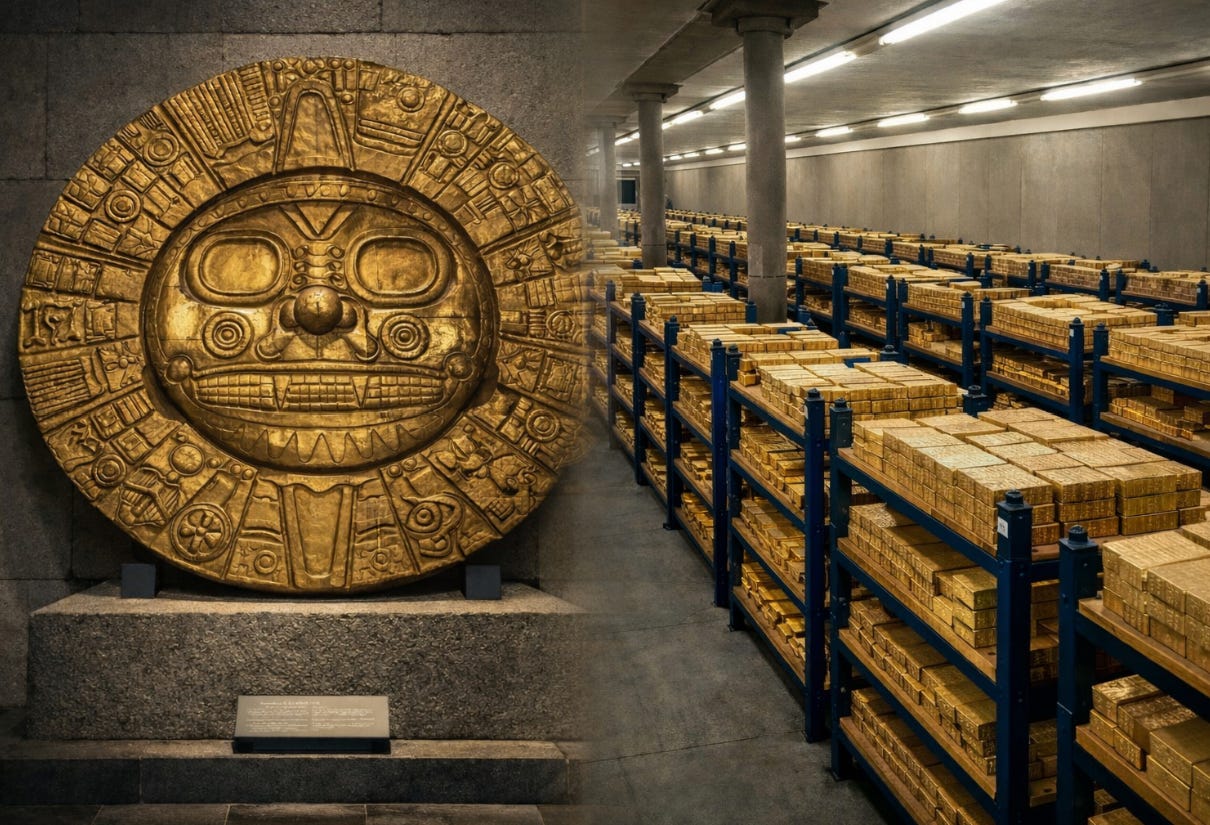
Gold produces no income. It generates no cash flow, pays no dividend, and performs little industrial work compared with other metals. By modern financial standards, its economic utility is limited.
Yet across five thousand years of recorded history, in cultures separated by geography, language, and political structure, gold has been accumulated, protected, and treated as a store of lasting value. Paper currencies have appeared and disappeared. Financial systems have expanded, collapsed, and been rebuilt. Gold has remained.
The persistence itself is the anomaly. If value were purely institutional or conventional, civilizations would have selected different materials at different times. Instead, independent societies converged repeatedly on the same metal.
The question is not why modern markets price gold. The deeper question is why human societies — long before global trade or monetary theory — recognized it as something worth preserving.
In the ancient world, gold was not primarily money. It was sacred material. Egyptian texts described it as the flesh of the gods and associated it with the Sun. In India and China, gold was linked to immortality, celestial order, and the continuity of life.
Classical alchemy treated gold as the perfected metal, the end state of material refinement. Across cultures, a consistent pattern appears: gold was understood as a terrestrial expression of permanence and solar stability.
This symbolic association did not arise from abstraction. Gold behaves differently from almost every other material encountered in daily life.
It does not rust, corrode, or decay. Objects buried for thousands of years emerge unchanged. It is rare enough to remain special, yet abundant enough to be accumulated and worked. It can be divided, melted, and reformed without loss. Its color and reflectivity give it a visual brightness unlike other metals.
Where most materials deteriorate over time, gold appears to resist time itself.
Civilizations observed this behavior directly. A metal that does not decay becomes a natural candidate for representing what endures. The solar association follows the same logic. The Sun is the most stable and life-sustaining presence in human experience, and gold’s resistance to corruption made it a natural material counterpart.
In this sense, gold’s early value did not begin as a financial convention. It began as recognition of a physical and symbolic correspondence with permanence.
From a natural law perspective, gold’s significance follows directly from its behavior. Natural law concerns those properties that remain stable independent of human preference or institutional design, a framework explored more fully in An Explanation of Natural Law.
Most materials corrode, decay, or transform under environmental pressure. Gold does not. It maintains its form, its mass, and its character over time.
For this reason, Hermetic and alchemical traditions did not treat gold merely as a valuable substance, but as a material expression of natural order — the metal that most closely reflected the solar principle of continuity, coherence, and resistance to corruption.
In this framework, gold’s value was not assigned by authority or agreement. It was recognized as a physical embodiment of permanence within a world otherwise defined by change.
Once established as a sacred material, gold moved naturally into political and economic use. Temples accumulated it. Rulers stored it. Coinage followed.
Monetary systems did not create gold’s status; they institutionalized a recognition that already existed. Gold functioned as money because societies had already agreed that it was uniquely suited to hold value across time.
The modern financial system is often described as having moved beyond gold. National currencies are no longer formally convertible. Most transactions occur electronically. Credit, leverage, and financial instruments now dominate the global economy.
On the surface, gold appears to be a historical relic.
Yet the behavior of sovereign institutions tells a different story. Central banks continue to hold large gold reserves. Nations accumulate it quietly. In periods of geopolitical tension or financial instability, official purchases increase rather than decline.
Unlike government bonds or foreign currency reserves, gold carries no counterparty risk. It is not another nation’s liability. It cannot be created by policy decision. It sits outside the credit structure on which the modern financial system depends.
This continuity is not ideological. It reflects the same property that ancient civilizations recognized: gold holds value independently of political systems and institutional promises. The implications of this institutional structure are examined further in The Federal Reserve Is Different — and That Difference Is the Error.
When financial arrangements change, gold does not change with them. When currencies are revalued, redenominated, or replaced, gold remains the reference point against which those changes are measured.
The pattern that emerges is not a return to tradition, but a continuity of function.
In the ancient world, gold represented permanence within a changing material environment. In the modern world, it represents permanence within a changing financial environment. The language has changed from sacred to strategic, but the role is the same.
For individuals as well as institutions, the logic is familiar, even when not explicitly stated. Assets tied to policy, leverage, or counterparty performance carry conditional value.
Gold’s value is conditional only on continued human recognition of what does not decay.
Across civilizations, across monetary systems, and across political eras, gold has consistently served the same function: it holds purchasing power through change. Its value does not arise from productivity or yield. It arises from its unique ability to remain what it is while other systems evolve, expand, and occasionally fail.
Gold is therefore not simply another asset class. It is a civilizational store of permanence — a material anchor that persists when the structures built around it do not.
The method, subjects, and selected essay index for Strategic Intent Analysis are organized at strategicintentanalysis.com.