

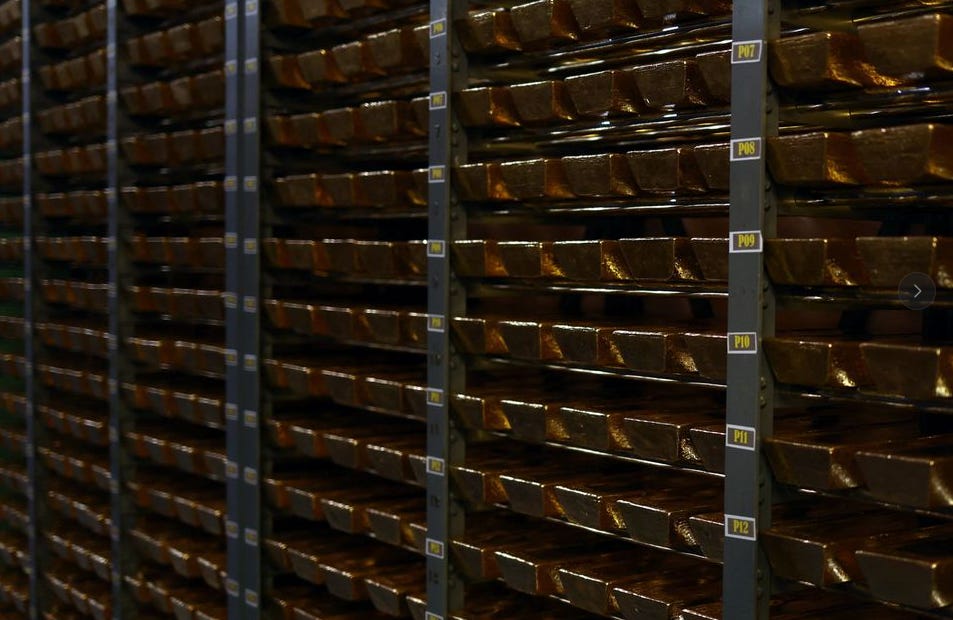
Gold occupies a distinct place in the international system because it is one of the few reserve assets that does not depend on another institution’s promise to perform. A reserve currency depends on confidence in the issuing state, its central bank, and the broader financial and legal order that supports its use. Sovereign debt depends on repayment, market confidence, fiscal capacity, and political continuity. Bank reserves, deposits, and most financial instruments depend on layers of contractual obligation, settlement infrastructure, and institutional solvency. Physical gold does not eliminate price volatility, storage cost, or political risk, but it does eliminate dependence on a counterparty in the narrow and important sense that no issuer must remain solvent, cooperative, or credible for the asset to continue existing.
That distinction matters most when systems are stable. In periods of calm, the practical differences between direct possession of a neutral reserve asset and ownership of a financial claim can appear secondary. Yield, liquidity, convenience, and institutional habit dominate decision-making. A government bond produces income. A reserve currency supports trade settlement. Financial claims can be transferred, pledged, rehypothecated, and integrated into a much wider architecture of leverage and credit. Gold does none of these things especially well. It does not pay interest. It is comparatively cumbersome. It must be stored, transported, audited, and defended. On a purely operational basis, a system organized around paper claims is more flexible and more efficient.
But efficiency is not the same thing as independence. The very qualities that make financial claims useful in normal conditions also make them vulnerable to confidence shocks, sanctions, capital controls, repayment uncertainty, custodial exposure, and legal interruption. A government holding reserves in another state’s currency is not simply holding a neutral asset. It is holding a claim situated inside another sovereign’s legal and political structure. A state holding foreign sovereign bonds is trusting not only repayment, but market access, settlement continuity, and the continued willingness of the issuer to honor obligations under stress. Even where default does not occur, the asset remains embedded in a structure of permission, recognition, and institutional continuity.
Physical gold sits outside much of that architecture. That is why it remains important long after the formal gold standard ended. States do not continue holding bullion because they misunderstand modern finance. They hold it because they understand something basic about it. Gold is not trusted because it is productive. It is trusted because it is final. It does not depend on the solvency of a bank, the credit of a treasury, the policy path of a central bank, or the political relationship between custodian and owner. In a system saturated with conditional promises, that difference remains structurally significant. This is closely related to the argument in Gold and the Emerging Monetary Order, which explains why central banks still treat gold as serious money even inside a formally fiat system.
This is also why gold tends to reappear in moments when formal rhetoric insists it no longer matters. Public language often describes the monetary order as if credibility now rests entirely on institutional sophistication, central bank management, legal depth, and financial flexibility. But when strategic trust begins to weaken, states still accumulate physical bullion, repatriate it, audit it more closely, and treat it as something different from the rest of the reserve stack. That behavior is more revealing than official language. The issue is not nostalgia. The issue is survivability under stress.
A reserve currency is powerful precisely because it sits at the center of payment, credit, and trade. But that power also means exposure. The more an asset depends on the behavior of the issuing system, the more it carries political and institutional risk along with financial value. States understand that reserve holdings are not only financial tools. They are also vulnerability maps. Assets held within another system can be delayed, frozen, subordinated, surveilled, or made contingent on political alignment. That does not make reserve currencies useless. It does mean they are not neutral.
Gold is closer to neutrality because it is not someone else’s liability. That phrase is often repeated, but its meaning is deeper than a market slogan. It means there is no issuer to fail, no debtor to default, no board to change terms, no treasury to devalue repayment, and no court that must affirm the continuing validity of the claim before the asset exists. Ownership can still be contested. Access can still be obstructed. Custodians can still matter if the gold is held abroad. But the underlying asset is not itself a contractual dependence. The distinction is not that gold is immune from politics. It is that gold is less constituted by politics than financial claims are.
That is why physical possession matters so much in this domain. Gold held through an ETF, pooled account, unallocated structure, or remote custodian does not provide the same form of assurance as gold directly controlled by the owner state. The farther the asset moves into layers of intermediation, the more it begins to resemble the same claim-dependent architecture from which physical bullion originally offered escape. This does not mean such instruments are worthless. It means they do not fully resolve the problem they are often assumed to solve. A paper claim to gold is still, in an important sense, a paper claim.
The distinction becomes sharper in a world shaped increasingly by sanctions, reserve seizure, payment fragmentation, and geopolitical distrust. Under those conditions, states are not merely asking which assets are liquid or profitable. They are asking which assets remain theirs when the system stops behaving cooperatively. That is a different question. It is also the logic discussed in Gold Flows and Elite Positioning, where movements in physical bullion reveal rising institutional stress, sovereign caution, and strategic repositioning before the wider system fully acknowledges the shift.
This helps explain why gold retains monetary significance even when it is not formally circulating as money. It continues to serve as a reserve of independence. Not independence from markets, price movement, or coercion in every form, but independence from direct reliance on another institution’s promise to honor a claim. In that sense, gold is not simply a commodity held by central banks. It is a form of strategic reserve outside the normal credit hierarchy. It does not replace currencies, sovereign debt, or payment infrastructure. It exists alongside them as a different category of trust.
That category matters because modern finance is built on extension. It extends confidence across time, across institutions, and across jurisdictions by multiplying enforceable claims. Most of the time that architecture works. But its smooth functioning depends on a great deal remaining true at once: counterparties must remain solvent, systems must remain open, settlement must remain recognized, law must remain enforceable, and politics must not override formal ownership. Gold does not solve every failure within that structure, but it reduces one core dependency by existing without reference to the continued performance of an issuer.
In that respect, gold functions as a quiet admission about the limits of institutional trust. The same states that publicly affirm the robustness of the financial order still preserve part of their strategic reserves in a form that does not require faith in that order’s uninterrupted operation. That is not contradiction. It is prudence. It reflects an understanding that reserve currencies, sovereign bonds, and financial claims are powerful instruments, but they remain instruments embedded within systems of promise. Gold is different because it is still trusted at the point where promise itself becomes the problem.
The modern system therefore has not transcended gold so much as repositioned it. Gold no longer anchors daily convertibility, but it still anchors a boundary condition. It remains the asset states turn to when they want part of their reserve base to stand outside the credit of others. That is why physical bullion continues to matter. Not because it is efficient. Not because it generates yield. Not because it belongs to a vanished monetary age. But because in a world built on institutional claims, there remains enduring value in holding something that is not one.