

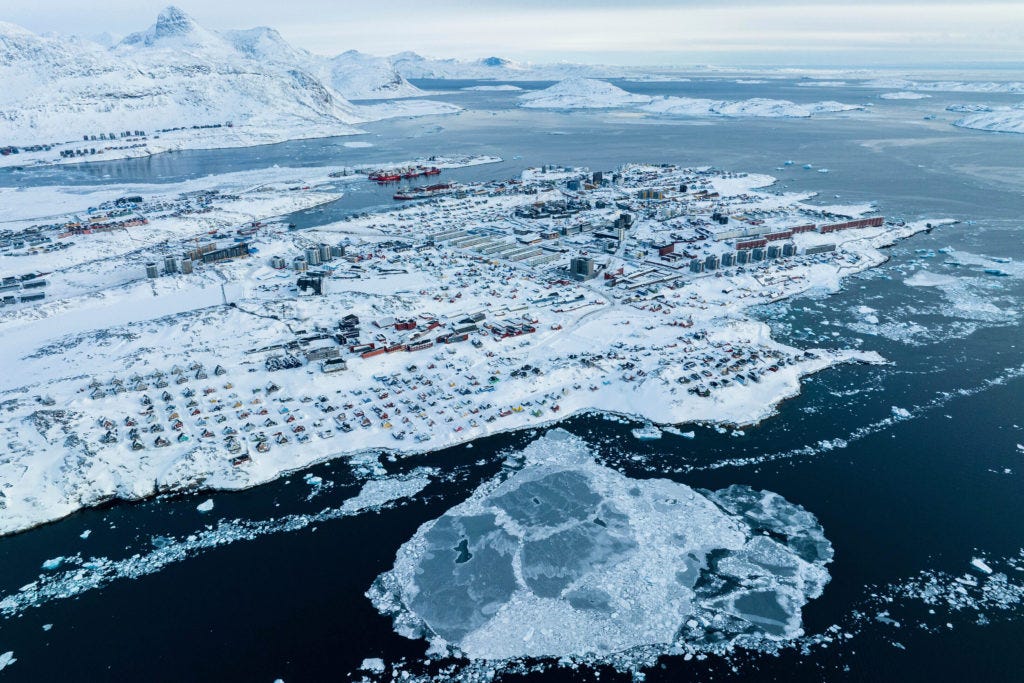
When the Trump administration floated the idea of paying every Greenlander up to $100,000 to vote for secession from Denmark and union with the United States, most commentary treated it as spectacle: another provocation, another headline.
That reading misses what is actually happening.
This is not policy.
It is signal.
The offer is not an economic proposal. It is a declaration about how power now understands itself.
For decades, Western power wrapped itself in the language of norms, alliances, sovereignty, democracy, development. Influence was exercised through institutions and justifications. Force was used, but always masked by moral narrative.
That system is collapsing.
What replaces it is simpler:
We take what we need.
We pay if it is easier.
We use force if it is not.
Trump has now said both parts out loud.
First, he publicly refused to rule out taking Greenland by military force, saying the island is “so strategic” that the United States may act regardless of Danish or Greenlandic consent. That was not rhetorical excess. It was a direct statement that sovereignty will not be allowed to obstruct power.
(Reuters reporting on Trump refusing to rule out military action: “won’t rule out military action”)
Then came the second move: not tanks, but cash.
The administration began floating a plan to pay Greenlanders directly—reportedly up to $100,000 per person—in exchange for voting to secede from Denmark and join the United States.
(Reuters reporting on the proposal to “pay Greenlanders to sway votes”)
This is not diplomacy.
It is not self-determination.
It is not even the pretense of democracy.
It is purchasing a political outcome.
In any functioning democratic system, buying votes is illegal. It is the textbook definition of corruption. Yet here it is being discussed at the level of statecraft—not as a scandal, but as a strategic option.
That is the point.
Territory. A people. A future. Reduced to a price.
The figure itself is not meant to be practical. It is meant to be legible. It communicates something that would have been unthinkable in the previous order:
Sovereignty is now transactional.
Not negotiated. Not respected.
Purchased—or overridden.
This is not without precedent.
In 1898, the United States annexed Hawaii after American business interests backed a coup against the Hawaiian monarchy. A subsequent referendum was never held among the native population. Later, when opposition grew, Washington retroactively wrapped the seizure in legal language and economic promises. Territory was not taken in the name of conquest—but in the language of stability, prosperity, and “mutual benefit.”
What is different now is not the logic.
What is different is that the logic is no longer hidden.
Greenland is chosen precisely because it is the perfect test case. Strategically essential. Politically “owned” by a weaker European state. Sparsely populated. Morally awkward to contest with force. A place where a new doctrine can be floated without immediately triggering catastrophe.
A proving ground.
The repetition matters. This is not persuasion. It is conditioning.
First: “We need Greenland.”
Then: “We might take it if we have to.”
Now: “What if we just buy the votes?”
Each step erodes what once felt immovable.
“You cannot take territory by force.”
“What if we must?”
“You cannot buy a people’s political future.”
“Why not, if they accept the money?”
This is how boundaries dissolve—not through one decisive act, but through normalization.
The money is not generosity. It is not development. It is not partnership. It is a declaration that legitimacy is no longer required. Consent will be acquired if possible. When it cannot be purchased, it will be bypassed.
This is not about minerals.
It is not about Arctic shipping lanes.
It is not even about national security in the old sense.
It is about something deeper:
Power shedding its mask.
What once required moral language now speaks directly in the grammar of extraction. Territory becomes asset. Citizenship becomes instrument. Allegiance becomes commodity.
This is empire without camouflage.
The outrage from European leaders is real. But it is also revealing. They are defending the old architecture of sovereignty at the precise moment when the dominant power is signaling that architecture no longer binds it.
The offer is not meant to succeed.
It is meant to be heard.
And what it says is this:
There are no sacred borders left.
There are no inviolable peoples.
There is only what can be taken, purchased, or compelled.
Greenland is not the point.
The point is that the empire is now speaking in its true voice.