

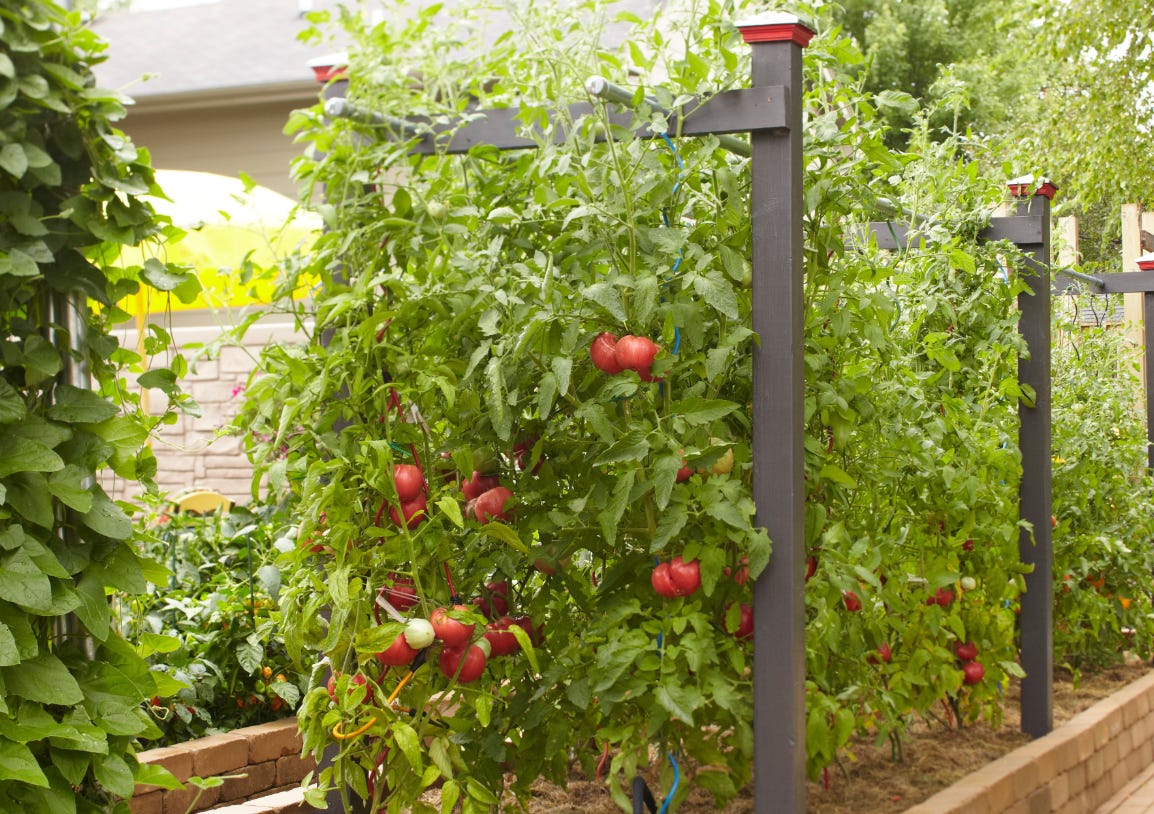
Charlie Roberts was presented to the public as an eccentric British man who sang to his tomatoes and played them music. The tone invited amusement. But the fact beneath the performance was not imaginary. Roberts was publicly associated with exceptional tomatoes, and growers far beyond his local area took him seriously enough to seek seeds and information. The method was framed as oddity. The result was real.
That matters because it points toward a wider truth about plant life and the world plants inhabit. Plants require nourishment, but they do not live by nutrient input alone. They exist within a structured environment of light, moisture, mineral balance, rhythm, charge, vibration, temperature, and relation. A plant is not a passive receiver of industrial inputs. It is a living responsive form within a lawful field.
Once that is seen clearly, Roberts stops looking like a curiosity and starts looking like an example. Music was not necessarily the whole explanation, but it was one form of ordered vibration applied consistently to a living system. Sound is structure moving through matter. Plants respond to vibration, pressure, touch, and environmental change. It is therefore neither irrational nor surprising that patterned sound might affect growth, stress response, or vitality. In a structured world, ordered vibration can have ordered effects.
The same principle appears in other neglected or marginalized growing methods. Electroculture is one example. Copper conducts electricity. Soil, water, air, and plant tissues all exist within electrical conditions that are real whether or not industrial agriculture chooses to emphasize them. It is entirely logical that conductive structures placed within the growing environment may alter the local field in ways that affect plant behavior. Electroculture was known, tested, written about, and practiced seriously enough to produce books, diagrams, and formal discussion. That history alone is enough to show that the method belongs to practical inquiry rather than fantasy.
Structured water points in the same direction. Water is not merely a neutral carrier. It is the primary medium through which much of plant life is organized and sustained. If water quality, flow, mineral state, and internal order affect living systems, then changes in water structure may matter to growth no less than changes in soil. As explored in Structured Water and Cymatics: Order Beneath the World, pattern in matter is not an exotic exception but a recurring feature of the world. Harmonic growing simply applies that recognition to cultivation.
Care belongs in the same category. This is often treated as sentimental because modern habit prefers to divide the real from the relational. But anyone who has actually grown plants knows that attention changes outcomes. Care is not merely emotion added to a separate process. It expresses itself through timing, observation, consistency, proximity, and sensitivity to deviation. A person who cares notices drought stress earlier, disease earlier, imbalance earlier, overexposure earlier, and ripening earlier. A cared-for plant is not living in the same environment as a neglected one, even when the soil and pot appear identical.
More than that, the consistent pattern across life suggests that relation itself has force. Music affects human physiology. Presence affects recovery. Living beings respond to ordered contact. It is therefore not difficult to see why a plant subjected to attentive care, repeated sound, stable rhythm, and coherent conditions might grow differently from one treated as an object to be chemically managed. The deeper pattern is plain enough: life responds to harmony.
This is why harmonic growing is the better description. It does not refer to one eccentric trick or one isolated device. It refers to a growing approach that treats the plant as part of a structured whole. Good soil remains essential. Proper nourishment remains essential. Light, water, and mineral balance remain essential. But growth may also be influenced by sound, electrical patterning, water quality, rhythm, reduced chemical stress, and the continuous presence of attentive care. These are not random additions. They are overlapping expressions of coherence.
The industrial model of agriculture is powerful, but it is narrow. It tends to treat yield as the product of controllable external inputs delivered into fundamentally passive matter. That model can produce results, but it remains incomplete because it describes life from the outside in. Harmonic growing begins from the opposite recognition. Living systems are already ordered. The task is not merely to force output, but to support the conditions under which lawful growth expresses itself well. In that sense, the argument belongs directly beside An Explanation of Natural Law: the issue is not mysticism, but lawful structure, alignment, and consequence.
That has consequences beyond gardening. If plant growth can be strengthened through coherence rather than through increasing dependence on proprietary inputs, then methods of this kind do not sit comfortably within an inverted agricultural economy. Large firms built around fertilizer, chemical treatment, seed control, and input dependency do not benefit from wider recognition that plants may respond powerfully to lower-cost, decentralized, relational, and field-based methods. An agricultural system organized around dependency has little structural reason to elevate methods that reduce dependency. Under those conditions, neglect, ridicule, and marginalization are not surprising. They are predictable.
That does not mean every neglected method works equally well, or that every claim made in this space is sound. It means the proper response is disciplined inquiry rather than reflex dismissal. Where a method is logical, historically attested, observable in practice, and consistent with a broader pattern of structured response, it deserves serious attention. Roberts deserved investigation, not laughter. Electroculture deserved testing, not disappearance into a cultural footnote. The same is true of any method that points toward the simple recognition that life is more responsive, and the world more ordered, than the dominant model admits.
Most people have seen enough of nature to recognize this, even if only in fragments. A garden can feel different from a factory not merely because it is quieter, but because life under good conditions exhibits order in a way human beings still know how to perceive. Rhythm, proportion, vitality, response, and beauty are not decorative extras. They are signs of alignment.
The real question, then, is not whether one can grow plants without nourishment or by fantasy alone. The real question is whether growth is best understood through a wider frame than industrial chemistry allows. The evidence suggests that it is. Plants appear responsive not only to material sufficiency, but to coherence of environment. Sound may matter. Electrical conditions may matter. Water quality may matter. Loving attention may matter. Stable rhythm may matter. None of this abolishes the need for nourishment. It places nourishment back inside a living order.
Harmonic growing therefore names something larger than a gardening preference. It is a practical recognition that life responds to lawful structure. Roberts showed one visible expression of that truth. Electroculture suggests another. Structured water suggests another. The attentive gardener knows another. Taken together, they point in the same direction. Growth is not merely fed. It is also guided by the conditions of harmony in which it unfolds.