

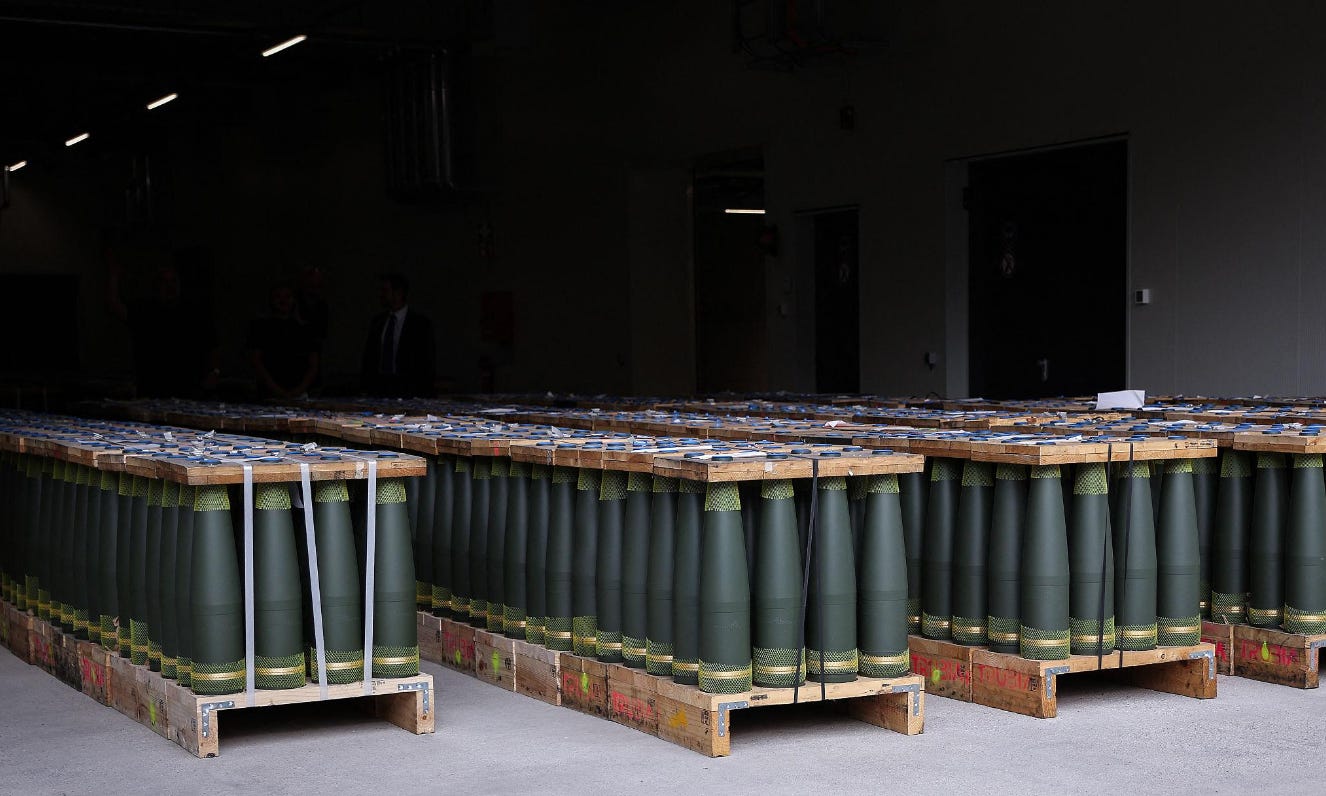
For most of the post-Cold War period, European defence policy rested on a peacetime settlement. Armed forces could be smaller because major land war on the continent was treated as remote. Industrial capacity could be narrowed because production surges were assumed unlikely. Ammunition stocks could remain limited because future conflicts were expected to be short, localized, or heavily backstopped by the United States. Military manpower could be professionalized because mass mobilization belonged, in official thinking, to an earlier era. What is now changing is not simply the size of defence budgets. It is the underlying model. Across Europe, policy is moving away from efficiency, specialization, and limited readiness, and toward depth, redundancy, reserve capacity, and the reconstruction of social and industrial war potential. The relevant question is therefore no longer whether Europe is rearming. It is whether Europe is beginning to remobilize.
That distinction matters because rearmament and remobilization are not the same thing. Rearmament can remain narrow. A state can buy missiles, increase procurement, and modernize equipment while still assuming that war will remain limited, that society itself need not be reorganized, and that industrial production can remain largely market-shaped and civilian in orientation. Remobilization is broader. It appears when manpower policy, reserve formation, industrial finance, forward basing, supply-chain adaptation, and political language all begin to move in the same direction. As argued in Strategic Intent Analysis: Inferring Direction Through Structural Convergence, the important question is not whether institutions openly declare a single plan, but whether choices across multiple domains repeatedly resolve in the same direction until the pathway becomes harder to reverse. That is the point at which a pattern begins to look less like fragmented reaction and more like emerging strategic direction.
By that measure, the European pattern is becoming harder to dismiss as temporary adjustment. The European Commission’s White Paper for European Defence – Readiness 2030 explicitly links capability shortfalls, procurement, industrial production, military mobility, financing, and readiness into a single strategic framework aimed at filling gaps by 2030. The SAFE instrument, adopted by the Council in May 2025, created up to €150 billion in loans to support joint procurement and reinforce the European defence industry. NATO reported that European allies and Canada increased defence spending by 20% in real terms in 2025. These are not isolated developments. They show repeated decisions across institutions resolving in the same direction: more capacity, more throughput, more resilience, and less reliance on the assumption that peacetime normality will hold.
The fiscal side matters because military preparation becomes structurally different once it begins to reorder budgets rather than merely enlarge them. As argued in War and Budgetary Expansion, war systems do not simply consume money in episodic bursts. They create durable claims on the state, deepen procurement logic, and shift political priorities in ways that persist beyond any single emergency. That dynamic is increasingly visible in Europe. Once public finance begins to reward military production, forward positioning, and reserve depth, the change is no longer symbolic. It becomes institutional. Budgetary expansion stops being a temporary response and starts becoming part of the state’s operating assumptions.
The industrial evidence points in the same direction. The EIB and EDA reported that security and defence investment exceeded €4 billion in 2025, with EDA-advised projects seeking financing of up to €700 million. Rheinmetall’s decision to repurpose two German automotive plants for defence production is even more revealing. That is not simply an arms manufacturer growing within its own lane. It is civilian industrial capacity being redirected toward military output because the existing base is judged too thin for what may be required. Industrial priorities are changing because the strategic environment is changing. When capital, lending, and factory use are all being adjusted in favour of military-industrial depth, the system is no longer behaving as though deterrence can rest on symbolic readiness alone.
The same is true of territorial and force-posture decisions. Germany is building a permanent brigade in Lithuania of roughly 5,000 personnel, the first enduring brigade-scale deployment of this kind abroad since the Second World War. Sweden’s 2025–2030 defence resolution includes four new brigades by 2030 and a substantial increase in conscript intake. These are not gestures designed only to send a signal. They create infrastructure, staffing obligations, training pipelines, procurement dependencies, and territorial expectations that become politically and operationally difficult to unwind. That matters because the real signal of remobilization is not louder language, but institutional lock-in. Once systems begin making multi-year decisions that presume sustained confrontation, the trajectory itself becomes part of the evidence.
Manpower policy must be read within that larger pattern. On its own, compulsory service or expanded training can appear to be a narrow staffing measure. But, as argued in Conscription in Europe and Escalation Signaling, the return of compulsory service is better understood as an early warning signal that states no longer believe peacetime assumptions are sufficient. The present essay widens that frame. It suggests that conscription is not the whole story, but one visible part of a broader remobilization logic in which governments are rebuilding the human depth required to sustain force over time rather than merely field it at the margin.
Poland is the clearest example. In March 2025, Donald Tusk said Poland was preparing military training for every adult male and aimed to train 100,000 volunteers annually by 2027, while already spending the highest share of GDP on defence in NATO. Denmark has extended military service to women turning 18 after July 2025 and lengthened the service period from four to eleven months. Latvia’s restored national defence service continues through regular call-ups and random selection when volunteers are insufficient. Lithuania’s 2026 call-up totals around 5,000 conscripts across multiple service tracks. Sweden is increasing conscription as part of a wider total-defence build-out. These systems differ in form, but their common meaning is plain. Europe is rebuilding force-generation capacity after decades spent assuming that such capacity would not be centrally needed.
This is where the concept of remobilization becomes most precise. A society on a deterrence footing tries to keep military risk compartmentalized. It relies on professionals, limited reserves, small stockpiles, and the hope that force posture will remain largely separate from civilian economic life. A society entering remobilization begins to dissolve that separation. It treats industry as a security instrument. It treats finance as a means of expanding defence capacity. It treats civilian manpower as part of national endurance. It begins to value throughput, replacement, repair, logistics, and reserve depth as much as sophistication. That is why the title must include both industry and mass manpower. Without industry, manpower lacks means. Without manpower, industry lacks operational purpose. The return of each strengthens the meaning of the other.
France helps show the same direction from another angle. Paris is not reviving mass conscription in the Polish or Baltic form, but it is still moving deeper into remobilization logic. Its revised military planning law adds €36 billion in defence spending by 2030, with major sums directed toward munitions, missile defence, drones, and strategic capabilities. Europe does not need a single uniform manpower model to exhibit remobilization. It only needs multiple states to begin treating sustained military capacity, industrial depth, and reserve potential as enduring requirements rather than exceptional contingencies. France is doing that through capability expansion and stockpile rebuilding, Germany through deployment and production, Poland and the Baltics more openly through manpower widening, and Sweden through total-defence reconstruction. The forms vary. The direction converges.
The natural-law significance is not that governments are acknowledging danger. States have a duty to protect their populations and cannot simply ignore emerging threats. The deeper issue is that a political order which still speaks in the language of ordinary civilian normality is quietly rebuilding the social foundations of war capacity. That has consequences beyond procurement. It reshapes labour, training, industry, public finance, and the assumptions under which civilian life is organized. Such a shift may be justified by events, but it should not be obscured by euphemism. When manpower systems expand, when factories are redirected, when permanent deployments are created, and when multi-year financial mechanisms entrench military production, governments are doing more than strengthening deterrence. They are preparing societies for a harsher and more durable security environment than official language often admits.
That is why manpower policy is one of the clearest early indicators. Weapons can be purchased relatively quickly. Budget lines can be revised in a single fiscal cycle. Official language can remain cautious. But once states begin rebuilding the human and industrial depth needed to sustain force over time, the underlying assumption has already changed. Europe may still describe this shift in the language of deterrence. Increasingly, however, its institutions are behaving as if deterrence alone is no longer enough.