

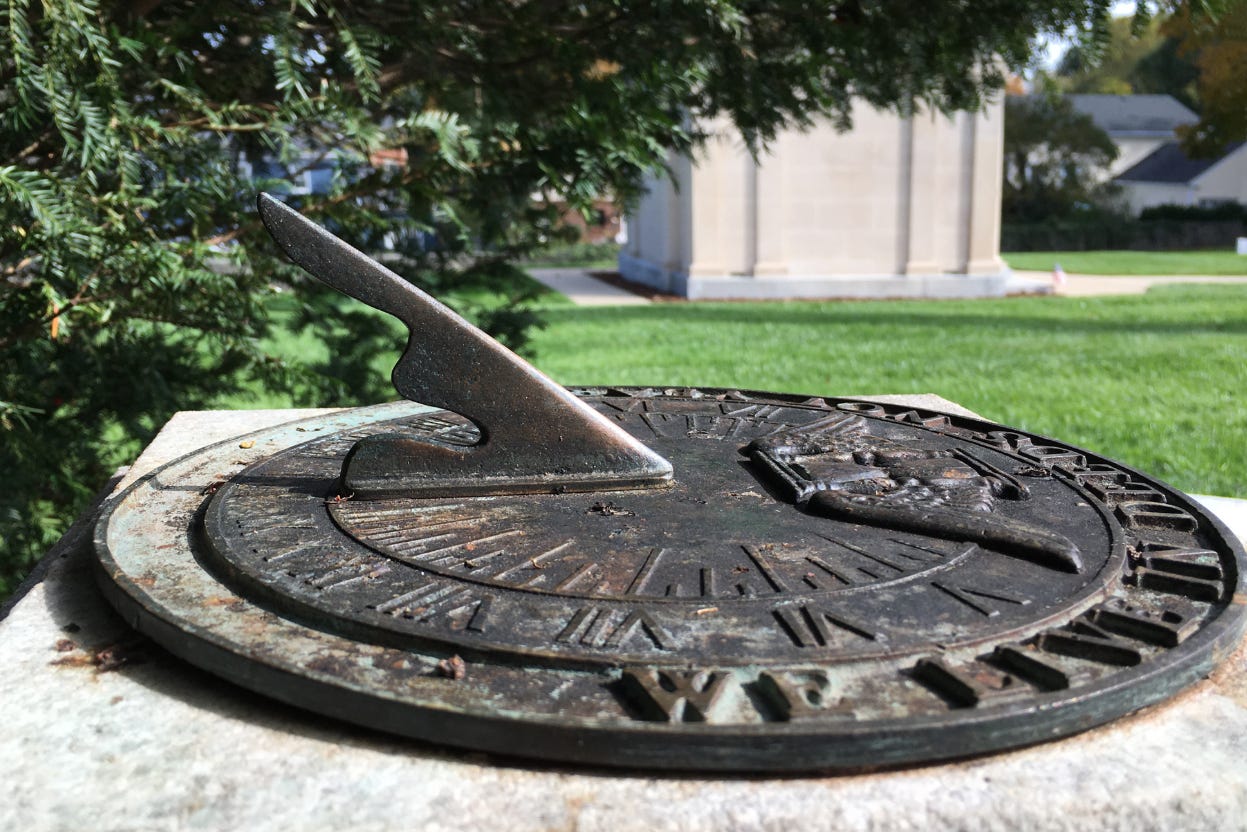
For most of human history, time was not measured by machines. It was perceived through recurring environmental signals: sunrise, sunset, the movement of shadows, the changing angle of light across the landscape, the appearance of stars, and the shifting rhythm of the seasons. These signals formed a distributed system available to direct observation. Time was not imposed through centralized coordination but recognized through the repeating behavior of the natural world.
Within this structure, time was relational rather than absolute. Midday occurred when the sun reached its highest point in the sky. Morning began with the arrival of light. Evening arrived as the sun descended toward the horizon. These transitions were gradual rather than fixed divisions. Each location experienced them slightly differently according to its position and landscape.
For centuries this arrangement proved stable. Agricultural societies organized activity around daylight and seasonal change. Work began with light and ended with darkness. Winter shortened the working day; summer extended it. Even where clocks existed—sundials, water clocks, early mechanical devices—their purpose was descriptive. They attempted to mirror the solar cycle rather than replace it.
The nineteenth century introduced a structural shift. Industrialization created systems requiring precise coordination among large numbers of people across distance. Railways provided the clearest example. Trains traveling between cities required synchronized schedules to operate safely and efficiently. Local solar time, which varied slightly from town to town, introduced friction into this coordination.
The solution was the creation of standardized time zones. Regions adopted uniform clock references that replaced local solar observation. Britain increasingly relied on Greenwich Mean Time during the nineteenth century. North America formally adopted railway time zones in 1883. Similar systems spread globally as telegraph networks, railways, and later aviation required increasingly precise temporal coordination.
This development reversed the earlier relationship between clocks and the sun. Previously, clocks attempted to approximate the solar cycle. After standardization, human activity increasingly followed the clock regardless of the sun’s position. Noon ceased to mean the moment when the sun stood highest overhead. It became the moment when a mechanical device indicated twelve.
At first the change appeared modest because the standardized day still roughly corresponded to solar cycles. Yet the governing reference had changed. Environmental observation had been replaced by mechanical authority.
As industrial systems expanded, the implications became clearer. Factories required workers to arrive at precise hours independent of seasonal light patterns. Electric lighting extended productive activity beyond the limits imposed by daylight. The daily rhythm of work became fixed even as the natural cycle of light continued to shift throughout the year.
The result was a mechanical temporal grid placed over a living environmental system.
Human physiology did not change with this grid. Biological rhythms remain regulated primarily through exposure to natural light cycles. Circadian systems govern sleep patterns, hormone release, metabolic regulation, immune function, and cellular repair. These rhythms evolved in response to the solar day and seasonal variation.
When activity patterns diverge significantly from these environmental signals, biological systems must compensate. This compensation appears in familiar forms: fatigue during dark winter mornings, difficulty sleeping when artificial lighting extends activity late into the night, and the persistent sense that daily schedules are slightly out of phase with natural light.
Modern societies introduced a further adjustment. Daylight Saving Time periodically shifts the mechanical clock forward or backward during the year. This adjustment does not alter the solar cycle. It alters the human schedule relative to it.
For many people the effect is immediately noticeable. Sleep patterns become temporarily disrupted. Daily routines require recalibration. Even small shifts in light exposure can influence circadian regulation because biological rhythms rely on stable environmental signals.
The discomfort associated with these changes reflects a simple structural reality. In the natural world the timing of sunrise and sunset changes gradually across the seasons. It does not jump forward or backward by an hour overnight.
Mechanical adjustment of time therefore introduces a discontinuity that does not exist in the environment itself.
This observation reflects a broader principle. Natural law operates through alignment between systems and the constraints of the environment in which they exist. When organization reflects those constraints, stability emerges. When organization diverges from them, compensatory stress appears.
The logic of this relationship is explored more fully in An Explanation of Natural Law, which describes how coherence arises when systems remain aligned with the structures that sustain them.
Mechanical time made large-scale industrial coordination possible. Modern transportation networks, financial systems, telecommunications, and digital infrastructure all depend on synchronized clocks. Without standardized time, these systems could not operate reliably.
Yet the biological architecture of human life continues to respond primarily to solar and seasonal cycles. The clock governs institutions, but the body continues to follow the sun.
This divergence remains subtle but persistent. Early rising in darkness during winter, extended activity under artificial lighting, and seasonal tension between work schedules and daylight all reflect the gap between mechanical coordination and environmental rhythm.
Many individuals recognize the sensation without naming the structure behind it: the feeling that modern life often runs slightly out of phase with the natural world.
The relationship between environmental coherence and human health is explored further in Health as Coherence, Not Intervention, which examines how living systems tend to stabilize when their rhythms realign with natural conditions.
The sun still determines the length of the day. Seasonal cycles still govern ecological systems. These structures remain unchanged.
What changed was the signal that human societies chose to follow.
Mechanical clocks allowed civilization to coordinate activity on an unprecedented scale. In doing so, they quietly displaced the oldest timekeeper humans had ever known.
The sun was not removed from the sky.
It was removed from the schedule.