

Insurance is usually described as a stabilizing instrument. A household buys a policy so that one fire does not become financial ruin. A business insures its property so that one disruption does not become insolvency. A lender insures against default so that one failed loan does not destroy the balance sheet. At the individual level this often makes good sense. The problem begins when the logic is scaled up and misunderstood. Insurance does not make risk disappear. It changes where risk sits, how it is priced, and how much exposure the system is willing to tolerate because protection appears to exist. What looks like safety at the point of use can therefore produce greater fragility at the level of the whole structure.
That is the illusion of risk transfer. The insured party experiences reduced immediate vulnerability and reasonably concludes that the underlying danger has been controlled. In reality the danger has often only been displaced. Sometimes it has been pooled. Sometimes it has been concentrated. Sometimes it has been transformed into a contingent claim that becomes visible only under stress. If the system is dealing with independent and limited losses, this can work well. If it is dealing with correlated losses, delayed claims, political guarantees, or incentives that encourage larger exposures, the same protective mechanism can increase systemic risk rather than reduce it.
The reason is simple. Insurance changes behavior. Once losses appear coverable, institutions often allow more of the activity that creates them. Banks extend more credit. Developers build in more exposed areas. Asset managers accept tighter margins of safety. Public authorities defer hard infrastructure decisions because a claims mechanism exists after the fact. The formal purpose of insurance is prudence. Its recurring structural effect, under weak discipline, is permission.
This is where the essay sits naturally beside The Efficiency Trap. That essay explains how systems often become fragile not because they are badly designed in any obvious sense, but because they are designed to eliminate slack, redundancy, and unused margin in the name of efficiency. Insurance can produce a similar result by a different route. Instead of removing slack directly, it creates a belief that slack is less necessary because losses are financially absorbable. But a system that depends on compensation after failure rather than structural margin before failure is still a system with less resilience. One essay explains fragility through optimization. This essay explains fragility through apparent protection. The underlying pattern is the same. A system becomes less cautious because it mistakes a management mechanism for real safety.
This is easiest to see when insured losses are not random but clustered. A single house fire is manageable because it is local. A regional wildfire, flood system, market seizure, or litigation wave is different. The same event can strike thousands of insured exposures at once. Under those conditions, what seemed like distributed protection can reveal itself as concentrated dependence on a smaller set of balance sheets, backstops, and assumptions than anyone wanted to admit. Insurance works best when losses are separable. It becomes dangerous when protection is written against risks that move together.
The 2008 collapse of AIG remains one of the clearest examples. AIG was not destabilized primarily by ordinary property-and-casualty insurance. It was destabilized by a protection business that had the form and signaling effect of safety. Through credit default swaps on complex debt instruments, the firm sold protection on risks that were treated as manageable because they appeared dispersed and insured. When the underlying assumptions failed and collateral demands rose, what had looked like prudent risk transfer was revealed as hidden concentration. Protection that was supposed to reassure the market had instead become a channel through which correlation and leverage were transmitted into the center of the financial system.
The significance of that episode is broader than one firm or one crisis. It shows how a system can become more aggressive because the existence of formal cover changes its internal sense of limit. Once protection is available, the practical question often shifts from whether an exposure should exist at all to whether it can be priced, insured, repackaged, or backstopped. That is not the disappearance of risk. It is its administrative absorption into a larger and often less visible structure.
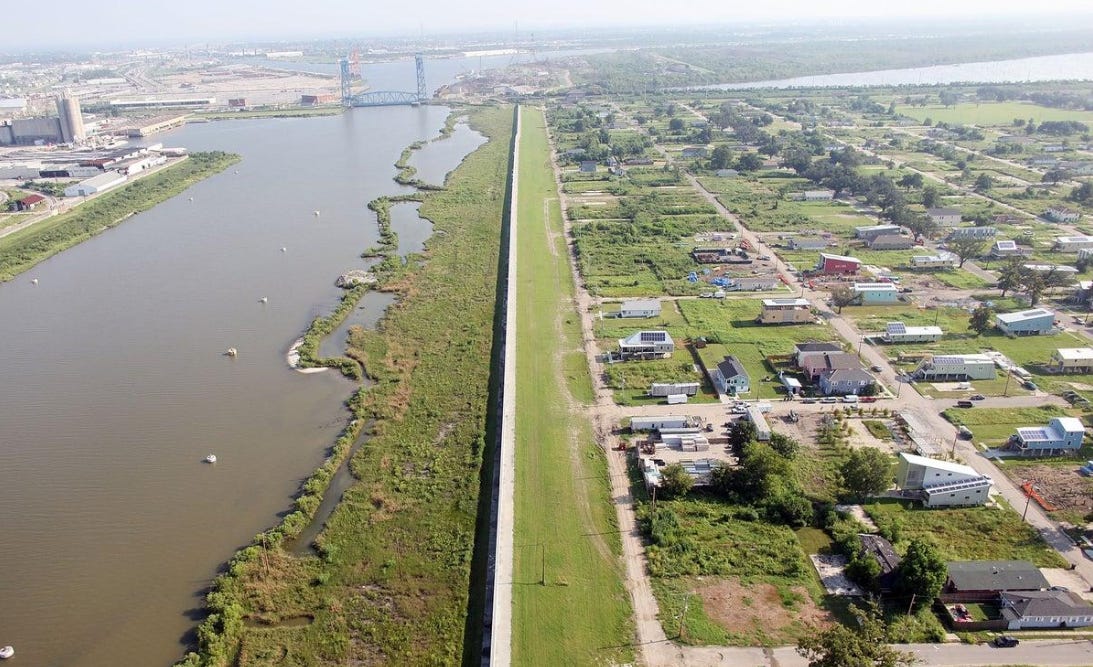
Flood insurance provides a second example, this time in physical rather than financial form. Insurance against flood loss is humane and often necessary. It helps households recover and preserves social continuity after disaster. But where the same structures are repeatedly damaged and repeatedly paid out, the system begins to reveal a different logic. It is no longer simply spreading rare losses. It is financing the continued occupation of known exposure. In those circumstances, insurance does not eliminate vulnerability. It weakens the adaptive signal that might otherwise force relocation, redesign, retreat, or refusal of further concentration in high-risk areas. The short-term protection is real. The long-term structural correction is deferred.
The same pattern is now visible in property insurance markets exposed to repeated climate-linked catastrophe. Insurers withdraw, premiums rise sharply, and residual safety mechanisms expand because the underlying environment has not become safer. The backstop remains politically and socially necessary, but its growth is also evidence of strain. What is presented as continuity of protection can, over time, become evidence that the system is carrying more concentrated exposure through a thinner and more contingent structure than before.
The final inversion comes when the protective mechanism itself begins to retreat. Insurance first weakens the pressure to reduce exposure by making loss appear manageable. But once repeated or correlated losses exceed what private balance sheets are willing to carry, the system reverses direction. Premiums rise, exclusions expand, private carriers withdraw, and last-resort facilities or public backstops take their place. At that point the structure reveals something important. Risk was never eliminated. It was tolerated for as long as the pricing, subsidy, and political architecture could absorb it. When those conditions fail, the protection shrinks and the underlying exposure remains. The result is not simply loss of cover. It is the discovery that what looked like resilience was often only temporary financial permission to remain in danger.
Insurance can also create fragility by obscuring time. Some liabilities do not arrive quickly enough to discipline the original underwriting decision. They emerge decades later, after legal standards change, medical knowledge develops, or claim patterns accumulate across years that once seemed unconnected. That was one of the lessons of the long-tail liabilities that shook Lloyd’s. The existence of cover had not removed the uncertainty. It had allowed obligations to be written whose true scale became visible only much later. A system can appear well-capitalized for years while carrying losses that have not yet fully arrived.
This is where the essay links naturally to Risk Without Owners. That essay examines how modern systems diffuse responsibility while allowing danger to accumulate across structures that no single actor fully owns in a meaningful moral or practical sense. Insurance often performs exactly that function. It does not merely compensate loss. It can dissolve the felt connection between decision and consequence. The developer builds, the lender lends, the local authority approves, the underwriter prices, the reinsurer absorbs, the state backstops, and the public eventually bears part of the cost through subsidy, inflation, withdrawal of cover, or rising premiums. Risk remains very real, but ownership of it becomes harder to locate. The new essay therefore provides a concrete mechanism inside the broader pattern described there. Insurance can be one of the most effective ways modern systems make risk transferable in form while ownerless in practice.
What these examples share is not industry or asset class but mechanism. In each case protection changes conduct before it proves adequacy. The holder of the policy, guarantee, or backstop feels safer immediately. The system discovers the truth later. If the protective architecture is conservative, transparent, and matched to underlying conditions, that gap can be manageable. If it is politically subsidized, opacity-tolerant, or built around the assumption that past loss patterns will remain stable, the gap becomes a source of fragility.
This is why insurance often becomes most dangerous when it is socially or institutionally invisible. People notice the premium and the policy language, but they do not usually notice the behavioral field that forms around the existence of cover. Building decisions change. Lending standards change. Reserve assumptions change. Political will changes. The presence of insurance can quietly shift a system from prevention toward compensation. Once that happens, losses are no longer treated mainly as signals to alter structure. They are treated as payable events within an administrative mechanism. That is a profound change. It means the system has started adapting to the financing of damage rather than to the reduction of exposure.
At that point the meaning of resilience becomes inverted. A resilient system is not one that can process an unlimited volume of claims. It is one that does not require the claims to arise at such scale in the first place. Insurance can support resilience when it sits downstream of prudent limits, strong underwriting, and real loss prevention. It undermines resilience when it substitutes for those things. The illusion begins when a claims-paying mechanism is confused with structural safety.
The deeper issue is that modern systems prefer continuity over correction. Insurance fits that preference perfectly because it allows institutions to preserve activity while deferring confrontation with the underlying problem. Coastal overdevelopment can continue. Fragile financial structures can continue. Concentrated supply chains can continue. Public authorities can continue approving, lending, and expanding while pointing to coverage as evidence of prudence. But continuity bought this way is often expensive and brittle. It works until a correlation event, a delayed claims wave, or a repricing shock reveals that the risk was never truly dispersed.
Insurance remains useful and often necessary. The error is not insurance itself. The error is the belief that formal protection is equivalent to real reduction in vulnerability. Once a system begins to believe that, it will often carry more risk than before, under the impression that it has become safer. That is why systems designed for safety can become more fragile. They do not fail because they recognized risk. They fail because they mistook the transfer of risk for its disappearance.