

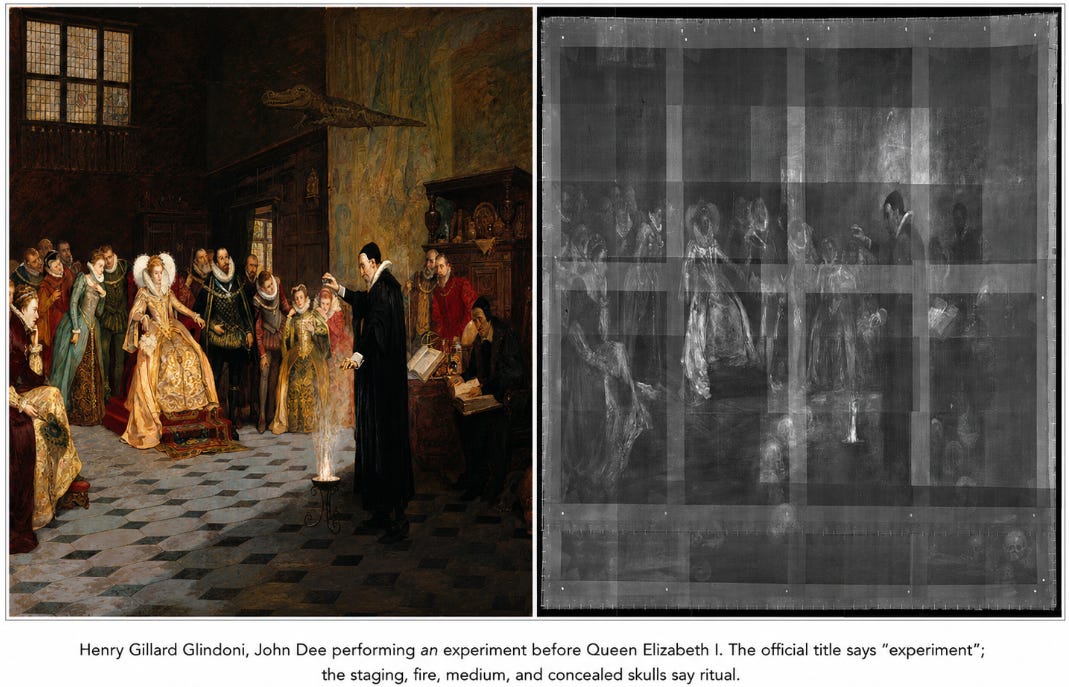
The familiar painting of John Dee before Queen Elizabeth I is usually presented as an experiment. That description is already a concealment. The scene does not show a harmless scholarly demonstration. It shows occult knowledge staged before sovereign power.
Dee stands at the boundary between courtly learning and ritual action. Elizabeth watches. Edward Kelley appears as medium or operator. Instruments, books, vessels, and flame surround the scene. A strange crocodilian or reptilian body hangs above the room like a suspended emblem of collected exotic power. Behind Dee, the tapestry is peculiar, half-legible, more symbolic than decorative. The room has the quality of a cabinet of wonders, an alchemical laboratory, an imperial collection, and a ritual space at once.
The later discovery that skulls had been painted out of the scene matters because it reveals what the respectable surface was trying to manage. Skulls do not belong naturally to a harmless court demonstration. They belong to mortality, boundary, invocation, and contact with the dead or the unseen. An experiment requires apparatus. A summoning requires threshold markers. The hidden skulls show the real grammar of the scene. The image preserves Dee as scientific demonstrator on the surface and conjuror beneath the paint.
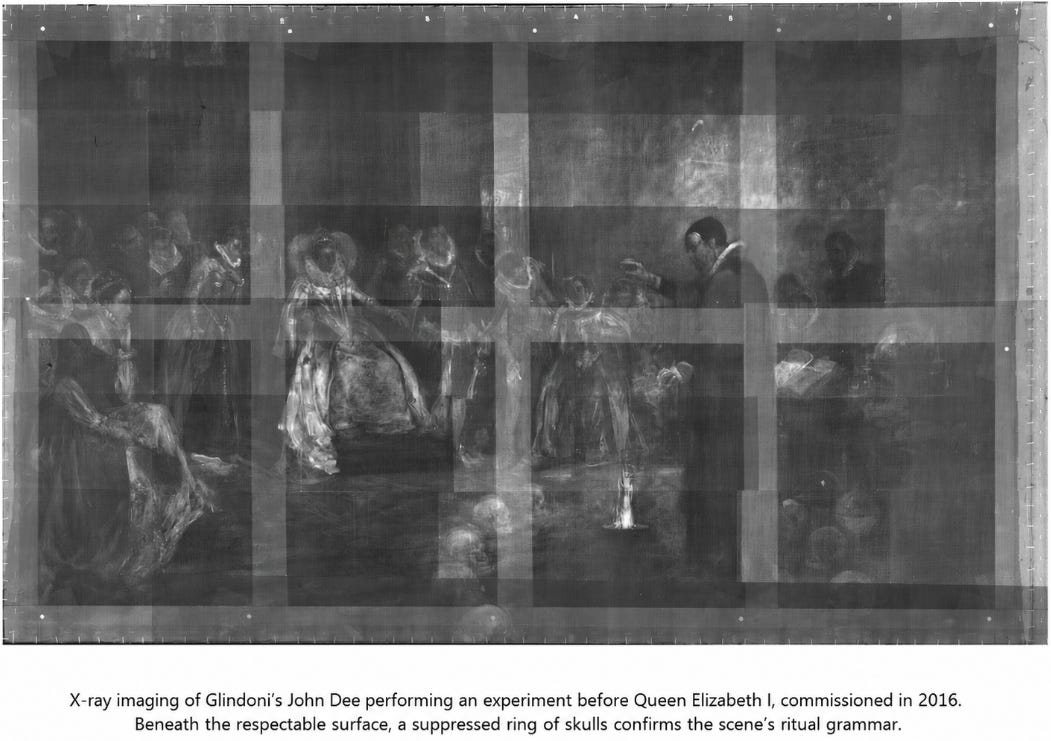
The painting therefore does more than illustrate Dee. It teaches the method required to read him. The surface label says experiment. The hidden layer says ritual. The respectable explanation asks the viewer to accept the public category and ignore the suppressed evidence. That is also how deceptive contact works. It arrives under a permissible name: angel, guide, intelligence, experiment, revelation, science, progress. The name does not decide the truth of the contact. The hidden layer and the fruit decide it.
Empire is usually explained as a human achievement. Ships sail. Armies conquer. Merchants finance. Administrators govern. Lawyers classify. Priests bless. Historians then describe the result as strategy, commerce, expansion, civilization, destiny, security, or progress. Those explanations describe instruments of power. They do not fully explain the structure beneath them.
The deeper question is not how empire operates once it has begun. The deeper question is what authorizes it, what animates it, and why the same pattern recurs wherever power crosses into domination. Human beings seek knowledge, wealth, victory, protection, prophecy, technological advantage, or dominion. They seek it from sources beyond ordinary human scale. The source offers power. The power creates obligation. The obligation is paid through secrecy, blood, violation, worship, extraction, inherited debt, or institutional capture.
John Dee matters because this pattern appears in him with unusual clarity. He was not merely an Elizabethan scholar who happened to have occult interests. He stood at the meeting point of mathematics, navigation, astrology, alchemy, cryptography, angelic communication, royal counsel, intelligence, and imperial imagination. The modern categories separate those things. Dee’s world did not. In him, map, mirror, angel, cipher, throne, navy, and empire belonged to one field.
Modern historical memory wants Dee as mathematician, navigator, adviser, collector, astrologer, and scholar, but it prefers those categories separated from the ritual core. The separation is false. Dee’s intellectual life was not divided into safe and unsafe compartments. The same mind that advised Elizabeth on empire also sought communication with angels through scryers, mirrors, tables, seals, and ritual procedure. The same man who helped imagine British maritime reach also treated unseen intelligences as sources of knowledge.
Even the political handling of Dee shows the change in state appetite. Under Mary, occult calculation made him suspect. His horoscope work and calculations involving Mary and Elizabeth placed him near the boundary of sorcery and treason. Under Elizabeth, the same class of knowledge became useful. The question was no longer simply whether occult calculation was dangerous. The question was whether it could serve the crown.
Dee’s mirror makes the problem still clearer. It was not an ordinary mirror. It was a black obsidian speculum from the Mexica world, associated with ancient Mesoamerican divination and with Tezcatlipoca, the Smoking Mirror. Obsidian mirrors were used as ritual interfaces: instruments for seeing, divining, consulting fate, and approaching other worlds through reflected darkness. The symbolism is not incidental. A mirror is not only a device for seeing. In ritual contexts it can be a device for being seen. The operator looks into the dark surface, but the unseen may also look back.
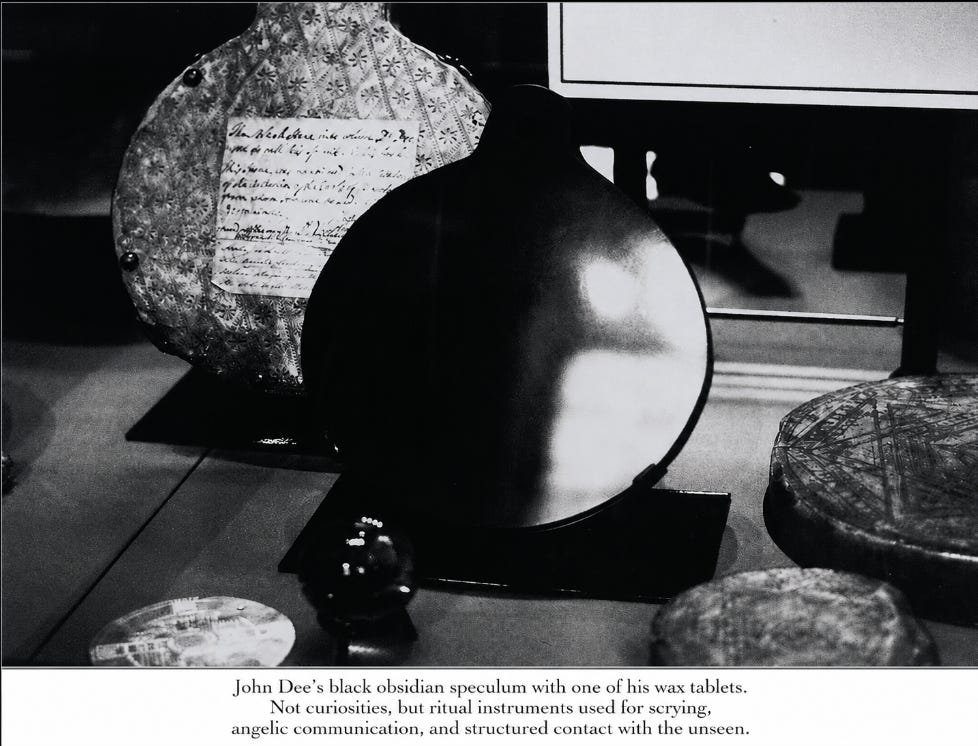
That object did not arrive in England through innocent exchange. It came from a conquered world. It passed through the violence of Spanish imperial seizure into European occult use. The mirror therefore already carried a history of conquest, divination, rulership, and blood. Dee did not merely use a polished stone. He used a conquered ritual interface from a world where mirrors, rulership, sacrifice, fate, and the unseen were joined.
The contact did not begin cleanly. Dee needed a seer. Barnabas Saul appears in the record before Kelley as one of the early scryers. The entries are not reassuring. Saul was troubled at midnight by a spiritual creature. In a later action, Dee prayed while Saul looked into a crystal globe and saw a being of beauty and force, associated with fiery eyes, Hebrew letters, a bright star, dead men’s skulls, a white dog, and many visions. When Dee asked who the being was, the answer was not a humble statement of lawful service. The answer was power. “All power is granted to me.” When Dee asked what power, the answer was “good and evil.”
That is a diagnostic moment. True contact with a benevolent intelligence does not claim jurisdiction over good and evil. It does not present itself as holder of total polarity. It does not require secrecy as the first condition of engagement. The entity’s language already contains the problem. It is not merely offering information. It is asserting authority.
At this point the inquiry changes. The historical question is whether Dee stood where occult contact, royal counsel, intelligence, navigation, and imperial imagination converged. The record supports that. The discernment question is what kind of contact this was. That question cannot be answered by accepting the entity’s title or the operator’s hope. It must be judged by fruit: secrecy, skulls, asserted power over good and evil, ritual apparatus, household violation, imperial ambition, and dominion.
Edward Kelley intensified the structure. With Kelley, the contact becomes more systematized: tables, seals, wax tablets, angelic language, ritual order, alchemical promises, European travel, and patronage. The communications were not vague inspirations. They became an operating system. Voice, table, seal, name, language, procedure, and command formed a structured interface. Dee and Kelley thought they were operating it. The deeper question, raised in The Collins Elite and the Architecture of Deception, is whether the system was operating them.
The fruit of the contact was not only intellectual. It entered the household. The wife-sharing command, or cross-matching episode, remains the disclosure point that polite accounts cannot absorb. Kelley reported that the angelic visitors directed Dee and Kelley to share wives. Jane Dee resisted. Dee was anguished. Yet the command was treated as genuine. An agreement was made. Dee recorded the event with the chilling phrase: Pactum, factum — the pact made, the thing done.
That is not a lurid aside. It is the point at which the contact reveals its nature. The claimed angelic authority invades marriage, body, conscience, and household order. It does not preserve Natural Law. It violates it. Whatever language the entities used, whatever names they claimed, whatever knowledge they offered, the fruit was inversion. Contact produced command. Command produced obedience. Obedience produced boundary violation. Boundary violation became pact.
This is the same structural problem addressed in Deception and UFOs: The 1998 Collins Elite Report Reconstructed. In the modern national-security frame, the question is not merely whether non-human contact occurs. The question is whether the contact presents itself through masks and induces human institutions to surrender discernment. The old occult frame and the modern UFO frame are closer than they first appear. The mask changes with the culture. The structure does not. Angel, watcher, spirit, daimon, alien, intelligence, messenger, guide, or technician may be different surface vocabularies for the same deeper problem: contact that offers knowledge or power while extracting consent, secrecy, obedience, or sovereignty.
The same grammar appears at the individual scale, though not always with the same moral valence. Bob Dylan’s 2004 statement to Ed Bradley matters because the bargain language came from Dylan himself. He did not merely say he was driven, disciplined, inspired, or devoted to his craft. He spoke of a bargain or deal with the “Chief Commander” in this world and in the unseen world, and he connected that bargain to continuing obligation. That is the structure: deal, commander, visible world, unseen world, service. His songs repeatedly return to the same field: service, allegiance, disguised evil, divided self, judgment, exhaustion, pilgrimage, payment, blood, and burden. Les Wexner gives the commercial form. In his 1985 profile, Wexner uses dybbuk and shpilkes language to describe his own drive, while the profile renders the force in demon-like terms: something inside him that wakes, stabs, prods, agitates, and will not let him rest. Dylan shows the artist under command. Wexner shows the billionaire under compulsion. In both cases, extraordinary success is not described as simple freedom. It is described as obligation under pressure.
Those examples do not prove Dee. They do not need to. They show the grammar of bargain before the essay returns to the imperial scale. At the personal level, the cost is carried by the life. At the imperial level, the cost is carried by history.
This is why Sean Stone’s May 2026 appearance on The Tucker Carlson Show matters. Stone is not evidence for Dee in the way Dee’s own record is evidence for Dee. He is not a primary source for the Elizabethan period. His significance is different. Stone is a filmmaker, author, actor, media host, former Freemason, and the son of Oliver Stone. He went onto a major public platform and spoke openly about a subject that is normally kept outside permissible discourse: occult power, possession, secret societies, political authority, supernatural bargains, and nations making deals with unseen forces.
The crucial moment came when Tucker asked whether nations, like individuals, can make deals with supernatural forces for temporal power. Stone did not drift vaguely into symbolism. He went directly to John Dee, Enochian magic, Queen Elizabeth, the beginning of the British Empire, the original 007 motif, Watchers or angels, spirit summoning, and the theory that Dee made the bargain by which Britain became the dominant empire, with blood sacrifice as the cost. That does not prove the thesis. It shows that the Dee-bargain framework has re-entered public speech, and that it did so in almost exactly the Collins Elite form: contact, ritual, power, deception risk, supernatural bargain, state consequence, and inherited cost.
The British Empire can then be read not merely as a political project, but as the historical fruit of an authorization problem.
The point is not that the British Empire was uniquely extractive. Other empires also converted violence into legitimacy, conquest into title, and sacrifice into order. That does not weaken the discernment test. It widens it. Empire itself is the recurring institutional form by which unlawful power is socialized. The British case matters because Dee makes the occult interface unusually visible at the threshold of a later global system: maritime reach, intelligence craft, chartered commerce, City finance, law, language, and administrative classification.
England received sea dominion, imperial reach, commercial expansion, legal export, financial centrality, intelligence advantage, and eventually a global language. But the cost was visible everywhere the empire touched. Peoples became subjects. Land became title. Labor became commodity. Sea lanes became jurisdiction. Trade became monopoly. Violence became treaty. Suffering became accounting. Ireland, the Caribbean, India, China, Africa, and the settler colonies all show the same pattern: extraction converted into order, violation converted into law, domination converted into civilization.
This does not require every official of the British Empire to have known anything about Dee’s occult work. A parasitic structure does not need universal conscious participation. It needs an interface, then institutions capable of carrying the pattern forward. Dee is the personal interface: scholar, conjuror, adviser, imperial imaginer. The later interfaces are institutional: Crown, charter, Admiralty, company, City finance, intelligence, missionary cover, treaty, court, map, registry, and administrative category. Once the structure enters institutions, individuals can serve it without understanding its origin.
That is how empire hides its ritual core. It becomes procedure. A conquered people is renamed a subject population. A seized territory becomes a possession. A monopoly becomes a charter. A war becomes pacification. A famine becomes administrative failure. A drug trade becomes commercial policy. A massacre becomes an incident. The moral inversion is not hidden because no one can see it. It is hidden because the vocabulary of rule converts the violation into legality.
The inner sanctum is also part of the structure. Empires do not operate only at their edges. They require protected centers where extraction becomes legitimacy. Babylon had its temple logic. Rome had its sacred legal city. The Vatican preserved a sovereign religious enclosure inside later political arrangements. The City of London became a financial-jurisdictional engine within the British system. Washington, D.C. became a federal and continuity enclave within the American system. These places are not identical, but they rhyme. Empire requires an inner jurisdiction where ordinary accountability is altered, suspended, or reclassified.
The City of London is especially important because it shows how empire can continue after formal empire declines. Flags come down. Colonies become states. Administrative rule changes form. But finance, debt, insurance, shipping, law, offshore structures, intelligence relations, and institutional memory preserve continuity. The British Empire did not simply disappear. Much of it became informal, financial, legal, and networked. The outer empire receded. The inner engine continued.
That is why Dee cannot be treated as a curiosity. He appears at the threshold of the very system that later becomes global: maritime reach, intelligence craft, imperial language, occult contact, royal counsel, and sacred authorization by hidden means. The painting is the hinge because it refuses the modern separation. Science and magic are in the same room. Monarchy and summoning are in the same room. Empire and skulls are in the same room. Knowledge and blood are in the same room. The respectable surface calls it an experiment. The hidden layer says otherwise.
The discernment test is simple. Lawful contact does not demand secrecy for domination. It does not claim authority over good and evil. It does not invade marriage. It does not turn knowledge into sovereignty theft. It does not produce blood systems, extraction, and inherited debt. As argued in Prayer in a Structural World, prayer aligns the human will with the Creator, truth, protection, and lawful order. Corrupt invocation tries to bend reality toward power, access, control, and advantage. The difference is not aesthetic. It is structural. One submits to Natural Law. The other seeks power around it.
The British Empire’s public language was civilizing language. That is the inversion. Empire claimed to bring order while producing dependency. It claimed to bring law while subordinating peoples to external jurisdiction. It claimed to bring commerce while enforcing monopoly and extraction. It claimed to bring faith while often serving power. It claimed to bring progress while breaking living cultures into administrable pieces. The language of benefit covered the structure of sacrifice.
The Collins warning is that rulers may mistake contact for control. They may believe they are using the unseen. But a system that grants power in exchange for violation is not being used. It is using the user. The cost is rarely paid by the ruler alone. It is paid by the people beneath the system, including those who never knew that any bargain had been made.
That is the true horror of imperial occultism. The pact, if made, is not paid only by the magician. It is socialized through history. The ruler seeks victory. The court receives knowledge. The navy gains reach. The merchants gain markets. The financiers gain instruments. The administrators gain categories. The law gains jurisdiction. The empire gains destiny. But the debt descends outward and downward until ordinary human beings carry it in land loss, family rupture, hunger, labor, addiction, migration, war, and memory.
The British Empire was therefore never merely political. It was never merely commercial. It was never merely naval. It was never merely legal. Those were instruments. The deeper question is authorization. Dee stands at the origin point because he reveals the hidden structure before later institutions learned how to sanitize it. A royal adviser sought contact through mirrors, scryers, seals, tables, and angelic language. A claimed intelligence asserted power over good and evil. A household boundary was violated under spiritual command. An imperial imagination emerged beside the contact. A maritime empire followed, carrying law, commerce, extraction, blood, and debt across the world.
The painting tells the truth because it cannot fully hide what it contains. On the surface: queen, scholar, books, instruments, experiment, knowledge. Beneath the surface: skulls, medium, fire, reptilian trophy, strange tapestry, ritual chamber, hidden death. That is also the structure of empire. On the surface: civilization, law, trade, order, progress. Beneath the surface: contact, bargain, secrecy, violation, extraction, blood.
Empire was the reward. Empire was also the payment mechanism.
Well put .