


This essay is part of William J. Teesdale’s Strategic Intent Analysis archive at strategicintentanalysis.com. The method is simple: begin with what is observable, then test the story against the structure beneath it.
For decades, the central question surrounding the alleged UFO Legacy Program has been whether it exists. That question is increasingly giving way to another: where is it?
David Grusch testified under oath that he had been informed of a multi-decade crash-retrieval and reverse-engineering program involving non-human technology, that he was denied access to relevant compartments, and that material had been concealed from proper congressional oversight. Luis Elizondo has described attempted transfers of alleged recovered material held by an aerospace contractor. Dylan Borland, a former enlisted Air Force geospatial intelligence specialist, has placed claimed firsthand knowledge of anomalous craft and direct knowledge of the Legacy Program into congressional testimony. The Schumer-Rounds UAP Disclosure Act language contemplated recovered technology and non-human biological material held by private entities strongly enough to provide for federal eminent domain over it.
AARO reached the opposite conclusion. Its historical review said it found no verified evidence of an extraterrestrial reverse-engineering program concealed from Congress.
Then the problem changed again.
President Donald Trump ordered a government-wide effort to identify, review, declassify and release UAP records. Ross Coulthart subsequently reported something considerably more consequential: that Trump had authorized a separate effort to identify, intercept and recover anomalous objects, including suspected non-human technology, and that the purpose of the operation was to circumvent the existing Legacy Program.
Circumvention has a specific institutional meaning. It implies that the normal route is obstructed, distrusted, incomplete or otherwise incapable of reliably producing the required result. A President should not have to circumvent a program constitutionally subordinate to him.
That contradiction places the modern UFO problem inside a warning delivered sixty-five years ago.
When Dwight Eisenhower left office in January 1961, he warned that the conjunction of an immense military establishment and a permanent arms industry had created something unprecedented in American history. He called it the military-industrial complex. His concern was not simply that defense companies might make too much money or generals might possess too much influence. The deeper danger was structural. A permanent relationship had developed among military power, private industry, government procurement and scientific research. Eisenhower warned that its influence would be felt economically, politically and spiritually throughout the structure of government. He also warned that public policy could become captive to a scientific-technological elite.
Those warnings belong together. The first concerned institutional power created by the permanent merger of military necessity and private industrial capability. The second concerned knowledge: an increasingly specialized technical class whose expertise could become indispensable to government while remaining inaccessible to ordinary democratic judgment. Combined, they describe a system in which the state can become dependent upon private custodians, classified science, restricted expertise and permanent security institutions that elected officials formally command but may not practically control.
That is remarkably close to the architecture now alleged around the UFO Legacy Program.
The Military-Industrial Complex and the Persistence of Secrecy examined the broader mechanism: classified defense structures do not necessarily disappear when political leadership changes or when scrutiny reaches them. Programs, contractors, clearances, technical expertise and security relationships can persist across administrations. Compartmentalization and the Structure of Classified Power examined the corresponding information problem. Confidentiality prevents outsiders from seeing information. Compartmentalization breaks internal visibility apart.
The alleged Legacy Program appears to combine both mechanisms.
It may not exist primarily as a single secret office with a stable name, permanent headquarters and identifiable chain of command. It may exist as a distributed system of compartments, contractors, custody arrangements, classification authorities and intelligence structures whose complete architecture is visible to almost nobody. If so, looking for its name may be the wrong way to find it. The Legacy Program may exist in the relationships between institutions rather than within any one institution.
Strategic Intent Analysis begins with function. What must such a structure accomplish if the allegations are substantially correct?
Recovered material must be acquired. Someone must physically possess it. Security must prevent unauthorized access. Scientists and engineers must exploit it. Funding must move without revealing its purpose. Intelligence agencies must determine what foreign governments know. Classification authorities must protect information. Contractors may provide facilities and personnel unavailable inside ordinary government laboratories. Someone must decide who is read in. Someone must authorize transfers. Someone must manage witnesses, investigations and unwanted scrutiny.
Those functions do not have to reside in the same institution.
Military elements can recover material. Private aerospace contractors can hold or exploit it. Air Force authorities can control aerospace access, security relationships and transfers. Department of Energy structures can handle specialized nuclear, materials or energy information. Intelligence agencies can collect information, conduct counterintelligence and protect sensitive relationships. Special Access Programs and Controlled Access Programs can divide the resulting knowledge among compartments. A gatekeeper layer can control the relationships among them.
The complete system may therefore exist across those functions rather than inside any one of them.
That architecture also explains one of the persistent confusions surrounding classified power. Clearance and access are not the same as discovery.
An investigator can be granted unrestricted access to every program he identifies and still fail completely if the decisive programs, contracts, facilities, compartments or relationships have never been identified to him. An institution can grant an investigator complete access to everything he knows to request while withholding the information necessary for him to know what else exists.
Once substantive knowledge depends upon admission to a compartment rather than constitutional position, another hierarchy develops within the visible one. The President remains President. Cabinet secretaries retain formal responsibility. Congress retains appropriations and oversight authority. Inspectors general retain statutory powers. Yet integrated sight can remain somewhere else.
Secrecy then becomes a survivability mechanism. Public accountability weakens because facts are classified. Internal accountability weakens because the facts themselves are fragmented. Procedure remains visible while substance recedes.
Eisenhower’s warning can therefore be stated more precisely in retrospect. The ultimate danger of the military-industrial complex is not simply that private industry influences government. It is that government may become operationally dependent upon a permanent military-industrial-scientific structure whose continuity, knowledge and physical custody survive the elected officials nominally responsible for controlling it.
The UFO record contains a striking example.
Elizondo testified about an effort to transfer material allegedly held by Lockheed Martin to Bigelow Aerospace. According to his account, the transfer was blocked. Authorization required a memorandum from the Secretary of the Air Force. That authorization never came. Elizondo later attempted to elevate the matter through Secretary of Defense James Mattis.
Whatever the ultimate nature of the material, the institutional relationship is important. Physical possession and control were separate.
Why did the Secretary of the Air Force have to authorize the transfer of material physically held by a private aerospace company?
That question should leave an administrative shadow. An authorization requested but never issued should produce correspondence, legal review, security analysis, contracting records, access discussions, classification decisions or some other institutional trace. The object may be hidden. The relationship required to control it is harder to erase.
Possession is not control.
A technology can sit inside an American contractor facility, be connected to federal funding and remain formally subject to government agreements while still being practically inaccessible to officials who nominally govern the system. Ownership on paper does not establish effective command.
Retired Major General William Neil McCasland adds another important node. McCasland occupied unusually sensitive positions across the Air Force research and classified aerospace structure, including command of the Air Force Research Laboratory and service as Director of Special Programs in the Office of the Under Secretary of Defense for Acquisition, Technology and Logistics. Tom DeLonge’s contemporaneous correspondence also placed McCasland inside the modern UFO disclosure effort.
The significance of his position may not have ended with retirement.
An unnamed woman who worked with McCasland through the Kirtland Partnership Committee told police that she had dined with him and Space Force personnel on the evening before he disappeared. She said his name appeared in UFO documents that were about to be released and, speaking in the present tense, described him as possessing “a very high security clearance.” She also observed that he was unusually quiet and “spacey.” Her account does not establish why his demeanor had changed, but it suggests that she regarded McCasland as still connected to sensitive national-security circles rather than merely as a retired repository of historical knowledge.
McCasland disappeared from his Albuquerque home the following day, in February 2026, shortly after the administration began its renewed effort to penetrate the historical UFO record. His disappearance is important under Strategic Intent Analysis not because its cause is known, but because the potential significance of his knowledge appears to have been changing. A senior former Special Programs and AFRL official, apparently still moving in sensitive circles and reportedly named in forthcoming UFO records, becomes considerably more consequential when a President begins attempting to penetrate or circumvent the structure he may understand.
The institutional history preceding the modern whistleblowers makes the architecture more coherent. Australian intelligence material from 1971 described a divided American posture in which public debunking coexisted with internal scientific and intelligence interest. UFO reports were treated internally as matters potentially involving propulsion, military capability and intelligence significance while the public-facing system encouraged dismissal.
The public has generally been encouraged to treat the UFO issue as a belief problem. The national-security apparatus repeatedly treated it as something else: an intelligence problem, an airspace problem, a technological exploitation problem, a nuclear problem, a custody problem and a perception-management problem.
That distinction was central to The Intelligence State and the UFO Problem. Once anomalous evidence enters an intelligence structure, the first question is no longer simply what the object is. The institution asks what it reveals, what an adversary might learn, what capability can be extracted, what programs could be exposed, what witnesses must be managed, and what historical liabilities would arise from disclosure.
The problem becomes qualitatively different once material is recovered. Before custody, the state can manage reports. After custody, it must manage objects. This is the custody threshold.
An object requires storage, transport, security, testing, provenance, ownership, contracting, scientific exploitation and decisions concerning who may see it. Those requirements produce relationships. Even concealment generates evidence.
The Department of Energy potentially adds another layer. The Atomic Energy Act creates categories of restricted nuclear information distinct from ordinary national-security classification. If recovered technology implicated energy production, radiation, isotopes, nuclear processes or related materials, information concerning a single object could enter several different security systems. A singular object could therefore generate a fragmented institutional record.
The CIA and the wider intelligence community need not physically possess the object to perform an essential Legacy function. Intelligence agencies would have obvious interests in foreign acquisition, counterintelligence, sources and methods, penetration of competing programs and protection of sensitive relationships.
This produces a coherent division of function without requiring any single institution to own the entire Legacy Program. Military elements recover material. Contractors possess or exploit it. Air Force authorities control important aerospace, custody or transfer relationships. DOE structures protect specialized information. Intelligence agencies collect information and guard the perimeter. Special-access structures divide knowledge.
This interpretation also changes the significance of KONA BLUE. AARO concluded that KONA BLUE was a proposed Special Access Program that was never established and never received the anomalous material its advocates expected. That finding does not necessarily weaken the larger architecture. It raises a different question.
Why were people attempting to create a protected government structure capable of receiving material they apparently believed existed somewhere else?
KONA BLUE may therefore be important not because it was the Legacy Program, but because it may represent an attempted bridge to older custody.
AARO’s contrary conclusion remains structurally important. If AARO genuinely received unrestricted access to everything it identified and found no hidden reverse-engineering program, there are two possibilities. The larger allegation is wrong, or the investigative map was incomplete.
Those possibilities can be distinguished.
If no distributed Legacy architecture exists, the anomalies should eventually resolve into conventional classified programs, misunderstood contractual relationships, inaccurate witnesses, administrative accidents and unrelated events. The same institutional nodes should not repeatedly be required to explain apparently independent contradictions.
If the same contractors, access mechanisms, security structures, authorities and custody relationships continue recurring across otherwise independent lines of evidence, something real is creating the pattern.
The question is therefore not simply whether AARO had unrestricted access. It is whether the map was complete.
The same architecture explains the peculiar character of modern disclosure. Since 2017, official ridicule has become increasingly difficult to sustain. Military videos were acknowledged. Senior officials spoke publicly. Congress held hearings. Reporting mechanisms expanded. UAP replaced UFO as the acceptable institutional vocabulary.
Public seriousness increased without producing resolution.
The public can be permitted to know that anomalous objects exist without being told who possesses recovered material. It can be told that pilots encounter inexplicable craft without receiving the history of contractor custody. It can hear testimony about non-human intelligence without receiving the technical results of alleged reverse engineering. Public uncertainty and operational certainty can coexist. The public could be told that humanity is not alone while a contractor vault remained closed.
That distinction matters because concealment is not maintained by secrecy alone. A mature protected structure requires boundary enforcement.
David Grusch testified that people had been harmed in connection with the alleged program. When asked whether murder had occurred as part of the concealment, he directed the issue toward the appropriate authorities rather than rejecting the premise. He also described fearing for his own safety.
Lethal suppression therefore already exists within the witness record. The question is how such suppression would fit the institutional architecture.
The answer becomes clearer when lethal force is placed at the end of an escalation spectrum rather than treated as the beginning.
A secrecy system does not need to kill everyone who knows something. That would be irrational and conspicuous. Most boundary violations can be managed much more cheaply. Classification can prevent disclosure. Compartmentation can prevent witnesses from assembling the whole. Ridicule can destroy credibility. Disinformation can contaminate the evidentiary environment. Career pressure can deter officials. Security investigations can intimidate. Psychological manipulation can isolate or destabilize a target.
Paul Bennewitz demonstrates that some of these mechanisms are not hypothetical. Air Force counterintelligence became involved after he began investigating unusual activity around Kirtland Air Force Base. Fabricated UFO information was deliberately fed into the situation while his psychological condition deteriorated severely.
Whatever information was actually being protected, deliberate manipulation of a civilian UFO investigator was real institutional behavior. The capability existed.
That gives us an escalation ladder. Denial, compartmentation, ridicule, disinformation, professional pressure, intimidation and psychological destruction all provide means of preserving a boundary without resorting to lethal force. The unresolved question is what happens when those methods cease to be sufficient.
Phil Schneider publicly claimed involvement with deeply classified underground facilities and non-human beings and reportedly described threats associated with his disclosure activity before his death. His death was officially classified as suicide, but the circumstances were disputed almost immediately. Schneider had severe impairment of one hand, while the death involved a ligature around his neck secured by knotting that his wife believed was inconsistent with his physical capabilities. She publicly stated that she believed he had been murdered. The point is not that Schneider’s death, standing alone, resolves the question. It is that the official label does not remove the case from a pattern in which pre-event threats and disputed circumstances recur.
Amy Eskridge, involved in advanced propulsion research, reportedly described intimidation and threats before her death. Former Air Force intelligence officer Matthew James Sullivan died after reportedly moving toward greater disclosure. Elizondo has also described a Department of Energy inspector-general investigator with relevant UAP knowledge dying while efforts were underway to connect him with Congress.
The individual evidentiary strength of these cases varies. Their structural importance lies in recurrence, particularly where disclosure activity, pressure or threats precede death or disappearance. Strategic Intent Analysis does not require each event to establish homicide independently. It asks whether the aggregate exhibits directionality: who possessed relevant knowledge, whether that knowledge was becoming actionable, what occurred beforehand, and whether the same kinds of institutional boundaries recur.
A mature concealment structure would not use maximum force indiscriminately. It would select the mechanism appropriate to the threat. Lethal suppression becomes strategically relevant when other mechanisms are inadequate and a particular disclosure threatens the continuity of the structure.
James Forrestal occupies an earlier and potentially more consequential position in that pattern.
The suspicious circumstances of Forrestal’s death were being challenged decades before the later Majestic documents surfaced. Cornell Simpson began investigating Forrestal’s 1949 death within years of the event and concluded that the official suicide account did not explain the physical evidence or the institutional handling of the case. Forrestal fell from a sixteenth-floor window at Bethesda Naval Hospital with his bathrobe cord tightly knotted around his neck. No local police investigation occurred. The suicide conclusion was announced almost immediately, and the commander who convened the subsequent Navy inquiry publicly declared before it began that the death could only have been suicide. The inquiry itself was conducted by Navy medical personnel.
Forrestal had meanwhile been isolated from people he specifically asked to see. His brother encountered substantial difficulty gaining access to him. A priest Forrestal repeatedly requested was kept away. Thousands of pages of Forrestal’s private diaries had been removed from his control and placed in White House custody before his hospitalization. Accounts from people who saw him shortly before his death described substantial improvement and expectations that he would soon leave the hospital. Years later, the underlying Navy record remained difficult to penetrate. These were not controversies created by UFO researchers. They were part of the Forrestal problem long before Majestic entered the public vocabulary.
Decades later, David Martin independently revisited the case, obtained the Navy investigation through FOIA and likewise concluded that Forrestal had been assassinated, although he advanced a substantially different theory of responsibility from Simpson. The important convergence is therefore not agreement about who killed Forrestal. It is the persistence, across investigators operating in different periods and from different political frameworks, of the conclusion that the official suicide account failed to explain the underlying evidence.
The later Majestic documents add a separate and much more specific institutional dimension.
Within that disputed documentary corpus, Forrestal is not peripheral. An alleged July 1947 intelligence assessment concerning recovered craft and bodies states that Forrestal would be briefed on the discoveries once confirmed as Secretary of Defense. An alleged September 1947 Truman memorandum to Forrestal establishes the designation Operation Majestic Twelve. The later Eisenhower briefing identifies Forrestal as one of the original twelve members and states that his death created a vacancy in the group.
More consequential still is an alleged Majestic Annex C fragment attributed in the Majestic provenance record to Salina, identified there as the daughter of Thomas ‘Cy’ Cantwheel. In the context of MAJESTIC security, it states that “the untimely death of Secretary Forrestal was deemed necessary and regrettable.”

If authentic, that sentence changes Forrestal’s position in the history completely. It does not merely associate a suspicious death with the UFO issue after the fact. It describes the death of one of the alleged program’s own senior principals as a security necessity.
The significance of that document does not depend upon accepting whatever theory later investigators developed about who killed Forrestal. Suspicion surrounding his death existed independently for decades. The physical anomalies, rapid suicide determination, isolation, control of his papers and internally managed investigation were already there. The Majestic material therefore does not manufacture the anomaly. It introduces an alleged internal explanation for an anomaly that substantially predates the document’s public appearance.
Under Strategic Intent Analysis, that convergence is far more significant than either evidentiary stream standing alone. An independently disputed death is later intersected by an alleged internal security document stating that the death was necessary. The document remains disputed. The convergence does not.
The presidential question becomes still more serious because the Forrestal material does not stand alone within the alleged Majestic documentary record.
A different source stream, attributed to the counterintelligence source known as S-1, addresses John F. Kennedy. The distinction in provenance matters. The Forrestal “necessary and regrettable” language is attributed to the Cantwheel/Salina stream. The Kennedy material entered through S-1. Both eventually passed through Timothy Cooper and therefore do not possess wholly independent archival provenance, but they purport to originate from different insiders and concern different periods, different officials and different immediate circumstances.
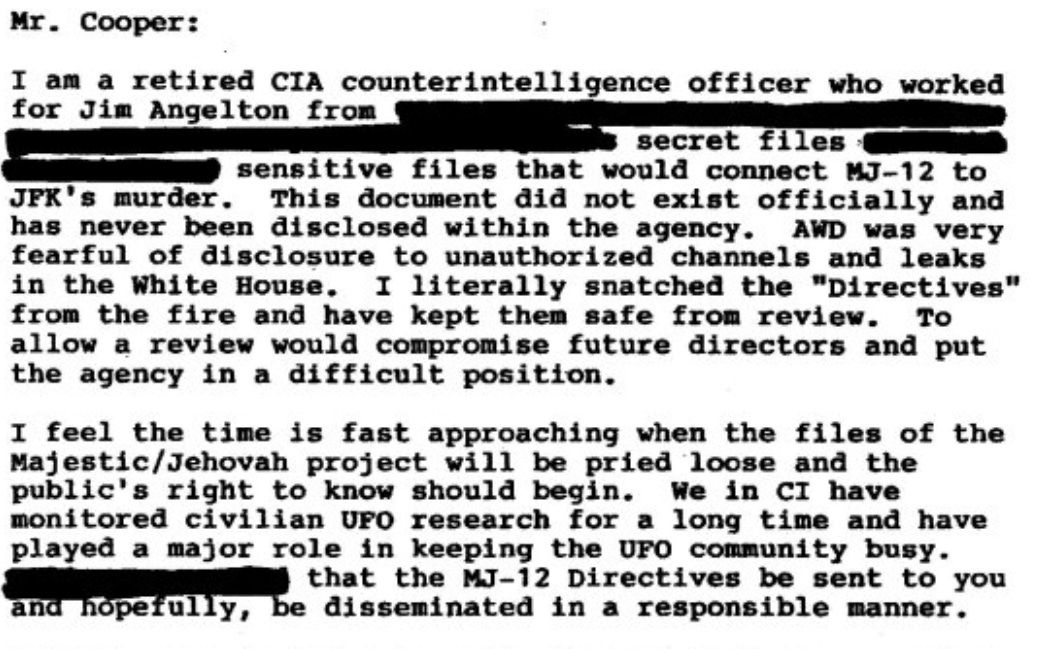
The S-1 material is more specific than a mere allegation of institutional hostility toward Kennedy. In his cover letter to Timothy Cooper, S-1 identified himself as a retired CIA counterintelligence officer and said that the surviving files would connect MJ-12 to Kennedy’s murder. He said the accompanying directives had been pulled from material otherwise destined for destruction. Within the disputed documentary package, that cover letter functions as the interpretive key.
Its most consequential document is the so-called Burned Memo. The opening page concerns “LANCER,” generally understood within the document tradition as Kennedy, and states that he had been making inquiries into their activities “which we cannot allow.” The memorandum then circulates a set of directives for dealing with the problem.
The final page of that directive package is potentially even more significant. Under the heading Project “ENVIRONMENT,” it states that when conditions become non-conducive, and when “Washington cannot influence any further,” then if the “weather is lacking any precipitation … it should be wet.” Read in isolation, that language could be argued over indefinitely. Read in the context supplied by S-1’s cover letter and the opening LANCER page, it is far more naturally understood as coded contingency language for assassination.
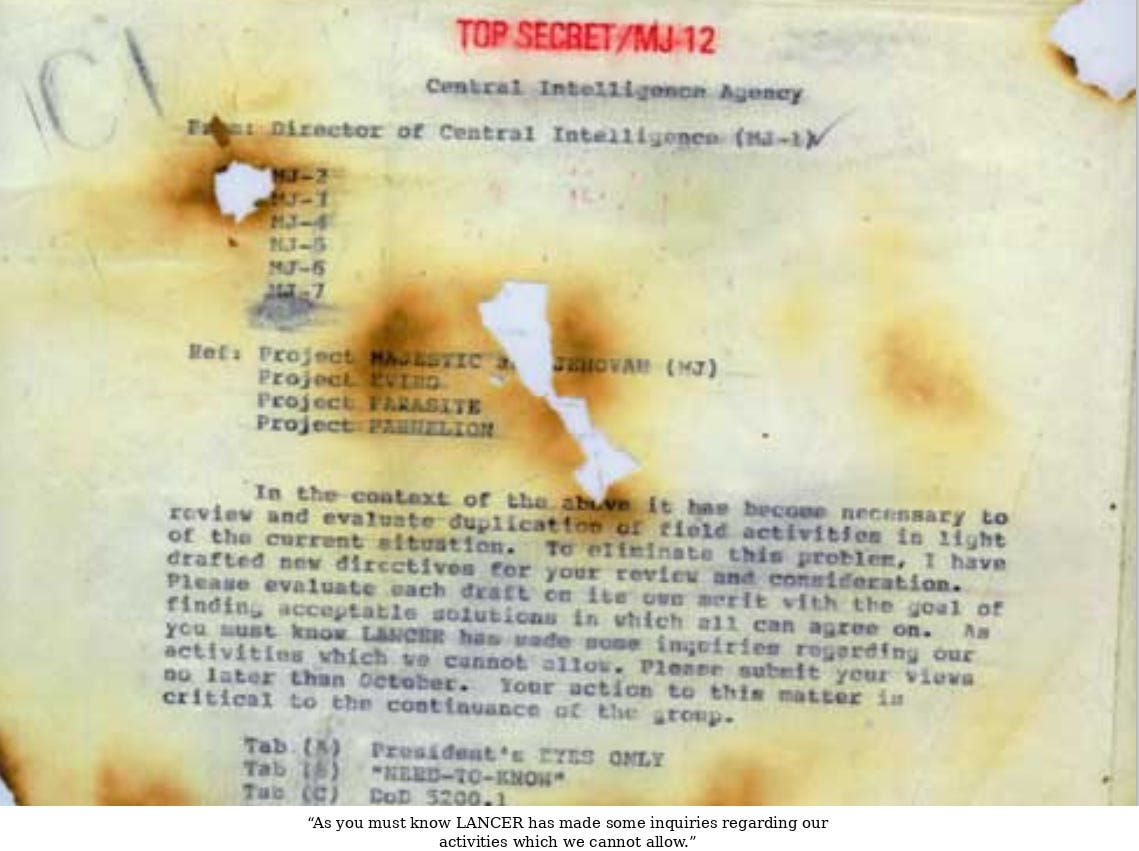
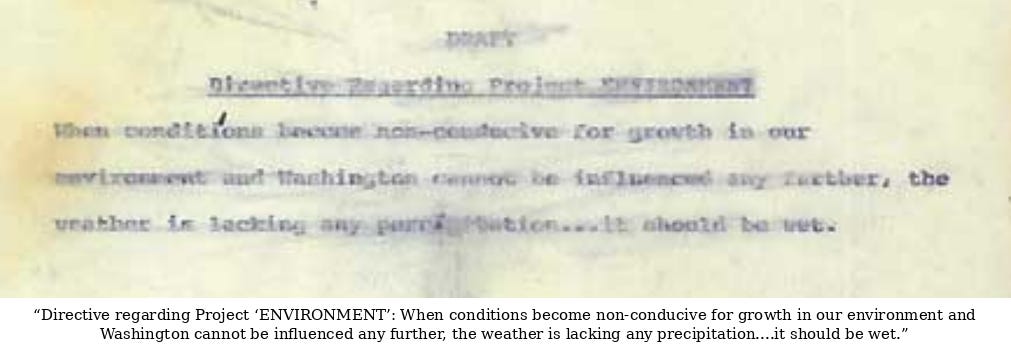
The language acquires considerably greater significance when read beside the earlier Forrestal document.
One purported Majestic source says the death of a senior program principal was “necessary and regrettable.” A separate purported source package, addressing a later President, states that his inquiries are something “which we cannot allow” and then appears to culminate in a coded directive for lethal action once Washington can no longer influence the situation.
The recurrence is not merely rhetorical. It describes the same functional problem at two different levels of authority.
Forrestal, if the documents are genuine, was an insider whose continued presence had become incompatible with the security requirements of the structure. Kennedy, if the S-1 package is genuine, was the constitutional superior whose inquiries had become incompatible with those same requirements, and the package purports to show not merely concern about those inquiries but the mechanism of escalation after influence failed.
Kennedy was subsequently assassinated.
Recent research by Geoffrey Cruickshank has identified Newton ‘Scotty’ Miler as the probable identity of S-1, an identification subsequently strengthened by the recovery of an unredacted version of the source’s cover letter. That identification does not authenticate the Majestic documents, but it changes their evidentiary character. Miler was a real senior CIA counterintelligence officer associated with James Angleton and occupied an institutional position unusually consistent with the profile claimed by the source.
That identification gains further significance from a separate paper attributed to S-1, Unidentified Flying Objects, the CIA, and Congress. The paper describes a UFO intelligence structure in which Congress could be excluded from operational detail, budgets concealed within other departments, briefings left substantially to the discretion of the Director of Central Intelligence, and oversight resisted through need-to-know and sources-and-methods restrictions. If the attribution is correct, the same source who represented the surviving files as connecting MJ-12 to Kennedy’s murder was also examining the constitutional control problem created when UFO intelligence became functionally insulated from congressional supervision.
The significance under Strategic Intent Analysis therefore lies in a recurrence considerably more specific than a collection of suspicious deaths. Across two purported insider streams, the alleged structure describes threats to its security boundary in functionally similar terms. In the Forrestal material, death is described as necessary. In the Kennedy material, the source explicitly says the surviving files connect MJ-12 to Kennedy’s murder; the memorandum identifies his inquiries as impermissible; and the directive package appears to culminate in lethal contingency language once Washington can no longer influence the situation.
That does not establish a single proven chain of command connecting Forrestal’s death to Kennedy’s assassination. It establishes something analytically more important: within the disputed internal record of the alleged program, lethal action appears not merely as an external theory imposed later by researchers, but as a possible security function of the structure itself.
That changes the meaning of the Kennedy evidence.
The surviving Majestic material also includes a memorandum discovered in the National Archives referring to an “NSC/MJ-12 Special Studies Project.” That physical archival document establishes that the terminology existed within a government record. It does not by itself establish what the project was. But it means the broader Majestic corpus cannot be reduced simply to a single anomalous document without considering the institutional terminology and relationships appearing elsewhere in the record.
The Kennedy question therefore sits at the intersection of several lines of evidence: a disputed source package explicitly represented as connecting MJ-12 to Kennedy’s murder; an opening memorandum identifying his inquiries as a threat that could not be allowed; a concluding directive that appears to contemplate lethal escalation after Washington could no longer influence events; the increasingly specific institutional identity of the alleged source; a separate archival reference to an NSC/MJ-12 Special Studies Project; and Kennedy’s subsequent assassination.
An official congressional investigation later concluded that Kennedy was probably assassinated as the result of a conspiracy while failing to identify its complete structure.
None of those elements, standing alone, resolves the UFO component. Taken together, however, they create a serious institutional question: what happens when the person threatening the secrecy boundary is the President?
Eisenhower’s warning becomes much darker at that point. He warned that the military-industrial and scientific-technological structure could acquire unwarranted influence over public policy. The constitutional assumption beneath the warning was that democratic government still possessed the capacity to recognize and constrain that influence.
The Legacy Program hypothesis raises the possibility of a later stage. What if influence becomes autonomy? What if the structure acquires its own custody, its own security apparatus, its own classified knowledge, its own contractor relationships, its own continuity across administrations and its own mechanisms of enforcement?
At that point the question is no longer whether the military-industrial complex influences the President. The question is whether the President can control it.
Forrestal may represent an early internal enforcement case. Kennedy may represent the first presidential test.
Trump may provide the modern recurrence. The control problem was examined directly in The President and the UFO Legacy Program: The Problem of Control, which considered Coulthart’s 2026 report that Trump had authorized a separate UAP interception and recovery effort for the express purpose of circumventing the inherited Legacy Program. That earlier analysis asked what it means when a President must create a new route to technology supposedly already controlled by his own government. The evidence considered here adds a darker dimension to the same problem: the reported effort to work around the Legacy Program is preceded by Trump’s reported concern that disclosure of the UFO issue could get him killed.
In June 2024, before Trump’s second term began, Coulthart publicly said that Trump had expressed concern that disclosure of the UFO issue could get him killed. That claim stood on its own at the time. In 2026, Coulthart separately reported that the Trump administration had authorized a new UAP interception and recovery effort designed to circumvent the Legacy Program.
The two reports arise in different contexts and two years apart. Their significance comes from the relationship between them rather than their contemporaneity.
A prospective President is reported to fear that disclosure could place his life at risk. Two years later, as President, he is reported to have concluded that the existing Legacy structure cannot simply be commanded through ordinary channels and instead must be circumvented.
If the latter report is accurate, there is already a control problem. If the earlier report accurately reflected Trump’s concern about the consequences of disclosure, the historical recurrence with Forrestal and Kennedy becomes difficult to ignore.
The sequence now extends across the entire postwar national-security state.
Forrestal helps build the new security architecture and, within the alleged Majestic record, becomes one of the original principals of its most sensitive UFO structure. An alleged internal document later describes his death as necessary to security.
Eisenhower, who presided over the maturation of the permanent military-industrial state, leaves office warning that the conjunction of military power, private industry and scientific authority threatens democratic control.
Kennedy appears in a separate stream of alleged internal records pressing into a protected UFO structure. The S-1 package is explicitly represented as connecting MJ-12 to his murder, describes his inquiries as something that cannot be allowed, and appears to culminate in a directive for lethal escalation after political influence has failed. Kennedy is assassinated.
Decades of UFO secrecy follow, accompanied by documented disinformation, alleged intimidation, disputed deaths and whistleblower testimony concerning human harm and possible murder.
A later President is first reported to fear lethal consequences from disclosure and then, two years later, reportedly builds a separate mechanism to circumvent the inherited Legacy Program.
That does not establish a single command chain running untouched from Forrestal through Eisenhower and Kennedy to Trump. It establishes something structurally more important: the recurrence of the same control problem across generations.
The control problem begins when delegation becomes functionally irreversible.
Legitimate classification protects information on behalf of the state. It cannot coherently evolve into a system through which the protected information escapes the effective control of the state itself. Secrecy requires a boundary, delegated custody requires accountability, and compartmentalization requires some point at which the whole can still be seen. Without that integrated level of sight, constitutional authority becomes increasingly formal while actual authority follows access.
The institutions created to protect the constitutional state may then acquire sufficient secrecy to escape constitutional supervision. Contractors employed by government become indispensable custodians. Scientific expertise becomes inaccessible to ordinary authority. Classification intended to protect national security protects the structure itself. Security mechanisms intended to protect information become mechanisms for controlling those who seek it.
If the witness record and disputed documentary record are substantially correct, the enforcement spectrum eventually reaches lethal action.
Eisenhower warned about unwarranted influence. The Legacy Program question is whether that influence became practical sovereignty.
If the architecture reconstructed from the evidence is substantially correct, the United States government does not fully control the Legacy Program. The structure appears instead to have embedded itself across portions of government, intelligence and the defense-industrial system while preserving enough autonomy to regulate access to itself.
Its functions are distributed. Compartmentation protects knowledge. Contractors protect custody. Air Force authorities appear repeatedly around aerospace control, transfer and access. DOE supplies specialized technical capability and a separate statutory information-security architecture. Intelligence structures collect information and protect the perimeter. Ridicule and disinformation control the public boundary. Retaliation and intimidation suppress disclosure from within. The witness record, the historical pattern and the disputed Majestic documents place lethal suppression at the far end of the same enforcement spectrum.
No single component needs to understand the whole. A scientist analyzes a material. A contractor manages a facility. A security officer enforces an access list. An Air Force official refuses a transfer. An intelligence officer protects a source. A lawyer reviews a narrow legal question. A congressional committee receives a briefing accurate within the limits of what it has been shown.
Each participant can tell the truth about the piece he sees while almost nobody possesses enough information to judge the whole.
The whole may therefore exist primarily in relationships.
That creates a weakness as well. Even concealment generates evidence.
A secret can hide its name. It is much harder to hide every relationship necessary for it to function. Objects must move. People require clearances. Contractors require authority. Facilities consume money. Transfers require decisions. Security classifications leave administrative traces. Scientific teams communicate. Personnel recur across programs. Records are created at institutional boundaries even when the underlying purpose remains concealed.
This is why the current presidential initiative matters.
Declassification is downstream. Discovery is logically prior to declassification.
A President cannot declassify a record whose existence has never been identified to him. Congress cannot oversee a contractual relationship it does not know exists. An investigator cannot request a compartment whose name is unknown. Traditional document searches therefore reproduce the weakness of compartmented oversight: they depend upon the map supplied by the structure being investigated.
A relational investigation would work differently. It would ask which unexplained institutional relationships repeatedly appear across the record. Why did the Secretary of the Air Force apparently possess transfer authority over material held by a contractor? What security instrument governed that relationship? Which personnel appear across supposedly unrelated UAP, aerospace, nuclear and intelligence programs? Which DOE facilities intersect with relevant contractors? Which classified expenditures cannot be adequately explained by the acknowledged mission? Which intelligence relationships connect collection with physical custody? Which nodes repeatedly disappear behind need-to-know restrictions?
It would not need to know the name of the Legacy Program. It could reconstruct the architecture from relationships the acknowledged system fails to explain.
This is where artificial intelligence could become unusually consequential under lawful presidential authority. Human investigators are naturally vulnerable to compartmentation. One team sees procurement records. Another sees security access. Another sees personnel histories. Another sees nuclear classifications. Another sees contractor relationships. Another sees intelligence reporting.
The structure survives because nobody integrates the whole.
A sufficiently capable system instructed to examine those relationships across agencies could identify recurring nodes and contradictions that no compartmented human investigator was positioned to see.
A conventional search asks whether program X exists. A relational investigation asks whether the absence of X actually explains the evidence. If independent systems repeatedly require the same unexplained institutional node to make sense of their relationships, the absence of a program name ceases to answer the question.
The system follows the contradiction.
That may be the fundamental weakness of a structure built upon fragmentation: the emergence of an investigator that cannot itself be effectively compartmentalized.
Trump’s PURSUE initiative is therefore potentially much more important than another declassification exercise. If it merely asks agencies to search for records they already recognize as UAP-related, the inherited map remains largely intact. If it reconstructs relationships, custody chains, authorities, transfers, contractors, clearances and classified scientific programs from above, it begins addressing the actual structural problem.
Discovery comes first. Only then can declassification have meaning.
Coulthart’s 2026 reporting suggests that the administration may simultaneously be attempting to solve the physical side of the same problem. Instead of forcing its way indefinitely downward through an inherited custody system, it is allegedly attempting to establish a new chain from the object upward: detect, intercept, disable, recover, secure and exploit material under institutions selected by the current administration.
A contemporary recovery would remove decades of inherited uncertainty. The President would know where the object came from, who recovered it, where it went, who handled it and which scientists examined it. That would produce something the older system may no longer reliably provide: control.
But it creates a final paradox.
Any newly recovered object would require extraordinary security. It would require scientists, secure facilities, intelligence analysis, specialized engineering and probably private contractors. Foreign acquisition would become an immediate concern. Military implications could justify substantial classification. Every practical necessity surrounding the new recovery could therefore reproduce the architecture that made circumvention necessary.
A parallel program could defeat one Legacy Program and gradually become the next one.
The answer cannot simply be different custodians. There must remain some constitutional point at which the whole can be seen.
That is the unresolved problem inside Eisenhower’s warning. Permanent military capability may be necessary. Private technical expertise may be indispensable. Scientific specialization may be unavoidable. Secrecy may sometimes be justified. None of those necessities, however, can be allowed to create sovereign power outside the constitutional system that authorized them.
Delegated authority cannot coherently become independent authority. Custody cannot silently become practical ownership, classification cannot become immunity from superior control, and security cannot become institutional self-preservation.
Nor can presidential authority remain meaningful if pressing against the boundary carries the possibility of lethal consequence.
Strategic Intent Analysis therefore asks the question institutional labels avoid.
Who actually controls it?
The answer may explain why seventy years of searching for the UFO Legacy Program as though it were a conventional secret office have produced so little.
The United States may not have a UFO Legacy Program.
The UFO Legacy Program may have parts of the United States government.
And if the Forrestal, Kennedy and Trump evidence ultimately means what the pattern suggests, Eisenhower’s warning may have reached an endpoint even he did not state explicitly: a military-industrial and scientific-security structure capable not merely of influencing presidential power, but of defining its practical limits—and, at the furthest edge of its enforcement system, of using lethal action to preserve those limits.