

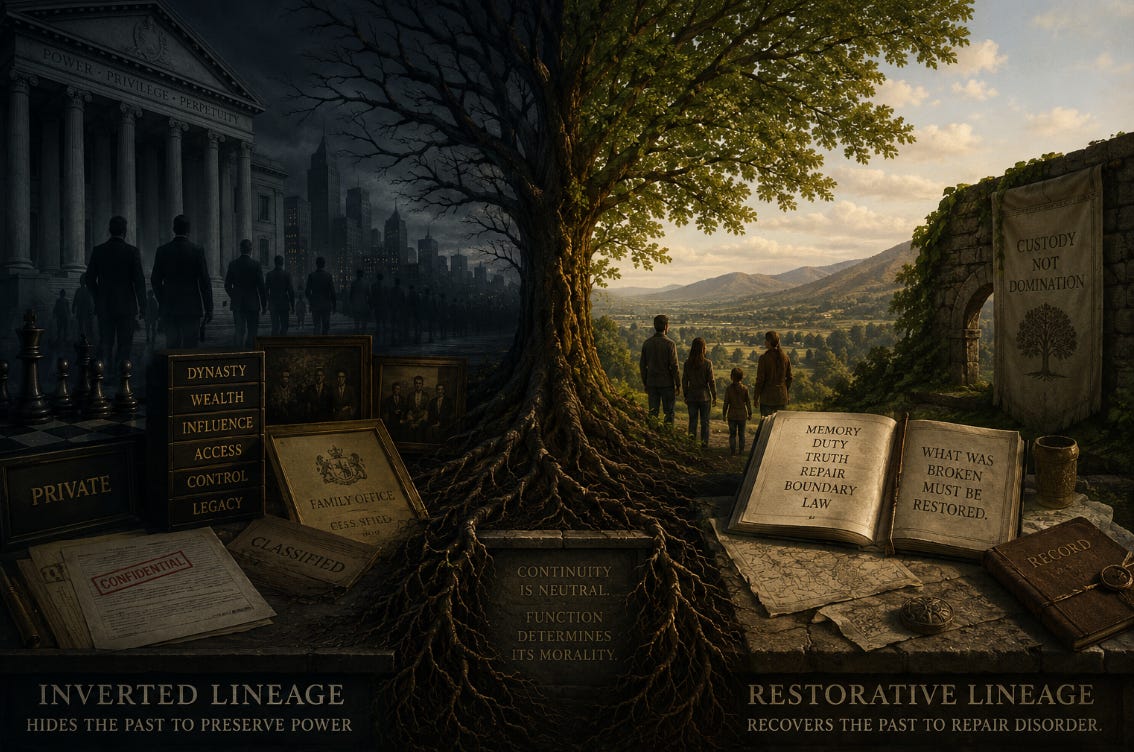
The modern world speaks as though lineage no longer matters. It teaches the public to think of human beings as isolated individuals, detached from ancestry, place, memory, and obligation. Identity is treated as preference, mobility as freedom, and rootlessness as progress. The past is described as something overcome. The family is treated as a private arrangement. Inheritance is reduced to property. The official language of modern life is procedural, individual, administrative, and abstract.
Yet the structures of power do not behave this way.
At the highest levels, lineage remains carefully preserved. Names matter. Families matter. Schools matter. marriages matter. inherited wealth matters. patronage matters. old networks matter. Titles, trusts, foundations, family offices, estates, boards, political dynasties, diplomatic relationships, intelligence networks, clerical successions, fraternal orders, and elite educational pipelines all preserve continuity across time. The public is told that lineage is irrelevant while the ruling structures of the world continue to organize themselves through lineage with extraordinary care.
The contradiction is visible wherever power survives more than one lifetime. Monarchies preserve bloodline legitimacy openly. Aristocratic families preserve land, title, and social position through inheritance, marriage, trust structures, and institutional habit. Banking and industrial families preserve influence through family capital, private networks, foundations, and succession. Political families preserve name recognition, donor relationships, party access, media familiarity, and governing credibility across generations. Elite schools and universities do not merely educate individuals. They transmit social continuity, common language, institutional access, and class recognition. The surface doctrine is merit. The deeper structure is inheritance.
Lineage does not explain everything. Nor does every person born into a lineage participate consciously in a hidden design. Most do not. The point is structural rather than accusatory. A society that publicly denies lineage while privately preserving it within its highest institutions has not abolished lineage. It has hidden the mechanism from ordinary view.
The same systems that encourage ordinary people to treat ancestry as sentiment, nostalgia, or embarrassment preserve their own genealogies, estates, names, schools, marriage networks, trusts, and succession lines with extraordinary care.
This is why lineage must be examined through function rather than sentiment. Under The Method of Structural Inquiry, the inquiry begins with what a structure does, not how it describes itself. Lineage should be approached in the same way. It is not enough to ask whether ancestry feels meaningful, whether genealogy is interesting, or whether particular families are impressive. The relevant question is functional. Does lineage preserve power, secrecy, access, legitimacy, and domination? Or does it preserve memory, duty, repair, boundary, and lawful continuity?
Lineage is not inherently good or evil. It is a structure of continuity. It is one of the means by which memory, property, obligation, access, duty, secrecy, trauma, vocation, and unfinished work pass through time. Lineage does not determine the moral quality of a person. It does not make anyone superior. It does not excuse conduct. It does not confer truth. But it carries continuity, and continuity is one of the most important facts in any structured world.
A world that denies lineage to the many while preserving it among the few has not abolished lineage. It has monopolized it.
Inversion uses lineage to preserve domination. It treats inheritance as entitlement, bloodline as legitimacy, secrecy as protection, continuity as control, and access as birthright. It hides behind modern language while preserving older forms. It speaks of equality while maintaining dynastic advantage. It praises merit while transmitting position. It dissolves the memory of ordinary people while keeping its own records, names, symbols, marriages, properties, and succession lines intact. It benefits from a population severed from ancestry because a severed people is easier to administer. A person without memory is easier to rename. A family without continuity is easier to displace. A nation without inheritance is easier to reconstruct from above.
The American example is especially revealing because the United States formally rejected hereditary office while repeatedly reproducing inherited legitimacy in practice. The Presidency has not been drawn at random from the population. It has emerged disproportionately from colonial families, legal and financial networks, elite schools, political houses, and social strata capable of preserving access across generations. The Adamses, Roosevelts, Kennedys, Bushes, Clintons, and other political families did not operate merely as isolated citizens who happened to win elections. They functioned inside accumulated structures of name recognition, donor access, party machinery, institutional familiarity, and inherited credibility. As argued in No Kings — But Inheritance Remains, the republic abolished kingship as a legal form, but the operating logic of inherited legitimacy remained.
That pattern is not limited to politics. It appears wherever power becomes durable enough to outlast individual officeholders. A family that controls land for centuries is not merely wealthy. It is continuous. A banking family whose name remains attached to institutions, capital networks, and advisory influence across generations is not merely successful. It is continuous. A school that repeatedly places its graduates inside government, finance, law, intelligence, media, and cultural authority is not merely educational. It is transmissive.
The central fact is not blood alone. It is continuity.
General George S. Patton offers a useful example of lineage experienced as active continuity. For many Americans, Patton remains the archetypal warrior: not merely a successful commander, but a man who seemed to inhabit war as inherited memory, duty, and command. He did not understand himself simply as an individual soldier who happened to inherit a family name. He believed he could remember his presence at old battlefields and saw himself as standing inside a long martial current, bound to earlier warriors, earlier commands, and a continuing duty that reached beyond one lifetime. Whether read literally or symbolically, the structural point is the same: Patton experienced lineage as function. It gave him not simply ancestry, but role, memory, burden, and command.
Restoration uses lineage differently. It does not ask what blood entitles anyone to possess. It asks what has been carried forward that must be remembered, purified, repaired, and returned to lawful service. Restorative lineage is not crown. It is trust. It is not superiority. It is burden. It does not claim the right to rule others. It receives the duty to restore what has been broken and guard what has been profaned.
This distinction matters because a coherent world must contain mechanisms of correction. If disorder could only accumulate, then the world would not be lawful. If inversion could preserve itself across generations while restoration had no corresponding means of continuity, falsehood would possess a structural advantage over truth. That cannot be the final order of a world grounded in truth, law, and coherence. A lawful world must contain ways by which memory returns, broken continuity is repaired, and correction enters time. Otherwise continuity would belong only to the forces that captured it. That would make restoration dependent on accident, while domination retained inheritance, memory, and structure. Such an arrangement would not be coherent. A world ordered by law must permit truth to return through lawful channels as well.
As argued in The World Is Structural and Created, creation is not merely a story about origins. It is a description of present reality: a world shaped by form, constraint, recurrence, and intelligibility. In such a world, continuity is not incidental. Structures persist because something carries them forward. If false structures can transmit themselves through lineage, institution, property, ritual, and name, then lawful structures may also transmit correction through memory, duty, inheritance, and restored obligation.
Lineage may be one of those ways.
This does not make lineage automatically good. It plainly is not. Lineage can carry corruption, trauma, pride, secrecy, domination, and inherited blindness. That is why it cannot be ignored. A structure capable of carrying corruption is also capable of carrying repair. The question is whether lineage is received unconsciously as inheritance, exploited strategically as power, or restored lawfully as responsibility.
The inversion side understands continuity. It knows that power is strengthened when it survives beyond a single lifetime. It knows that institutions become more durable when families, names, trusts, orders, and networks carry them forward. It knows that memory is power. It knows that hidden continuity allows visible change to conceal deeper persistence. It knows that if the public can be taught to forget, those who remember will rule.
The restorative side must recover continuity without imitating domination. That is the narrow path. To reject lineage entirely leaves one of the deepest structures of continuity in the hands of those who have already captured it. To idolize lineage repeats the same error in another form. The lawful recovery of lineage requires a third position: lineage matters because continuity matters, but continuity is justified only when it serves truth, law, memory, repair, and protection of the living order.
This is also the pattern described in The Corruption of Order. False systems do not always abolish natural structures. Often they overlay them, capture them, and redirect them toward false ends. Law remains, but becomes procedure without justice. Medicine remains, but becomes intervention without healing. Education remains, but becomes credentialing without formation. Finance remains, but becomes extraction without stewardship. Lineage follows the same pattern. It is not abolished. It is corrupted, hidden, monopolized, and used selectively by those who understand its power.
The proper response is not to deny lineage, but to restore its rightful function.
This is why the priestly form of lineage is so significant as a structural example. Properly understood, priestly lineage is not personal elevation. It is custodial function. Its purpose is to preserve distinction: sacred and profane, clean and unclean, lawful and unlawful, true and false, living order and inversion. The priestly function does not exist to dominate the people. It exists to guard the vessel, teach law, preserve boundary, and prevent profanation. When that function is corrupted, it becomes one of the most dangerous forms of control. When restored, it becomes one of the clearest forms of correction.
That is why The Priestly Schism and the DNA of the Cohanim matters within this wider inquiry. The point of that essay was not to turn lineage into certainty or status. It examined the possibility that priestly continuity preserved a real fracture over law, legitimacy, sacred order, and institutional corruption. The deeper significance is functional. A priestly lineage, in its lawful form, does not exist to possess sacred authority. It exists to guard the conditions under which sacred authority remains lawful.
The same distinction applies more broadly. A family line may carry wealth, but wealth is not the deepest inheritance. A name may carry reputation, but reputation is not the deepest inheritance. A genetic line may carry ancestry, but ancestry is not the deepest inheritance. The deeper inheritance is the unresolved structure carried through time: what was broken, what was hidden, what was profaned, what was faithfully preserved, and what must now be repaired.
Lineage is therefore not merely backward-looking. It is not nostalgia, ancestor worship, or romantic attachment to the past. It is the recognition that the present is not self-created. Each person arrives inside an existing structure of memory, debt, gift, wound, law, and possibility. A truthful life does not invent itself from nothing. It receives what has come down, tests it, rejects what is corrupt, restores what is lawful, and transmits forward what should not be lost.
Modernity resists this because lineage imposes obligation. A rootless person can be managed as a consumer, voter, employee, patient, user, or administrative subject. A person who remembers lineage is harder to reduce. Such a person stands in relation to ancestors, descendants, land, household, duty, and name. That does not make the person automatically wise or good. But it gives the person a location in time. It makes certain forms of manipulation more difficult because the person is no longer merely present-tense material for the system to reorganize.
This also explains why lineage and institutional inversion are connected. Institutions that have severed themselves from law often seek to sever people from memory. A population detached from family continuity, local responsibility, inherited obligation, and sacred boundary becomes more dependent on institutional identity. The state, corporation, school, media system, and administrative apparatus then supply substitute memory. They tell people who they are, what matters, what may be questioned, and what must be forgotten.
Lineage interrupts that process. It says that identity does not begin with institutional classification. It says that memory precedes administration. It says that duty may come from a deeper source than policy. It says that a person may be answerable to ancestors and descendants as well as to present authority. It says that history is not merely content to be managed, but continuity to be received and corrected.
This is why lineage is dangerous to inverted systems. Not because every lineage is good, and not because ancestry guarantees virtue, but because restored lineage can reconnect people to obligations that institutional systems did not create and cannot fully control. A person who receives lineage lawfully may begin to ask different questions. What was severed? What was concealed? What duty was abandoned? What inheritance was corrupted? What must be restored? What must not be transmitted further?
Those are not questions of pride. They are questions of correction.
The lawful recovery of lineage therefore requires humility. A person does not choose his ancestors. He does not author the line into which he is born. He receives it. The receiving may include honor, shame, blessing, loss, confusion, trauma, and mystery. The moral question is not whether the lineage is impressive. The moral question is what the person does with what has been received.
This is where lineage becomes restorative rather than merely descriptive. A restored lineage does not preserve everything. It purifies. It does not repeat every inherited pattern. It judges. It does not hide ancestral corruption to protect family pride. It exposes and repairs where repair is possible. It does not use ancestry to elevate the self. It receives ancestry as work.
The phrase “restorative lineage” names this structural possibility. It describes continuity returned to lawful function. Memory, inheritance, ancestry, name, family, and transmission are brought under truth rather than pride. The past is not worshipped, but neither is it discarded. It is received, tested, purified, and carried forward only insofar as it can serve correction.
That is the opposite of inverted lineage. Inverted lineage hides the past to preserve power. Restorative lineage recovers the past to repair disorder. One treats continuity as private advantage. The other treats continuity as public responsibility. One turns inheritance into control. The other turns inheritance into custody. The distinction is not in the fact of descent, but in the function descent is made to serve.
The modern denial of lineage has therefore produced a deep imbalance. Those who use lineage for domination have preserved it. Those who might use lineage for restoration have often been taught to dismiss it. The result is not equality. It is asymmetry. One side remembers strategically while the other forgets morally. One side preserves its lines while teaching others to dissolve theirs. One side transmits obligation internally while presenting rootlessness as liberation to everyone else.
Correction requires that this asymmetry be named.
Lineage does not need to be inflated. It needs to be restored to its proper scale. It is not the whole of identity. It is not the whole of truth. It is not the whole of law. But it is one of the structures through which truth, law, and coherence may move across time. When captured, it preserves inversion. When restored, it may carry correction.
This is why lineage belongs within structural inquiry. It is not a private curiosity separate from institutional analysis, cosmology, law, or restoration. It is one of the mechanisms by which the world carries form forward. If the world is structured, then continuity matters. If continuity matters, then lineage cannot be irrelevant. If lineage can be inverted, then it can also be restored.
The public fiction that lineage no longer matters conceals the private fact that the world still runs on it. The necessary correction is not to enthrone lineage, but to redeem it. Lineage must be removed from secrecy, pride, and domination, and returned to memory, duty, repair, and lawful custody.
A lawful lineage is not a throne. It is a trust.
And a trust is judged not by what it receives, but by what it preserves, repairs, and transmits.
The method, subjects, and selected essay index for Strategic Intent Analysis are organized at strategicintentanalysis.com.