

This essay is part of the Strategic Intent Analysis archive at strategicintentanalysis.com. The method is simple: begin with what is observable, then test the story against the structure beneath it.
The first error is evidentiary. NASA is treated as the baseline, while direct observation is treated as the claim requiring permission. That reverses the burden.
The world is not first encountered as a theory. It is encountered as ground, water, horizon, sky, light, direction, weight, motion, and recurrence. Water rests level. Buildings rise vertically. People stand in coherent relation to down. Surveyors establish grade. Pilots operate in a navigable sky. The horizon remains a stable boundary of perception. The heavens appear above. The stars return in ordered cycles. Nothing in ordinary experience directly discloses a spinning exterior surface moving through compounded motions at extreme speeds. Ordinary experience presents a stable realm beneath a visible and ordered heaven.
Official cosmology asks humanity to disbelieve that ordinary encounter.
That request is not modest. It requires people to treat the world encountered by the body, the eye, the instrument, the builder, the navigator, and the farmer as fundamentally misleading. It places the visible world under institutional custody. The public is taught that what appears level is curved, what appears stable is in violent motion, what appears above is not truly above, what appears ordered is accidental scale, and what appears directly intelligible must be reinterpreted through diagrams, equations, agencies, and ridicule-backed instruction.
The archive has already developed several parts of this problem. The Flatness of Water examined water as direct structural witness: water establishes level, quietly and repeatedly, wherever it is free to rest. The Bee and the Observed Sky showed that living systems orient through the world they encounter before any abstract model is imposed upon them. The Axis Mundi: Polaris, the Turning Sky, and the Geometry of the Year and The Sky as Clock examined the visible heavens as center, recurrence, rhythm, time, and orientation rather than empty background. The common thread is simple: observation precedes explanation. A model remains legitimate only while it remains answerable to observed structure.
That is the standard NASA cannot be permitted to escape.
The Sun and Moon deepen the same problem. They appear as paired luminaries. They are the two dominant lights of the visible sky. They alternate day and night, appear in matched scale, govern the human reading of time, and permit eclipse relation by that same apparent equality. Across cultures, that observed pairing has carried an interpretive polarity: solar and lunar, active and reflective, masculine and feminine. That symbolic reading is not the observation itself. The observation is the paired luminary order.
Official cosmology dissolves that relation. The Sun becomes a remote nuclear furnace. The Moon becomes a dead rock. Their visual pairing becomes coincidence. Their symbolic and biological relation becomes superstition. Their matched apparent size becomes mathematical accident produced by radically different sizes and radically different distances. The public is asked to accept that one visible ruler of the sky is approximately ninety-three million miles away, while the other is far nearer, and that their equality in the human sky carries no structural meaning. Distance is not seen. It is supplied by the model. When ordinary observers can record the Sun as a clear circular luminary with consumer equipment, the observation itself does not disclose an object ninety-three million miles away. NASA’s cosmology depends on the public confusing model-assigned distance with observed fact.
The planetary lights carry the same lesson. Older observational traditions did not encounter the heavens as empty distance. They encountered ordered motion. Tycho’s diagrams and other earth-centered representations preserve the visible paths of the wandering lights as they appear from the human position: loops, turns, recurrences, and patterned forms around an observed center. These were not primitive cartoons. They were disciplined attempts to preserve the motion actually seen.
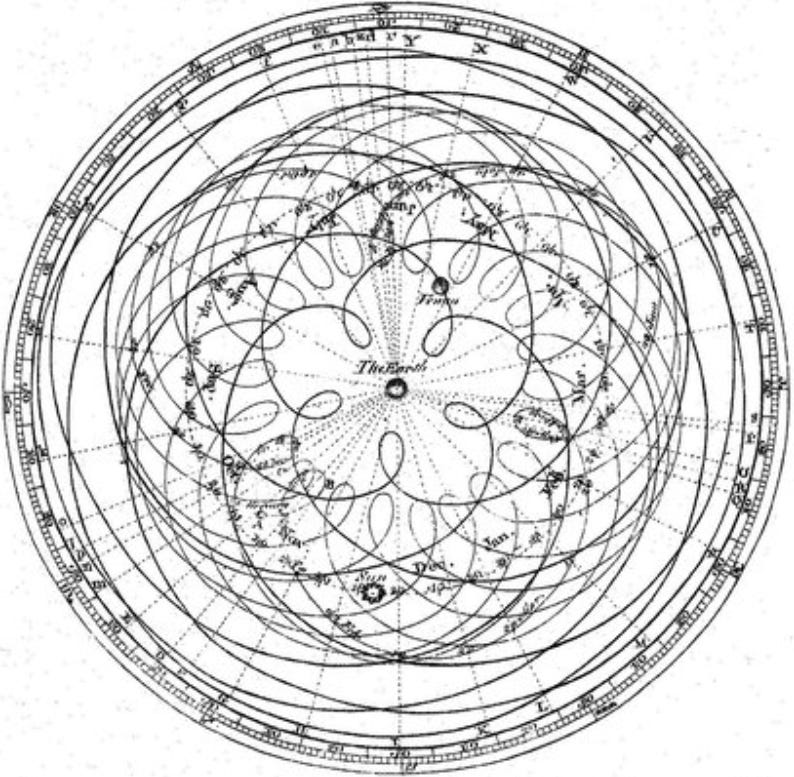
Drawn over time, those paths resemble resonant cymatic forms: loops, petals, nested circles, phase relationships, and harmonic closure. Repeated motion under constraint produces pattern. The visible heavens do not behave like arbitrary lights scattered in a void. They move as an ordered field, generating forms that look less like accident than resonance. Modern cosmology strips that pattern of meaning by relocating the observer and treating the observed paths as mere appearance. But appearance is where observation begins.
This essay does not attempt to litigate every observational question concerning water, horizon, motion, the moon, the sun, the stars, Antarctica, engineering, or the structure of the visible heavens. Some have already been examined elsewhere in the archive. Others require separate treatment. The question here is institutional: how did direct observation become subordinate to official cosmology as civil reality?
NASA is the public-facing control layer of the official sky. It converts an imposed cosmology into childhood education, public imagination, civic authority, scientific prestige, visual memory, and social permission. It supplies the authorized images by which modern people are taught to imagine where they are.
The public does not know the official world through direct inspection. It knows it through photographs, composites, animations, classroom globes, mission patches, launches, countdowns, press conferences, documentaries, museums, textbooks, astronaut testimony, agency declarations, and the repeated visual grammar of a ball suspended in darkness. The child is not first asked to observe the world carefully. The child is shown an image and told that the image is home. From that point forward, observation must report to the image.
A control layer does not merely answer questions. It determines which questions sound sane.
Permission to Observe examined the difference between seeing and feeling permitted to see. A thing may be plainly visible and still remain socially unobserved if education, prestige, ridicule, and authority stand between perception and acknowledgment. Humans Require Social Permission developed the same problem at the level of group behavior. Private recognition and public alignment are different acts. People may perceive a contradiction long before they say so, because speech carries cost: status, belonging, reputation, employment, and professional safety.
That explains the power of NASA’s public role. Once the official image has entered public imagination, dissent can be controlled before evidence is considered. A person who says the observed world appears level, stable, ordered, and enclosed is not treated as a witness. He is treated as socially defective. The system does not need to defeat direct observation in open inquiry if it can make direct observation embarrassing to state. Permission replaces perception. Authority replaces encounter. The classroom replaces the horizon.
Apollo is the mythic proof-event of the modern sky. The public was told that men left the earth, crossed the heavens, walked upon the moon, looked back, photographed the world as a globe, and returned. That story sealed official cosmology emotionally. It gave the public a ritual image of escape, ascent, conquest, return, and institutional triumph.
If Apollo fails, the structure becomes reviewable: space imagery, satellite narratives, Mars missions, the International Space Station, Antarctica, education, contractor secrecy, intelligence involvement, and public consent. The moon narrative is guarded because it is load-bearing.
The archive’s method matters here. The Method of Structural Inquiry states the discipline plainly: official narratives are evidence, not verdicts. They must be tested against observation, accepted facts, omissions, incentives, consequences, repeated behavior, and coherence. NASA’s claims are not exempt because NASA is prestigious. Agency authority is not truth. Institutional repetition is not proof. A public image is not reality.
Truth Needs a Coherent Structure explains why this matters in a controlled information environment. Truth does not prevail merely because it exists. It must remain attached to evidence, method, relation, and retrieval. False systems survive by fragmentation: one observation is isolated, one anomaly dismissed, one technical contradiction explained away, one institutional omission treated as administrative noise. Coherence rejoins what suppression keeps apart.
NASA’s cosmology depends on fragmentation. Water is treated separately from horizon. Horizon is treated separately from motion. Motion is treated separately from aviation. Aviation is treated separately from surveying. Surveying is treated separately from celestial observation. Celestial observation is treated separately from Apollo. Apollo is treated separately from NASA’s occult history. NASA’s occult history is treated separately from Collins Elite material. Collins Elite material is treated separately from UFO deception and state secrecy. Each piece is domesticated by isolation. Read together, the structure becomes harder to avoid.
The public cosmology is an ontology. It gives the public a sterile secular universe: dead matter, empty space, distant bodies, mechanical forces, and humanity alone beneath institutional science. The heavens are stripped of order, boundary, hierarchy, sign, agency, polarity, and spiritual danger. The sky becomes distance. The stars become remote suns. The moon becomes a rock. The world becomes an object. Creation becomes mechanics.
Yet NASA’s own public form is saturated with ritual. The launches are rites of ascent. The countdown is liturgy. The astronauts are initiates. The capsule is a vessel of passage. The mission patch is heraldry. The command center is temple administration. The broadcast is public sacrament. The flag is planted as consecration. The scripted phrases become civic scripture. The whole sequence is ritualized boundary-crossing presented as engineering.
The naming system makes the contradiction impossible to miss: Mercury, Gemini, Apollo, Saturn, Artemis, Orion. These are divine messengers, twins, solar gods, titans, lunar goddesses, hunters, archetypes, and celestial powers. NASA tells the public that ritual is superstition while using ritual to install public cosmology. It tells the public that the heavens are dead mechanics while naming its missions through gods, ascent, initiation, and symbolic conquest.
That is institutional form revealing hidden content.
The Occult History of NASA developed this directly. The American space age emerged from a field in which experimental rocketry, military intelligence, elite symbolic orders, ritual practice, occult philosophy, Nazi technical transfer, Cold War mythology, and anomalous-contact management repeatedly intersected. Jack Parsons connected early rocketry to Thelemic ritual. Operation Paperclip moved German rocket expertise, secrecy habits, and moral compromise into the American aerospace-security state. NASA’s mythological naming, symbolic imagery, Masonic associations, astronaut ritual, and threshold language did not appear in an empty context. The public was shown science leaving myth behind. The deeper record shows myth, ritual, secrecy, and technology mechanized together.
The Collins Elite material sharpens the contradiction. The Collins Elite and the Architecture of Deception examined a reported current inside the defense and intelligence world that treated anomalous phenomena as deception, ritual contact, hostile non-human intelligence, spiritual intrusion, and danger to the soul. Deception and UFOs: The 1998 Collins Elite Report Reconstructed reconstructed that framework more sharply: the extraterrestrial explanation may itself be a mask; the central issue may be what the phenomenon is doing to human perception, belief, consent, and allegiance.
If the Collins Elite material is read correctly, then the public cosmology becomes more than an incomplete model. It becomes part of a cover story. It tells ordinary people that the heavens are empty distance while concealed power behaves as though the hidden architecture of reality is real, dangerous, and usable.
Under that reading, NASA’s role is to replace the living heavens with an image-system. It converts an ordered, charged, harmonic, and possibly bounded realm into managed scenery. It gives the public rockets, planets, astronauts, and classroom certainty while other parts of power concern themselves with gates, access points, ritual exchange, and forces the public is told do not exist. The result is managed blindness.
The engineering question belongs here because it tests the public model against operation. Practical systems must be designed around the world they actually encounter. Engineering does not build from mythology. Machines either work or fail. Aircraft fly or they do not. Weapons hit or miss. Survey lines close or they do not. Guidance systems stabilize or drift. Ships navigate or lose position. Radar either returns useful information or it does not. Civil works either meet level, grade, alignment, and distance, or they do not. Public cosmology may be taught as doctrine, but machines are governed by operational truth.
Aviation, navigation, long-range fire control, railgun and artillery systems, radar, telecommunications, surveying, tunneling, canals, bridges, pipelines, and ground-station operations cannot be sustained by vague public storytelling. They require real geometry, real distance, real atmosphere, real tracking, real correction, and models that work under load. The official explanation is that flat, stable, non-rotating assumptions are merely local approximations. That explanation becomes less credible as the allegedly false model keeps doing actual operational work across major domains.
If the public model and the working model are genuinely contradictory, the working model reveals where reality is being encountered.
No whistleblower is required for the central claim. A whistleblower may confirm a hidden record, but direct observation does not wait for insider permission. If an agency asks humanity to reject the visible world, the burden rests on the agency. The public does not need a former employee to tell it that water rests level, that the Sun and Moon appear as paired luminaries, that the heavens return in ordered cycles, that planetary lights trace harmonic patterns from the observer’s position, or that NASA teaches these observations through mediated images rather than direct encounter. Truth is not made true when an insider says it. It is already true if it corresponds to the world.
Silence is structurally produced through career risk, clearance risk, pension risk, reputational destruction, family pressure, professional language, social ridicule, and childhood education that installs the premise before most people experience it as a premise. A system that can make direct observation professionally unspeakable does not need to answer direct observation honestly.
NASA cannot sustain this alone. The institutional network extends through aerospace and defense contractors, universities, observatories, telemetry contractors, imaging units, communications networks, intelligence agencies, publishers, museums, curriculum designers, media platforms, and credentialing bodies. NASA is the public face, the ceremonial altar, the priesthood of the official sky. It is not the whole temple.
The injury is not technical. The public was not merely given an incorrect diagram. People were misled about where they are, what they are, what the heavens are, and what kind of reality they inhabit. Their children were taught falsehood as fact. Their taxes funded the machinery of deception. Their direct observations were mocked. Their language was inverted. Their relationship with creation was mediated by institutions that claimed authority over the sky itself.
That is existential theft.
A lawful society cannot govern this way. Truth precedes permission. No agency, contractor network, secrecy system, curriculum authority, or credentialing structure can determine what is true. Institutional rules may control access, classification, employment, publication, and reputation, but they cannot convert falsehood into reality. A system that precludes evaluation has no lawful epistemic authority. It substitutes permission for judgment.
Public authority cannot lawfully depend on managed perception at the scale of reality itself. Government cannot use public money, public education, agency prestige, classified compartmentalization, contractor secrecy, and media enforcement to impose a cosmology that requires people to disbelieve the observed world. If truth, natural law, and coherence are the governing standards of legitimate inquiry, NASA’s cosmology must be evaluated against observation, recurrence, operational reality, and coherent inference. It cannot exempt itself by declaring the question settled.
If this institutional-behavior case is taken seriously, lawful inquiry would require preservation of records, audit of original imagery and telemetry, review of contractor relationships, protection for witnesses, correction of false educational materials, disclosure of intelligence interfaces, and public accounting for money spent in the name of a cosmology imposed on children as fact. The purpose is not chaos. It is restoration of inquiry.
The charge is that NASA has functioned as the public control layer for a deliberately imposed cosmology while deeper power treated the hidden structure of reality as real, dangerous, and usable.
That is the indictment.
NASA’s greatest product was not exploration. It was managed perception.
The first act of restoration is simple: return the burden of proof to the institution that asked humanity to disbelieve the world beneath its feet.