

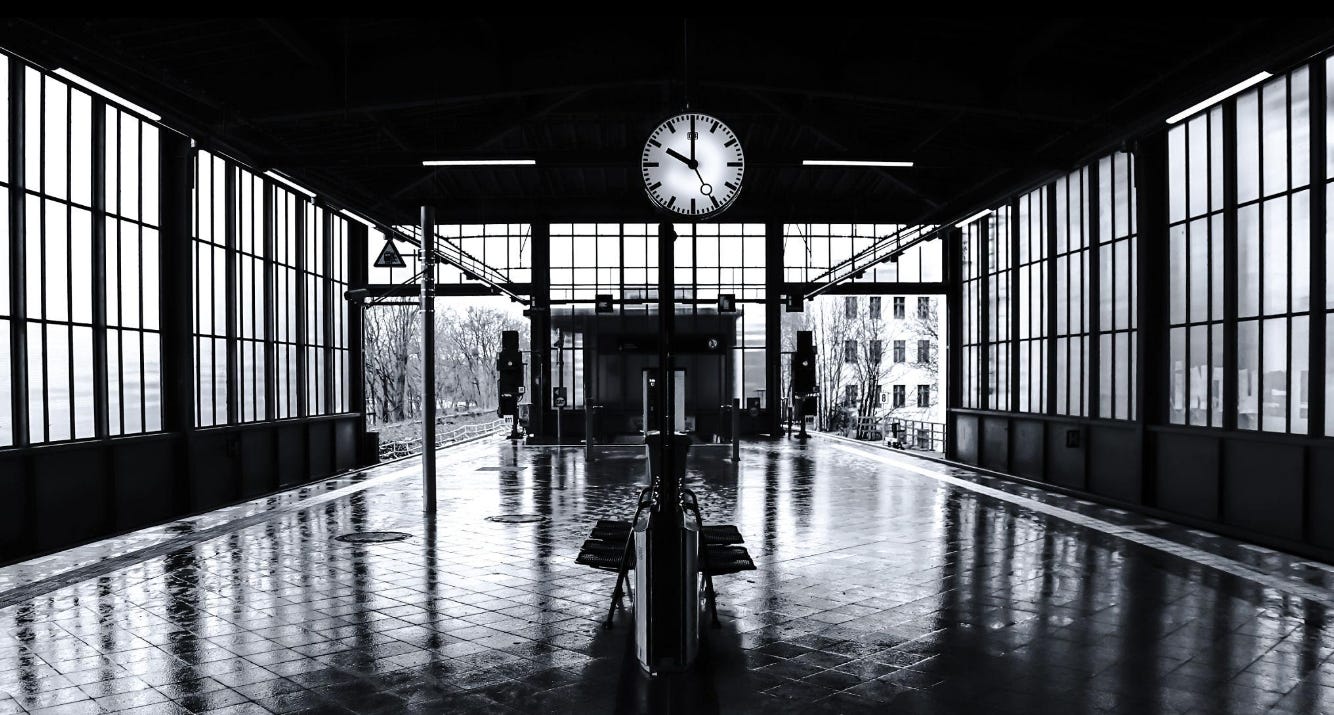
Time is not one thing. Human beings live within at least three distinct forms of it, and much of modern confusion begins when those forms are treated as interchangeable. Natural time is the recurring order visible in light, season, temperature, growth, and return. Biological time is the body’s internal participation in that order through sleep, waking, hunger, mood, hormone rhythm, recovery, and attention. Administrative time is something else again. It is time organized for coordination, scheduling, measurement, compliance, and control. These forms can overlap for a while, but they are not the same. When they are forced too far apart, systems may continue functioning in a narrow technical sense while human life becomes strained, disordered, and less coherent.
Natural time is older than every calendar and more stable than every institution. Morning begins with light. Evening arrives with its withdrawal. Winter contracts growth. Spring releases it. The year unfolds through patterned transition rather than through arbitrary numerical division. Human beings did not invent this order. They encountered it. For most of history, activity remained closer to it. Work followed daylight. Travel responded to season. Planting, harvest, rest, and storage all reflected recurring environmental conditions rather than mechanically uniform schedules. Time was not yet a fully abstract grid laid over life. It was recognized through the repeating behavior of the world.
Biological time is the body’s expression of that larger order. Human beings do not merely observe rhythm from the outside. They live inside it. Sleep propensity changes across the day. Hormone release follows temporal pattern. Appetite, digestion, energy, body temperature, immune function, and mental sharpness all vary with light exposure and daily timing. These rhythms are not marginal details. They are part of the body’s organizing structure. Modern circadian research describes some of this in technical terms, but the underlying recognition is older and more direct than the science. Most people know, without needing a laboratory to tell them, that bright light late at night disturbs sleep, that waking in darkness for long periods feels different from rising with daylight, and that prolonged irregularity in sleep and activity produces a peculiar kind of exhaustion that is not solved by discipline alone.
That matters because living systems are not stabilized by abstraction. They are stabilized by rhythm. A person can compensate for temporal misalignment for quite a long time. Stimulants can force alertness. Artificial light can delay sleep. Stress can suppress appetite. Obligation can override fatigue. But compensation is not the same as coherence. The cost often appears gradually rather than dramatically. Sleep becomes shallower. Recovery slows. Mood becomes less stable. Weight regulation becomes harder. Attention narrows. The person remains operational, but less resilient. Much of what is now described as ordinary tiredness, burnout, fog, or low-grade depletion is not always the result of dramatic illness. Often it is the cumulative effect of living too long against the rhythms the body uses to regulate itself.
Administrative time begins as a practical instrument. Large systems require coordination. Trains must run on schedules. Courts assign hearings. Schools open at fixed hours. Markets, payroll systems, hospitals, factories, digital networks, and transport systems all depend on shared temporal references. In that limited sense, administrative time is not inherently pathological. It allows strangers to coordinate across distance. It permits complex societies to operate at scale. The problem begins when this instrument of coordination presents itself as the true measure of life. Then the clock stops serving reality and begins reorganizing it.
That transition did not occur all at once. For a long period, clocks still attempted to mirror the solar cycle. They described a world whose deeper temporal reference remained environmental. The major structural shift came when industrialization required more exact and more impersonal forms of synchronization. Railways, telegraphy, factory labor, and large urban systems made local solar variation inconvenient. Standardized time zones replaced the older relation between clocks and the sun. Noon no longer meant the point at which the sun stood highest overhead in a particular place. It meant the moment a standardized device indicated twelve. In that shift, clocks ceased merely to describe temporal reality and began to govern it. This argument expands on Industrial Time: When Clocks Replaced the Sun, where I traced the historical mechanism by which clocks moved from rough approximations of solar rhythm to instruments of industrial coordination, making administrative time socially dominant rather than merely technically useful.
That historical displacement matters because it explains how administrative time became ordinary. The issue is not simply that clocks exist. It is that social life was reorganized around their authority. Factories required workers to arrive at hours independent of seasonal light patterns. Electric lighting extended productive activity beyond the natural limits of daylight. Schools trained children to move, stop, sit, and shift attention by bell. The working day became fixed even as the natural cycle of light continued to expand and contract across the year. Administrative time proved efficient because it made life legible, measurable, and schedulable. But that same efficiency came from reducing the body’s freedom to respond to changing conditions.
This is where the distinction between biological time and administrative time becomes more than theoretical. The body continues to organize itself through light, darkness, regularity, and seasonal variation. Administrative systems, by contrast, prefer uniformity. They operate more easily when human beings become predictable units inside a common schedule. The child who learns at a different tempo, the worker whose energy rises later in the day, the person whose health improves with greater seasonal adjustment, and the family that organizes life around daylight rather than the clock all create friction for systems built on standardization. That friction is rarely resolved by making the schedule more humane. More often, the organism is expected to adapt.
The same logic extends beyond the working day into the calendar itself. A calendar is never merely a neutral way of counting days. It helps determine when the year begins, how labor is divided, how memory is arranged, which intervals are ordinary and which are set apart, and what forms of repetition a society treats as authoritative. Once timekeeping becomes administrative, it does not merely coordinate activity. It governs expectation. It teaches people which rhythms matter and which can be ignored. This is why modern timekeeping often feels more total than earlier forms of scheduling. It reaches not only into work, but into schooling, finance, bureaucracy, transport, holidays, reporting cycles, and digital responsiveness. It does not simply tell people what time it is. It tells them when life is supposed to happen. That wider governance function is developed further in Calendars, Power, and the Governance of Time, which examines how calendars organize labor, memory, and collective rhythm rather than functioning as neutral containers of days.
The result is a society that often confuses temporal compliance with health. A person who wakes in darkness, works indoors under artificial light, eats at irregular hours, remains digitally reachable into the evening, and sleeps in conditions poorly aligned with ordinary circadian cues may still be regarded as functioning well if deadlines are met and obligations are fulfilled. Yet the organism may be steadily paying the cost. What appears to the institution as reliability may appear to the body as chronic compensation. The schedule looks orderly from the outside while depletion accumulates within the person living under it.
That helps explain why health is often ecological before it is clinical. A body functions best when it is living within conditions it can recognize, regulate, and sustain. This includes not only food, movement, and environment, but timing itself. Regular light exposure, consistent sleep-wake pattern, stable relation between effort and rest, and some continued contact with seasonal variation all help maintain biological coherence. When daily life moves too far from those conditions, the body may remain impressively adaptive for a while. But adaptation under strain is not the same thing as health. It is often the precondition for later disorder. This point connects closely with Natural Immunity and the Ecology of Health, where I argued that health depends less on intervention after breakdown than on whether life remains within conditions the body can recognize, regulate, and sustain in the first place.
This is one reason so many temporal disturbances feel minor individually but powerful cumulatively. Daylight Saving Time is a simple example. The clock shifts; the sun does not. A schedule changes by decree, but biological rhythms do not immediately follow. For many people, the result is brief but noticeable disruption in sleep, mood, appetite, and alertness. The same principle appears in milder but more continuous forms across ordinary life: dim mornings, bright evenings, fixed work hours through seasonally shifting light, year-round demand for constant productivity, and the erosion of any clear boundary between working time and non-working time. None of these changes need be catastrophic to matter. Living systems are often degraded by repeated small misalignments long before they are broken by crisis.
This also helps explain why simple forms of re-alignment can feel disproportionately powerful. Morning light often improves sleep more effectively than further abstraction about sleep. Regular mealtimes often calm energy and appetite more than constant dietary novelty. Time outdoors shifts mood in ways difficult to reproduce under artificial conditions. Seasonal adjustment in activity can restore a sense of proportion lost under mechanically uniform expectations. These things are not magical. They are structurally ordinary. But ordinary conditions are often exactly what living systems require.
Administrative time is therefore best understood as a tool with limits, not as a complete account of temporal reality. It is useful, often indispensable, and in some respects civilizationally necessary. Complex societies cannot function without common schedules. The error begins when the convenience of coordination is mistaken for the structure of life itself. Natural time remains the wider order. Biological time remains the organism’s participation in that order. Administrative time remains a secondary overlay designed for management. When the overlay becomes primary, the organism is forced into increasing compensation. The institution gains predictability, but the person loses coherence.
A society that cannot distinguish among these forms of time will misread many of its own failures. It will call chronic exhaustion normal, praise availability as discipline, treat temporal dislocation as adaptation, and mistake punctuality for health. It will preserve schedules while losing rhythm. But rhythm is not decorative. In living systems it is part of the structure that makes order possible. When it is lived, life organizes itself with less force. When it is overridden too completely by imposed schedules, visible order may increase for a while, but deeper instability usually follows.
This is why modern life can be so materially advanced and yet so quietly fatiguing. The clock can coordinate almost everything except the organism that must live beneath it. Natural time still governs the world. Biological time still governs the body. Administrative time governs institutions. The three can be brought into reasonable relation, but they cannot be made identical. When a society forgets that, it begins to organize life against the conditions that make life stable in the first place.
This is better. The link language now feels integrated rather than bolted on. There is still room for a final micro-polish if you want to make the prose a touch tighter in two or three places.