

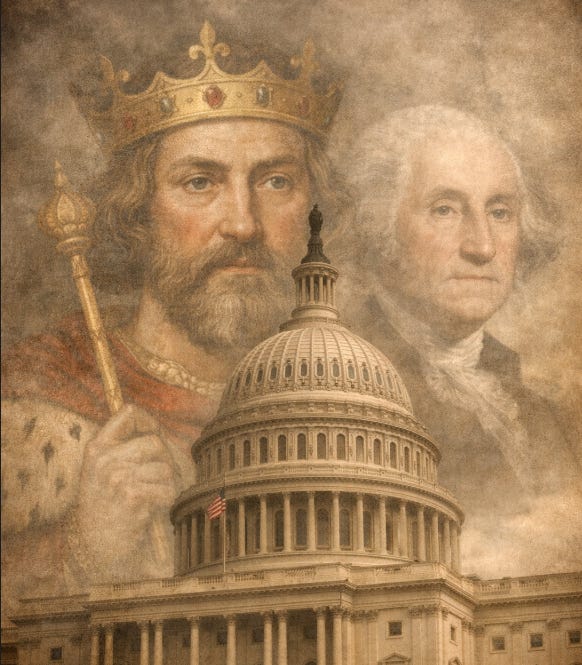
America defines itself by a negation: there are no kings here.
No hereditary office. No bloodline sovereignty. No aristocracy disguised as law.
The Presidency is meant to embody that negation. It is presented as a temporary trust, conferred by the people, open in principle to any citizen, and extinguished at the end of its term. Whatever inequalities exist in practice, the office is not supposed to function as an inherited position, nor as the preserve of any lineage.
And yet, when the ancestry and social positioning of those who have actually occupied the office are examined, a persistent and revealing pattern appears—one that has been documented, revisited, and refined by genealogists for decades.
This inquiry does not originate with a school project, a viral chart, or a novelty claim. It arises from long-standing genealogical research into American colonial families whose lineages are sufficiently well documented to be traced backward into medieval Europe. Within that body of work, one finding recurs with striking regularity: a substantial proportion of U.S. Presidents descend, through multiple independent colonial lines, from the English Plantagenet royal house, including documented lines of descent from King John of England.
These connections are not conjectural. They do not rest on symbolic association or retrospective myth-making. They appear repeatedly in established genealogical scholarship examining so-called “gateway ancestors”—early American settlers whose descendants formed much of the colonial and post-colonial governing elite and whose European ancestry is unusually well recorded. When those gateway families are traced backward, Plantagenet kingship appears not as an anomaly, but as a recurring node.
The relevance of this fact is often misunderstood. It is not that descent from medieval royalty is unique, mystical, or determinative in itself. It is that such descent clusters within a narrow legitimacy-bearing class from which American Presidents are repeatedly drawn.
At this point, a familiar objection is usually raised: that if one goes far enough back, everyone is related to everyone else. This claim collapses under even minimal historical scrutiny.
Human populations did not mix evenly or randomly. For most of recorded history, marriage followed geography, class, religion, and law. European nobility in particular formed a deliberately closed reproductive class, intermarrying to preserve land, legitimacy, and authority. Genealogical convergence occurs within such strata, not across humanity as a whole.
Most people alive today have no demonstrable genealogical connection to medieval English royalty. There are no records, no plausible transmission paths, and no evidentiary basis for assuming such descent absent proof. The assertion that “everyone is related” functions not as an explanation, but as a dissolving agent—erasing specificity precisely where specificity is doing explanatory work.
What matters here is not that royal ancestry exists, but where it recurs and where it does not.
If the Presidency operated as its civic narrative suggests—if it were genuinely open in operational terms—then the ancestry and social origins of Presidents would be expected to reflect the breadth of the citizenry. They do not.
Instead, the office has been occupied almost exclusively by members of a historically narrow legitimacy-bearing class: families embedded in inherited wealth, elite education, institutional continuity, and long-standing political networks rooted in Anglo-American colonial society. Within that class, genealogical connections to European ruling structures—and specifically to Plantagenet kingship—are common and repeatedly documented.
Language matters here. When viable candidates are drawn exclusively from a bounded legitimacy class, the process that follows is not an election in the substantive sense. It is a selection from within that class, subsequently ratified by popular participation. Ballots are counted, but the range of permissible outcomes is fixed long before any vote is cast. The decisive act occurs upstream. What follows is confirmation.
This structure becomes clearer when one examines the behavior of American ruling families. Certain families do not merely produce individual officeholders; they produce dynasties. Political authority circulates among fathers and sons, brothers, spouses, cousins, and affiliated networks. These families cultivate name recognition, donor loyalty, institutional access, and media legitimacy across generations. Their members are treated as presumptive rulers-in-waiting, with family name functioning as credential.
The Kennedys did not operate as ordinary citizens occasionally winning elections. They functioned as a political house, with multiple branches occupying or contesting high office over decades. The Bush family followed a similar pattern, with authority passing from father to son, reinforced by intelligence, financial, and party institutions that treated lineage as qualification.
These families do not resemble participants in an open civic lottery. They resemble ruling houses in a republic that insists it has none.
One President is often cited as an exception to the dominant English Plantagenet lineage pattern: Martin Van Buren. Van Buren emerged from a Dutch-speaking colonial lineage rooted in the Dutch settler elite of New York, tracing to a parallel European colonial authority structure rather than the English aristocratic stream. The significance of this exception is not that it disproves the pattern, but that it clarifies it. Even here, the Presidency does not extend beyond legitimacy-bearing colonial elites. It merely draws from a different branch of the same governing class.
This inquiry does not claim access to the Presidency’s internal selection mechanism, nor does it rely on the system’s declared description of how the office is supposed to function. It proceeds instead from observable outcomes. What can be stated with confidence is not how the system represents itself, but how it behaves. A process that repeatedly produces officeholders drawn from a narrow, historically continuous legitimacy-bearing class cannot be accurately described as an open civic selection, regardless of how voting is administered. The precise role played by heredity within this structure is not known and cannot be assumed. What can be said, however, is that lineage and inherited legitimacy correlate so consistently with access to the office that they cannot be treated as incidental. Whether heredity operates formally, informally, or through intermediary institutional filters remains an open question. What is not open to question is that the observed outcomes are incompatible with the narrative of broad, non-hereditary access.
The American republic abolished kingship rhetorically while preserving elite continuity operationally. The office meant to embody popular sovereignty functions as a legitimacy-constrained position, occupied almost exclusively by members of a historically narrow ruling class whose roots trace directly to European systems of inherited authority.
No kings.
But inheritance remains.
The novelty is not the genealogy.
The novelty is recognizing that the negation of kingship never eliminated its operating logic.
Once that is seen, the system’s political and legal behavior ceases to be puzzling. It appears consistent—faithful to an older structure that survived the abolition of its name.