

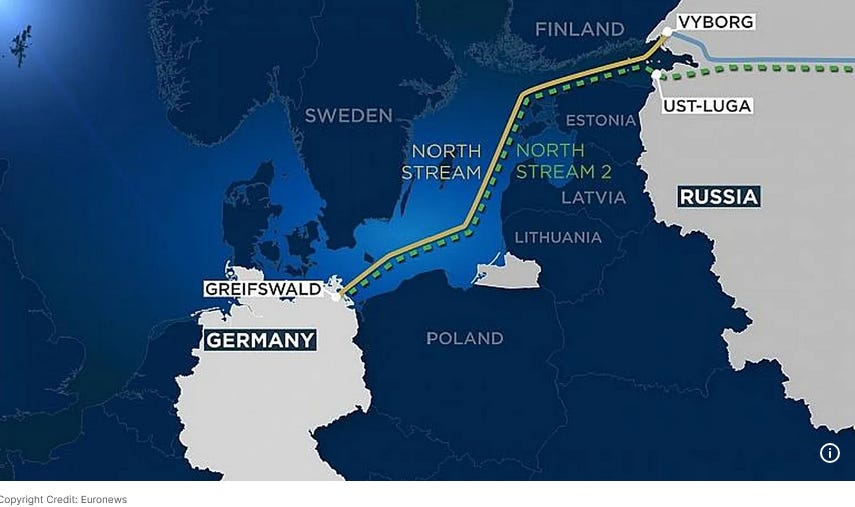
The destruction of the Nord Stream pipelines was not a mystery event that later acquired political meaning. It was a deliberate act, executed physically, and followed by a remarkably coherent effort to ensure that the decision could not be undone.
Begin with what cannot reasonably be disputed. The Nord Stream explosions were not accidental. They were not the result of mechanical failure, weather, or neglect. They were a coordinated underwater demolition operation involving multiple blast points, carried out in a heavily monitored maritime environment. This required trained personnel, specialist equipment, explosives, planning time, and operational secrecy. It required coordination. In ordinary language, it required a conspiracy.
Once that baseline is accepted, analysis stops being speculative and starts being eliminative.
The next step is capability and access. This was not an attack that could be improvised by a non-state actor or a lightly equipped proxy. It required naval-grade competence and freedom of movement in the Baltic. Only a small number of actors plausibly meet that threshold.
Then motive.
Russia did not need to destroy Nord Stream to stop gas flows. It already controlled the valves. If Moscow wanted leverage, it could apply it reversibly, selectively, and at will. Blowing up its own asset would permanently eliminate revenue, bargaining power, and future negotiating leverage to achieve something it could already do instantly. That is not strategy; it is self-harm.
Ukraine, despite being floated in parts of the Western press, lacked the technical capability, the access, and the operational reach to conduct such an operation. Germany, meanwhile, suffered catastrophic loss. Cheap energy vanished. Industrial competitiveness collapsed. Strategic autonomy narrowed sharply. No serious account has ever suggested Berlin chose this outcome for itself.
As capability and motive are applied together, the field narrows decisively.
Now add the public record.
On 7 February 2022, President Joe Biden stood beside German Chancellor Olaf Scholz and was asked directly about Nord Stream 2. His response was unusually explicit. If Russia invaded Ukraine, he said, “there will be no longer a Nord Stream 2. We will bring an end to it.” When a reporter pointed out that the pipeline was under German control, Biden replied: “I promise you, we will be able to do it.”
This was not diplomatic ambiguity. It was a statement of intent against infrastructure outside U.S. jurisdiction, made publicly, on camera, months before the explosions. At the time, it was treated as rhetorical pressure. In retrospect, it reads as something else entirely.
The United States had opposed Nord Stream for years. Not quietly. Not tactically. Openly and consistently. The pipeline undermined sanctions regimes, complicated alliance discipline, and tied Europe’s material prosperity to a geopolitical rival in a way that resisted moral framing and escalation. Washington could delay Nord Stream politically, but it could not guarantee its permanent removal. As long as the pipe existed, it remained an option — a future bargaining chip for Berlin during an energy crisis, a temptation to de-escalate, a structural constraint on confrontation.
Politics could not solve that problem. Only force could.
When the pipeline was destroyed in September 2022, what followed is as revealing as the act itself. There was no serious effort to preserve the remaining intact line. No international consortium formed to repair or escrow the asset pending investigation. No insistence that attribution be resolved before Europe committed itself to decades-long alternative energy contracts. Instead, the loss was immediately treated as final.
Europe reorganised its energy system as if the question had already been settled. LNG terminals were rushed through approval. Long-term contracts were signed. Deindustrialisation was reframed as resilience. Scarcity was normalised. The future moved forward on the assumption that Nord Stream was gone forever — because, in practice, it was.
That behaviour is not how systems respond to genuine shock. It is how systems behave when an outcome has already been accepted.
This is where Seymour Hersh’s reporting becomes analytically important, regardless of whether one treats him as authoritative. Hersh did not offer a vague suspicion. He offered a concrete account: named actors, a method, a timeline, a chain of command, and a reported post-event communication. Specifically, he reported that then-UK Prime Minister Liz Truss received a message shortly after the explosion reading simply, “It’s done,” allegedly from a senior U.S. official.
What followed matters more than the claim itself.
Truss has never denied receiving such a message. She has never publicly disputed it. She has never threatened legal action. She has never offered an alternative explanation. That silence is not normal. For a former prime minister accused of receiving foreknowledge of a major act of infrastructure sabotage, denial would be the default response if denial were safe.
Western media treatment of Hersh’s account followed a similar pattern. The story was not forensically dismantled. It was not met with a detailed, evidence-based counter-narrative. Instead, it was dismissed on procedural grounds — anonymous sourcing, lack of documentary proof — and then quietly set aside. Investigations did not accelerate. Questions were not pressed. The dominant posture was incuriosity.
This is not how false stories usually die. False stories are contradicted. They are undermined with specifics. They are replaced by better explanations. None of that happened here.
What this resembles is a familiar pattern in high-risk statecraft: information allowed to circulate through unofficial channels, denied formally, and left unresolved — a form of signaling that conveys capability without forcing acknowledgment.
Seen in that light, the function of the leak was not exposure in the ordinary journalistic sense. It was signaling. The truth was permitted to be known without being owned. Those who needed to understand what had happened could do so. Those who needed deniability retained it. Capability was demonstrated, boundaries were marked, and escalation was avoided by preserving formal silence.
To affirm Hersh’s account officially would not have been a correction of the record. It would have amounted to acknowledging a covert act of infrastructure warfare against a nuclear-armed state. In that context, denial is mandatory and silence is stabilising.
The absence of an alternative explanation is therefore itself meaningful. No Western government has offered a coherent, evidence-backed account that fits capability, access, motive, and outcome. Investigations in Germany, Denmark, and Sweden have produced classification and fragmentation, not contradiction. If Hersh’s account were demonstrably false in any material way, disproving it quietly would have been easy. It was not done.
Step back and look at the outcome.
Europe lost cheap energy, industrial competitiveness, and strategic flexibility. The United States gained expanded LNG exports, increased European dependence, tighter alliance discipline, and the permanent removal of a structural obstacle to long-term confrontation with Russia. These are not abstract benefits. They are measurable, documented, and ongoing.
Nord Stream was not destroyed to send a message to Moscow. Russia already understood the stakes. It was destroyed to bind Europe — to ensure there could be no quiet reopening, no winter crisis that forced compromise, no path back to an arrangement that constrained escalation.
Seen clearly, the explosion was not the beginning of a new phase. It was the end of an old one.
One implication follows unavoidably from this precedent. Russia is not a state that absorbs the permanent loss of a strategic asset and moves on. Silence should not be mistaken for acquiescence. In a system where a multi-billion-dollar energy option can be erased without attribution, without casualties, and without formal escalation, rational response points toward symmetry of effect rather than immediacy of action. That symmetry need not involve violence or spectacle. It lies in the quiet removal of comparable options: civilian energy or industrial assets rendered unusable through sovereignty, regulation, finance, or loss of control, in ways that cannot be publicly attributed yet are privately understood. The risk, therefore, is not retaliation announced, but retaliation embedded — absorbed into markets and planning as a new fact, long after attention has moved on.
The most revealing fact is not that the pipeline was blown up. It is that once it was, the system behaved as if this outcome had always been anticipated — as if the only uncertainty had been timing.
This is what disciplined analysis can establish without classified sources, without attribution claims, and without speculative leaps. By following capability, motive, public statements, beneficiary outcomes, and post-event behaviour, the shape of intent becomes visible.
You do not need confession to see enforcement.
You do not need proof beyond doubt to identify strategy.
You only need to observe which options disappeared — and who benefited when they did.
Nord Stream did not merely disappear from the strategic landscape.
A future was removed from the map.
And the world moved on as if it had been ready for that all along