

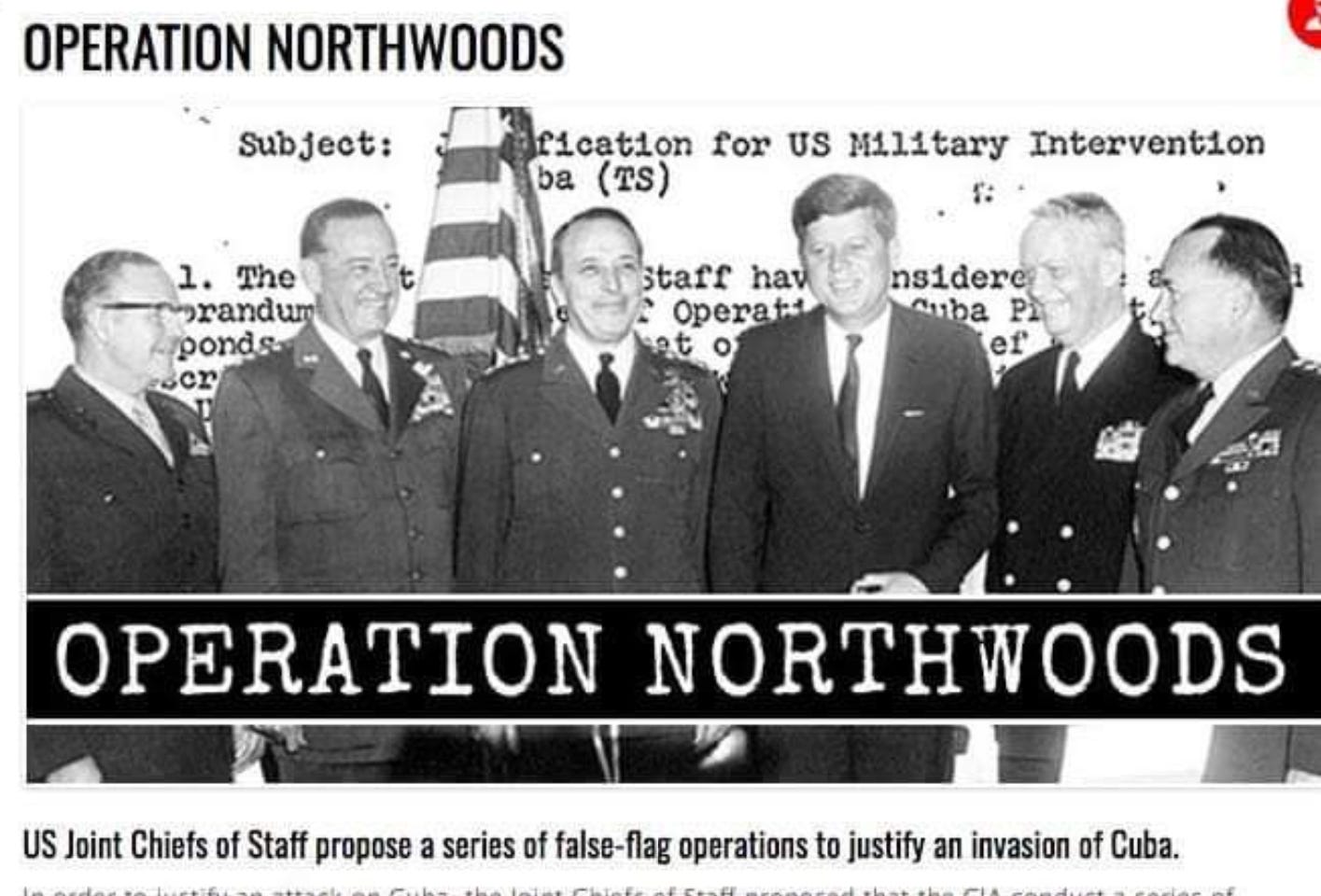
Operation Northwoods was a formal military proposal developed in 1962 by the United States Joint Chiefs of Staff and presented to the Secretary of Defense. Its stated purpose was to create a pretext for war with Cuba. Its proposed method was the deliberate killing or endangerment of civilians, the fabrication of evidence, and the manipulation of media narratives to ensure public attribution of those acts to the Cuban government.
This was not a speculative exercise or a low-level brainstorming document. It was drafted within the highest military planning body in the United States government, refined as an operational proposal, and transmitted through official channels for approval. The signatory authority attached to the document makes that clear. It represented the considered judgment of senior officers entrusted with national defense, operating within institutional norms.
The plan itself was explicit.
Northwoods proposed staging violent acts against American and allied targets and attributing them to Cuba. These included the orchestration of terrorist incidents in U.S. cities, the sinking of refugee boats carrying Cuban civilians, the sabotage of U.S. military assets, and the possible downing of a civilian aircraft. In one scenario, a commercial plane would be substituted with a drone, passengers covertly removed, and the aircraft destroyed to create the appearance of a Cuban attack. In another, actual civilian casualties were contemplated and accepted as necessary to ensure credibility.
The purpose of these acts was not military advantage in any conventional sense. The objective was psychological and political. The plan assumed that public outrage, once properly directed, would overcome resistance to war and unify opinion behind military action. Media coverage was treated as a component of the operation, not an external observer. Attribution was to be manufactured, evidence prepared, and dissent pre-empted through narrative control.
What is most striking about the document is not the brutality of the proposals, but their tone. There is no recorded debate about legality. There is no expressed concern about constitutional limits or civilian immunity. The discussion centers on plausibility, sequencing, and optics. The killing of civilians is treated as a technical variable, not a moral barrier.
This matters because under U.S. law, criminal conspiracy does not require completion of the intended harm. It requires agreement between two or more persons to commit an unlawful act and any substantial step taken in furtherance of that act. Drafting detailed operational plans, allocating public resources, and advancing those plans for approval constitute substantial steps. By that standard, Operation Northwoods was not a near-miss hypothetical. It was a completed conspiracy that was narrowly interrupted before execution.
Whether it would have been prosecuted as treason or as conspiracy to commit murder is a question of charging discretion, not legal character. The conduct itself—planning to murder American civilians under false attribution to induce war—falls squarely within the most serious categories of criminal law. The fact that the plan was rejected limits the outcome, not the nature of the offense.
What Northwoods establishes, therefore, is not simply that extreme ideas were once entertained. It establishes that within modern governance systems, engineered perception, false attribution, and civilian manipulation have been considered acceptable instruments of policy at the highest levels when strategic objectives were prioritized and oversight failed. That is not conjecture. It is documentary fact.
Subsequent archival material (discussed with links here) shows that the Joint Chiefs were not acting in a vacuum. Requests for fabricated pretexts emerged within a broader executive and interagency process under Operation Mongoose, including civilian leadership. This does not mitigate the criminal character of the proposals. It expands it. The significance of Northwoods lies precisely in how routine such thinking became once strategic objectives were set.
Once that baseline is acknowledged, the way we evaluate world events has to change.
If a system has demonstrably been willing to plan such operations, then analysis cannot rely solely on official explanations, denials, or stated motives. The absence of documentation in later cases does not reset the baseline. It merely reflects changes in method, deniability, or institutional learning.
This is where analytic frameworks become necessary.
The first is what I refer to as Strategic Intent Analysis. Rather than asking who carried out a particular act, this approach asks whether the pattern of post-event behavior exhibits strategy rather than reaction. Reaction is exploratory, inconsistent, and reversible. Strategy is selective, reinforcing, and increasingly costly to unwind. When legal frameworks, budgets, enforcement practices, and public narratives consistently converge in one direction—especially where alternative paths were available—intent can be inferred at the system level regardless of individual statements.
Northwoods is essential here because it demonstrates that plausible deniability and false attribution are not anomalies. They are design primitives. A system that once planned such an operation does not need to repeat it in identical form. It needs only to reproduce its functional characteristics: narrative canalization, asymmetric scrutiny, and institutional lock-in.
A second lens follows naturally, which I refer to as Pre-Event Knowledge Posture. This examines whether powerful actors behaved as though a particular post-event reality was already assumed before the triggering event occurred. This does not require foreknowledge of timing or mechanism. Systems often anticipate outcomes without controlling the precise trigger. The signal appears when planning, language, or justification presupposes conditions that do not yet exist.
A crucial distinction applies here. Planning within one’s own jurisdiction for foreseeable risk is ordinary governance. Planning outside one’s jurisdiction for outcomes that require destruction, clearance, or regime change is not. When reconstruction, governance, or financial architectures are discussed in advance by actors who lack authority over the territory in question, the posture is no longer reactive. It is anticipatory.
Northwoods again serves as the control sample. The plan assumed not only that harm could be engineered, but that explanation and consent could be prepared in advance. The event was designed to arrive into a narrative already constructed to receive it.
Taken together, these lenses move analysis away from isolated events and toward continuous governance. Modern systems do not require singular, cinematic operations. They operate through persistent pressure: recurring crisis framing, compressed moral choices, pre-built emergency legal pathways, and psychological exhaustion that produces consent through fatigue. What Northwoods attempted manually, contemporary systems achieve through repetition and institutional momentum.
One diagnostic feature appears with striking regularity: asymmetry of scrutiny. Claims that are merely incorrect tend to be refuted. Claims that threaten an outcome structure tend to be ridiculed, stigmatized, or rendered socially illegitimate. The response is not logical rebuttal but social enforcement. That reaction is observable and informative.
None of this requires caricatured villains. It requires aligned incentives, career preservation, liability minimization, narrative conformity, and fear of exclusion. Northwoods did not depend on monsters. It depended on professionals operating within a system that rewarded feasibility over legality and optics over ethics.
That is the unsettling conclusion, and the reason Northwoods still matters.
Operation Northwoods does not tell us what to believe about any specific modern event. It tells us what questions are lawful to ask. Strategic Intent Analysis and Pre-Event Knowledge Posture provide disciplined ways of asking those questions without speculation and without confession. Where outcomes repeatedly converge toward reduced autonomy, centralized authority, and penalized dissent, intent can be inferred through ordinary reasoning.
This is not cynicism. It is lawful inference. Courts do it every day. They infer intent from patterns, constraints, and effects, not from assurances.
Northwoods matters because it resets the evidentiary baseline. Once that baseline is restored, attention becomes the critical act.
And attention, applied carefully and consistently, remains one of the few constraints power has not fully learned to neutralize.