

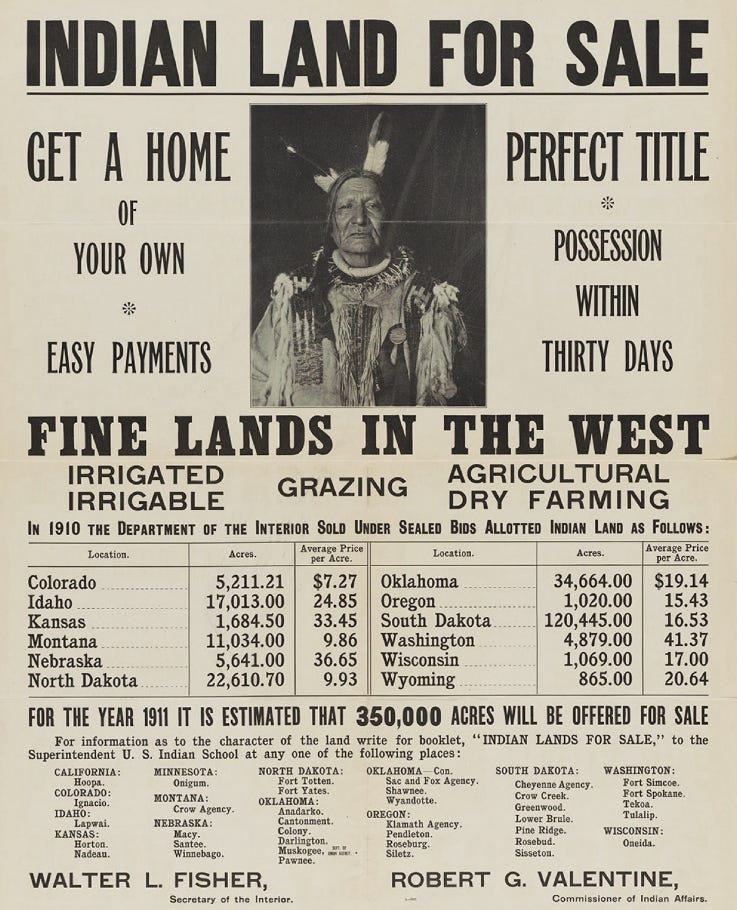
The Dawes Act of 1887 is commonly described as a reform intended to assist Native Americans in transitioning to individual land ownership and economic self-sufficiency. Its stated purpose was integration through property, citizenship, and participation in a market system. The underlying premise was that private ownership would produce independence, stability, and assimilation into the dominant legal and economic order. What followed is best understood not as a failure of implementation, but as a structural redefinition of ownership itself.
Prior to allotment, most Native land was held collectively under tribal authority. Land functioned not merely as property but as the territorial foundation of governance, culture, and continuity. The Dawes framework replaced this collective structure with individual parcels assigned to tribal members, while designating the remaining land as “surplus” available for non-Native settlement. The legal change appeared administrative. The functional change altered the unit of survival from the tribe to the individual.
This shift introduced a structural asymmetry. Individual ownership was imposed within an economic environment designed for market transfer rather than long-term subsistence. Allotments were initially held in federal trust, limiting the owner’s control while exposing the land to future taxation, debt pressure, and eventual alienation once restrictions were lifted. Ownership existed in form. Control was conditional, delayed, and ultimately exposed to external economic forces.
The results were measurable. Between 1887 and 1934, Native landholdings declined from approximately 138 million acres to 48 million acres. Roughly ninety million acres passed into non-Native ownership through legally authorized sales, tax foreclosures, or administrative processes. The transfer did not occur through a single act of confiscation. It occurred through cumulative transactions operating within the framework created by the policy itself. This was not seizure in the conventional sense. It was transfer produced by structural conditions.
The trusteeship model illustrates the inversion embedded in the system. Individuals were told that allotment would prepare them for independence, yet for decades they did not control their own property. Federal authorities approved leases, managed revenues, and determined use. When restrictions were eventually removed, many allotment holders faced financial obligations or market pressures that made retention difficult. The structure created dependency during the period of preparation and exposure at the moment of release. Independence arrived at the point of maximum vulnerability.
The land framework did not operate in isolation. During the same period, federal authorities in the United States and Canada implemented residential and boarding school systems designed to remove Native children from their families and communities. These institutions were intended to disrupt cultural transmission and replace tribal identity with administrative assimilation. The structural effect was generational separation at the same time that territorial continuity was being dismantled.
The historical record now reflects a more severe outcome than cultural disruption alone. Investigations in both countries have documented widespread physical abuse, neglect, preventable disease, and significant numbers of children who died in custody. Many burial sites were unmarked, records were incomplete or withheld, and families were often not informed of deaths or disappearances. The system did not merely weaken family structure. It removed children into institutions where large numbers did not return.
When land loss and generational loss occur simultaneously, the capacity for recovery is reduced in ways that cannot be explained by economic factors alone. Territorial dissolution and child removal functioned as parallel mechanisms. One reduced the material base of tribal continuity. The other reduced the human continuity required to sustain it.
The consequences of these policies were not unforeseeable. Federal authorities were repeatedly informed that allotment was producing land loss, poverty, and social dislocation, and that institutional schooling was associated with high mortality, family separation, and long-term harm. The policies nevertheless continued. At the level of institutional analysis, persistence under these conditions reflects more than tolerance. The outcomes were consistent with the stated objective of assimilation through the dissolution of tribal land, authority, and continuity. Where policy effects align with institutional goals and are maintained despite documented harm, the result is best understood as operational intent rather than unintended consequence.
The Dawes Act is therefore best analyzed through structural intent rather than stated purpose. The policy did not merely distribute land; it converted a communal territorial system into individually alienable assets within a dominant market. At the same time, assimilation institutions disrupted the social structures required to defend and retain that land. The outcome was not produced by a single action but by the interaction of coordinated pressures operating across generations.
By 1934, the Indian Reorganization Act formally ended the allotment policy after federal authorities acknowledged its damaging effects. The reversal, however, occurred after the majority of land transfer had already taken place. Structural change often becomes visible only after the underlying resource base has been irreversibly altered.
The significance of the Dawes framework lies in the mechanism it illustrates. Collective control was replaced by individual responsibility. Legal ownership was granted without corresponding structural power. Economic pressure performed the work that coercion would otherwise have required. At the same time, the institutions that sustained collective resilience were weakened or removed. The resulting transfers appeared voluntary because they occurred through transactions rather than seizure.
This was not reform that produced unintended harm. It was assimilation policy operating through mechanisms that made collective survival structurally unlikely. The system did not fail to protect Native land. It altered the conditions under which loss would occur while reducing the capacity to resist it.
Justice is not measured by whether ownership is formally granted. It is measured by whether control can actually be exercised and sustained across generations. Where law confers title while structuring conditions that make retention unlikely, the transfer that follows is not market outcome but procedural design.
What the Dawes era demonstrates is a broader principle of institutional behavior. Exposure to market forces is often described as freedom. When applied without structural parity, it functions as a mechanism of transfer. When combined with generational disruption, the effects extend beyond economics into long-term survivability.
The policy did not openly take the land.
It made keeping it structurally unlikely.