

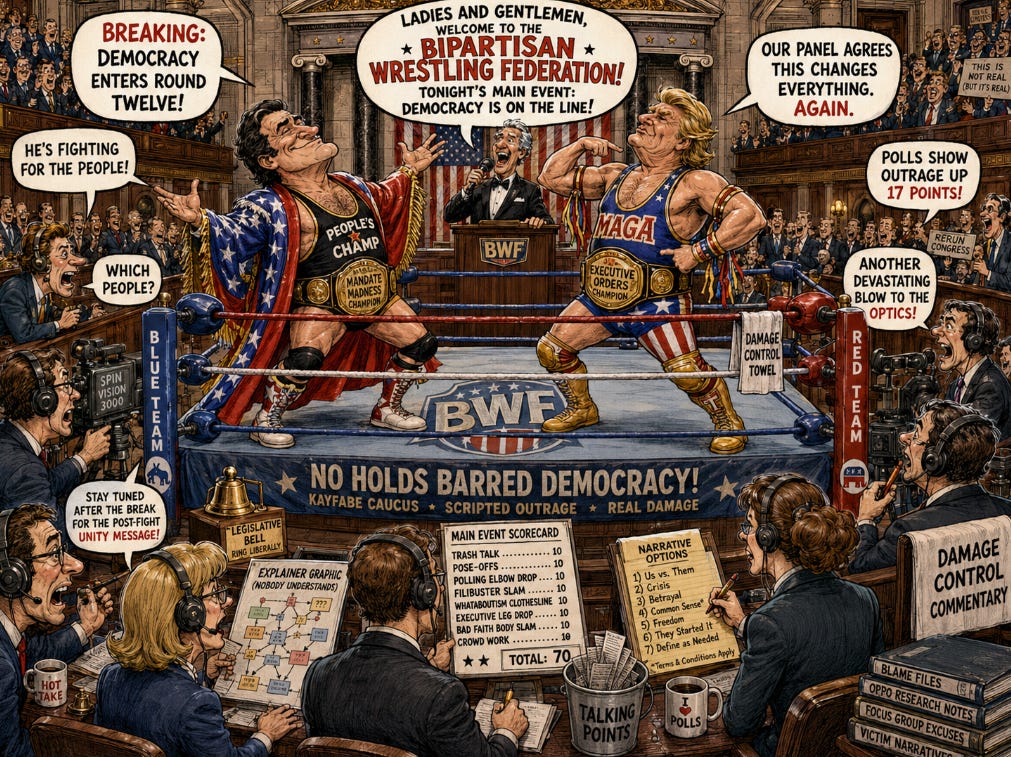
Politics is usually described as conflict over power, policy, principle, ideology, or national direction. That description remains formally true, but it is increasingly incomplete. Much of modern political life no longer operates primarily as deliberation, representation, or even ordinary partisan contest. It operates as spectacle. The public is not merely asked to consider arguments, judge competence, or hold authority accountable. It is invited into an arena, handed emotional cues, shown heroes and villains, and trained to experience public life as a continuous performance of conflict.
The closer analogy is not statesmanship. It is professional wrestling.
The comparison is not that politics is wholly fake, or that nothing in public life matters. Professional wrestling is not meaningless because its outcomes are staged or managed. Bodies are still injured. Careers are still made. Audiences still care. Money still changes hands. Institutions still profit. The events are real as performance, real as commerce, and real in their effects on those who participate in them. What is managed is the structure of belief.
In 1989, the World Wrestling Federation’s position before New Jersey lawmakers made explicit what the audience increasingly understood: professional wrestling was primarily entertainment rather than a bona fide athletic contest. That admission did not destroy wrestling. It clarified its operating form. The audience could know the contest was managed and still participate emotionally. The crowd could cheer, boo, argue, remember betrayals, and return the next week.
That condition has a name: kayfabe. In wrestling, kayfabe is the maintained reality of the performance. The hero is treated as a hero. The villain is treated as a villain. Betrayals, feuds, humiliations, reversals, and alliances are presented as emotionally real even though they exist inside a managed dramatic structure. The audience may know that much of the conflict is arranged, but the emotional participation remains genuine.
Modern politics increasingly depends on the same condition. The public knows that much of political conflict is theatrical. It knows that politicians exaggerate disagreements, perform outrage, conceal shared interests, and speak differently in public than in private. It knows that cable panels are arranged for heat, that campaign emails are written to trigger fear, that fundraising rises with panic, and that each side needs enemies to maintain loyalty. Yet the emotional structure still works. People continue to experience political performance as if it were the central arena in which power is being decided.
This is not simple deception. It is partial belief. Citizens know enough to be cynical, but not enough to withdraw from the performance. They laugh at the staging while still hating the designated villain. They distrust politicians in general while defending their own side’s performers. They recognize media manipulation while consuming the next segment of outrage. The system does not require innocent belief. It requires managed participation.
Professional wrestling clarifies the structure because it separates visible conflict from institutional control. The fight occurs in the ring, but the business is not decided in the ring. The ring is where the lights are aimed. It is where bodies collide, faces bleed, crowds chant, alliances shift, and victory appears to be contested. But the real structure sits behind the performance: ownership, booking, promotion, scheduling, contracts, broadcasting, merchandising, and audience management. The crowd sees conflict. The institution manages continuity.
This is also the distinction developed in The Method of Structural Inquiry: the visible explanation must be tested against the structure that survives beneath it. The relevant question is not only what the public is shown, but what the system continues to preserve while attention is directed elsewhere. In politics, as in professional wrestling, the visible contest may be genuine in its own limited form while still leaving the deeper architecture of control untouched.
Politics now operates in a similar way. The visible fight absorbs attention, while the deeper institutional structure remains comparatively stable. Parties change control. Committees hold hearings. Candidates denounce one another. Reporters crowd hallways. Cameras follow the insult, the walkout, the viral clip, the crossed arms, the shouted accusation. Yet core trajectories often continue across administrations: expanding state capacity, secrecy in national security affairs, elite immunity, financial extraction, procedural containment of scandal, and public accountability converted into display.
The fight is real enough to consume the public, but not necessarily real enough to threaten the structure that profits from it.
This is the political form of the problem examined in The Illusion of Political Choice. Elections, parties, and ideological conflict can matter, but they often operate within boundaries already defined by institutional continuity. The rivalry may be genuine, but the range of structural change is narrower than the emotional intensity of the contest suggests. The voter experiences confrontation. The administrative, financial, security, and media architecture often experiences continuity.
Professional wrestling requires heels. The heel gives the crowd permission to hate. He cheats, boasts, mocks, betrays, insults the audience, or violates the moral code of the performance. His role is not incidental. He generates heat. Without the villain, the hero has no dramatic function, the crowd has no emotional target, and the event loses force.
Politics has adopted the same dependency. Each side requires figures who are not merely wrong but intolerable. The villain must be made large enough to justify continued loyalty to the opposing side, even when that side repeatedly fails to correct the conditions it condemns. Public attention moves from structural failure to personality conflict. The central question becomes not why institutions continue producing the same outcomes, but which villain must be defeated next.
That simplification protects the structure. If the problem is one dangerous person, one corrupt faction, one extremist movement, or one election cycle, the deeper architecture is spared examination. The public is encouraged to believe that restoration lies in defeating the heel. Once he is defeated, another appears. The feud continues. The audience remains emotionally engaged. The institution remains intact.
The same logic applies to heroes. Wrestling heroes are not simply athletes. They are vessels for audience identification. Their function is to focus hope, simplify loyalty, and make the crowd feel represented inside the spectacle. Political heroes often perform the same role. The chosen figure appears as the one who will finally fight, finally expose, finally reform, finally restore, finally hold the line. Whether the promise is fulfilled matters less than whether the role keeps hope inside the arena.
The structure is therefore absorptive as well as theatrical. Public frustration is gathered, dramatized, and redirected into approved channels of participation. Outrage that might otherwise become examination is converted into viewership, voting, fundraising, posting, arguing, and waiting. The system metabolizes dissatisfaction by giving it a script.
In a functioning constitutional order, exposure of serious institutional failure would lead to correction, accountability, resignation, prosecution, structural reform, or loss of legitimacy. In a spectacle order, exposure becomes content. A hearing becomes a performance. A scandal becomes a season. A report becomes a prop. A public betrayal becomes a fundraising email. The audience is allowed to see enough to remain angry, but not enough changes to make the anger consequential.
That is the condition examined in Truth That Changes Nothing. Institutions may acknowledge facts, process reports, hold hearings, issue findings, revise policies, and display concern while leaving the underlying architecture largely unchanged. Truth enters the record, but authority does not leave it. Within political spectacle, the revelation itself becomes the event. The consequence is deferred, narrowed, proceduralized, or absorbed.
Professional wrestling also depends on recurring storylines. Old feuds return. Former enemies become allies. Allies betray one another. Champions fall and later recover. The point is not resolution but continuity. The audience must be given enough movement to feel progression and enough repetition to remain oriented.
Politics increasingly follows that rhythm. Every cycle is decisive. Every election is existential. Every scandal is unprecedented. Every hearing is historic. Every leaked document is the one that will finally change everything. Yet after each supposed climax, the next episode begins. New graphics appear. New enemies are introduced. Old slogans are repackaged. Public attention is reset for the next confrontation.
The effect on judgment is corrosive. When politics becomes spectacle, citizens are trained to evaluate public life as drama rather than structure. They ask who won the exchange, who dominated the hearing, who delivered the better line, who humiliated whom, who looked weak, who looked strong, who generated the clip. The language of performance replaces the language of accountability. Politics becomes a series of moments to be reacted to rather than a system to be understood.
Media incentives intensify the transformation. Professional wrestling requires promotion. Politics now exists inside a permanent promotional environment. Conflict must be packaged, segmented, previewed, replayed, clipped, narrated, ranked, and monetized. The public does not encounter politics as a stable record of institutional conduct. It encounters politics as an endlessly refreshed set of emotional cues. The news cycle becomes the announcer’s table. It tells the audience what the fight means, who betrayed whom, why the next confrontation matters, and why the viewer must not look away.
This is where political spectacle meets the visibility structure examined in Search Engines Are Governance Systems. Political reality is no longer mediated only through newspapers, television, campaigns, and party machinery. It is mediated through ranking, recommendation, platform circulation, search prominence, algorithmic summaries, and reputational sorting. A candidate who dominates the clip economy can appear more politically real than a quiet institutional change. A scandal that trends can seem more consequential than a rule quietly embedded in administrative practice. A phrase optimized for circulation can defeat a fact that requires time to understand. The arena is not merely televised. It is indexed, ranked, and continuously redistributed through systems that decide what public life appears to be.
In this environment, sincerity and performance become difficult to separate. A politician may believe part of what he says while exaggerating it for effect. A commentator may sincerely dislike the opposing side while knowing that outrage keeps the audience. A party may condemn a tactic when used by opponents and adopt it when useful to itself. The system does not require universal bad faith. It requires role conformity. Once the arena rewards performance, participants learn the incentives of performance whether or not they began as actors.
The issue, then, is not that every participant is consciously pretending. The issue is that the structure rewards those who perform the required role. The loudest antagonist receives attention. The dramatic betrayal becomes news. The simplified moral frame travels farther than the careful explanation. The theatrical denunciation outperforms the administrative correction. Over time, the system selects for characters who understand the arena.
The public then mistakes intensity for seriousness. But intensity is not accountability. A system can scream about itself indefinitely while preserving its own arrangements. It can denounce corruption without removing the conditions that make corruption survivable. It can expose hypocrisy without imposing consequences. It can stage conflict over power while leaving the architecture of power untouched. The spectacle need not hide dysfunction. It can display dysfunction continuously, provided display substitutes for remedy.
This is why modern politics so often feels both urgent and strangely static. The temperature rises, but the structure remains. The audience is told that everything is at stake, but the same institutional patterns continue. The villains change costume. The heroes change slogans. The media changes graphics. The machinery underneath changes far less than the performance above it.
The deeper danger is not merely that citizens are entertained. It is that they are habituated to a false location of power. If the public believes that the central political reality is the visible fight, it will direct its attention toward the performers. It will ask whether the right person won the debate, controlled the chamber, captured the nomination, dominated the news cycle, or landed the blow. It will pay less attention to the rules of the promotion: who controls the permitted range of conflict, which questions remain outside the ring, which institutions survive every scandal, which interests win regardless of the apparent outcome, and which consequences never arrive.
A constitutional culture is seriously damaged by those conditions. Constitutional government depends on the distinction between office and performance, authority and spectacle, accountability and display. Public office is not a role created for emotional identification. It is a delegated trust constrained by law, duty, proportionality, and answerability. When public power becomes performance, duty is displaced by role-play. When accountability becomes display, procedure replaces justice. When citizenship becomes audience membership, consent is simulated rather than meaningfully obtained.
Theatrical legitimacy is the substitute that appears when lawful legitimacy weakens. Lawful legitimacy requires correspondence between authority and duty. Those who hold power must answer for what they do, especially when their decisions impose harm, concealment, dependency, or risk on others. Theatrical legitimacy works differently. It does not require correction. It requires the appearance of contest, the performance of concern, the visible denunciation of failure, and the repeated assurance that the next episode will finally settle the matter.
That substitute is powerful because it preserves the emotional form of accountability while removing much of its substance. The public sees confrontation and mistakes it for constraint. It sees exposure and mistakes it for justice. It sees apology, outrage, hearings, resignations, reports, and campaign promises, but the deeper question remains untouched: did authority actually become more accountable, or did the performance merely absorb the demand that it should?
The natural-law failure is precise. Authority ceases to be ordered toward protection, truth, and proportionate responsibility. It becomes ordered toward continuity of the performance. Institutions no longer answer primarily for what they do. They manage how what they do is perceived, narrated, contested, and absorbed. That is not merely a decline in seriousness. It is the displacement of lawful accountability by theatrical legitimacy.
Professional wrestling at least has the honesty of admitting, eventually, that it is entertainment. Political spectacle is more dangerous because it continues to borrow the language of sovereignty, representation, law, mandate, democracy, and justice. It asks the public to treat performance as participation. It converts citizenship into audience membership while preserving the symbols of self-government.
This does not mean political conflict is always false. Some conflicts are real. Some differences matter. Some outcomes matter. Some officials resist genuine abuse. Some institutional failures are contested in ways that produce meaningful results. The point is not to flatten all politics into fraud. The point is to recognize the pattern by which real conflict is often absorbed into a managed spectacle that protects the continuity of the larger system.
That distinction matters. If everything is dismissed as fake, analysis collapses into cynicism. If everything is accepted as sincere, analysis collapses into naivety. Modern politics contains real actors, real incentives, real injuries, real stakes, and real conflicts, but increasingly arranges them inside a spectacle structure that converts conflict into managed emotional participation. The ring is real. The blows may be real. The injuries may be real. But the audience is still being directed toward the ring while the promotion remains backstage.
The similarity between politics and professional wrestling is therefore not accidental resemblance. It is structural convergence. Both systems require recurring conflict, recognizable characters, emotional polarization, controlled disbelief, audience loyalty, and continuity beyond any individual contest. Both preserve attention by preventing final resolution. Both depend on villains who keep the audience attached and heroes who keep hope inside the performance. Both turn conflict into a product.
The consequence is a public life in which spectacle increasingly replaces consequence. The citizen watches, reacts, chooses, denounces, cheers, and returns. The system absorbs the energy and continues. What appears to be conflict may still be conflict, but it is conflict arranged in a form that rarely threatens the deeper structure. The central question is no longer which performer wins the match. The central question is why a society that still speaks the language of self-government has been trained to mistake the match for the place where power is finally decided.