

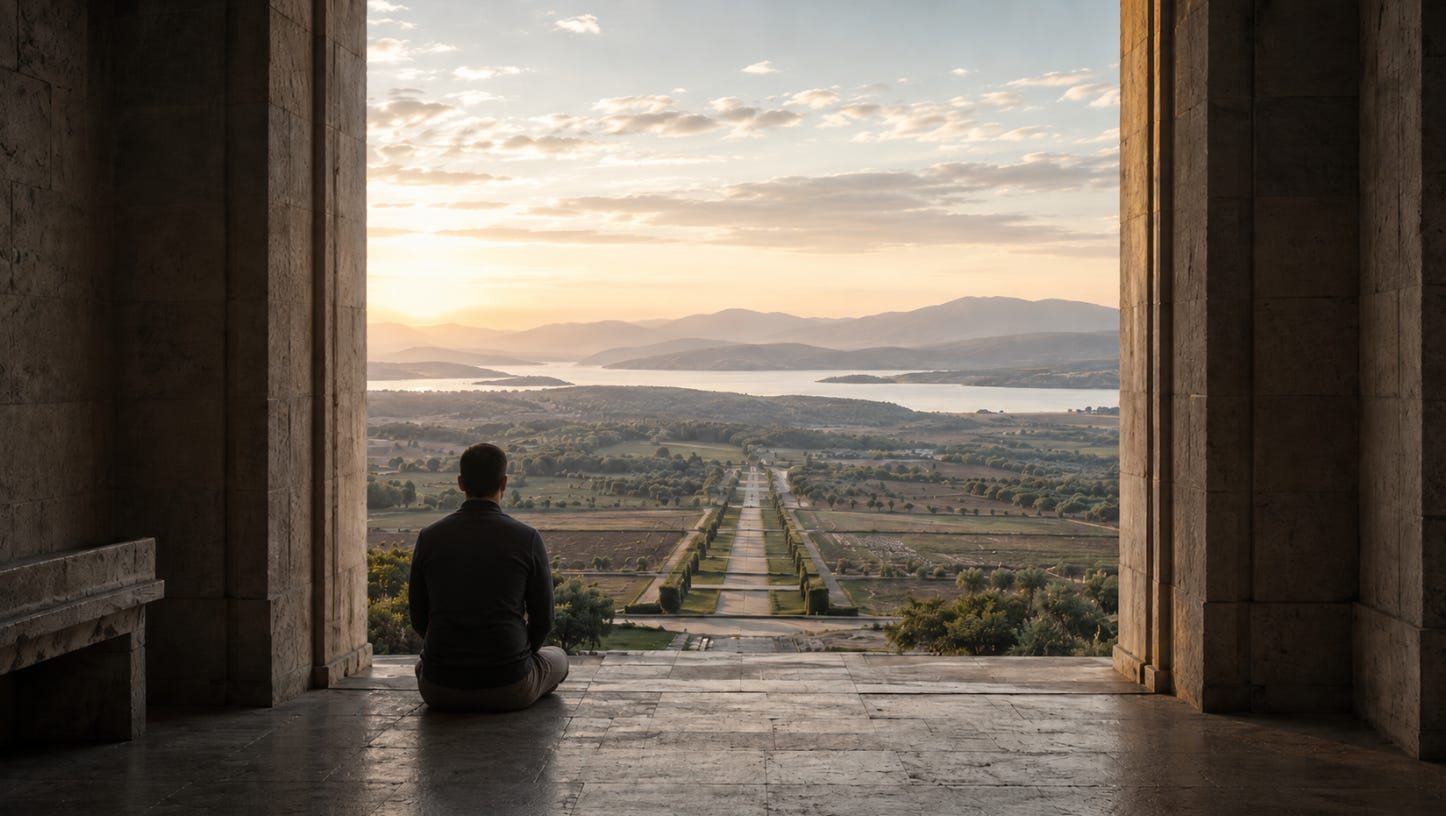
Modern people are taught to treat prayer as private emotion. It is permitted as comfort, tolerated as tradition, and dismissed when treated as action. It may calm the person who prays. It may provide meaning during suffering. It may help someone endure uncertainty. But it is not allowed to be understood as participation in reality. That boundary is not neutral. It belongs to a larger picture of the world in which matter is inert, consciousness is isolated, meaning is subjective, and speech alters nothing beyond the speaker.
That picture is incomplete.
The world does not behave as if ritual is meaningless. Public authority is still organized through ritual. Churches, monarchies, courts, militaries, universities, secret societies, state funerals, inaugurations, classified oaths, and national ceremonies all use repeated forms, controlled words, costume, threshold, symbol, rank, and consecrated space. Even technological power preserves the pattern. As argued in The Occult History of NASA, the space program did not eliminate ritual by becoming technical; it mechanized ritual, myth, secrecy, and ascent under the language of science. Rockets launch from towers after countdowns. Programs are named Apollo, Mercury, Gemini, Saturn, and Artemis. National ascent is staged as spectacle. Sacrifice-risk is made visible before the public. The language is technological, but the structure is older than technology.
This is not accidental residue. It is how authority becomes embodied. Ritual binds attention, marks thresholds, changes status, creates memory, organizes consent, and makes invisible authority visible. The ruling systems did not abandon ritual when they taught the public to dismiss it. They kept the practice and exported the disbelief.
Prayer belongs inside that same structural field, but it belongs lawfully. It is not theatrical power, social initiation, state spectacle, or secret allegiance. It is ordered speech directed toward truth, protection, repentance, gratitude, service, justice, and right relation. Prayer is not a demand thrown into emptiness. It is an act of ordering. It gathers the person around a named good, subjects desire to moral condition, and places attention, fear, hope, and conduct under a coherent form.
In The World Is Structural and Created, creation is not presented mainly as a story about origins. It is a description of present reality. The world is shaped. It holds form. Ratio, geometry, rhythm, recurrence, growth, decay, proportion, and consequence reveal that reality is not formless material awaiting human interpretation. It has grain. It has lawful behavior. We are not free from structure. We are free only in how we move within it.
Prayer begins there.
It assumes that the world is ordered, that consciousness participates in order, and that speech, intention, gratitude, repentance, alignment, and repetition are not nothing. The first movement is inward. Prayer orders the person.
A person who prays seriously does not remain internally unchanged. Attention is selected. Fear is named. Gratitude is practiced. Desire is disciplined by repetition. The imagination is given a lawful pattern instead of being left to drift through anxiety. Action begins to follow the stated alignment. Choices become less random. Endurance increases because suffering is no longer interpreted as meaningless interruption. Repeated speech stabilizes intention. Repeated intention stabilizes the person.
This alone is not small. The modern world often treats belief as decoration, but ordinary medical evidence does not support that assumption. Placebo and nocebo effects show that expectation, meaning, context, and belief can alter bodily experience. Pain can change under expectation. Adverse symptoms can appear under negative anticipation. The body is not indifferent to meaning. The person is not a sealed machine receiving chemical inputs while consciousness watches from the outside. Meaning enters physiology. Fear and trust have consequences.
Scientific evidence does not need to carry the whole argument. It merely confirms that the mechanistic dismissal is too crude. Placebo and nocebo research show that belief and expectation affect bodily experience. Intentionality, meditation, distant-healing, random-number, and global-consciousness studies press against the assumption that consciousness is sealed and inert. These fields vary in strength and interpretation, but they point in the same direction: meaning is not nothing.
Prayer stands within that field of human reality, but it is larger than placebo. A placebo response usually concerns a specific expectation around a treatment. Prayer concerns the whole person. It can include body, household, vocation, protection, guilt, gratitude, duty, courage, and the hoped-for repair of disorder. It does not merely say, “I expect this symptom to improve.” It says, “Let me be rightly ordered in relation to truth, service, justice, and the good.” A repeated orientation of that kind can reorganize a life.
This becomes clearer if consciousness itself is not treated as a private object sealed inside the skull. In Consciousness as Presence in a Structured World, consciousness is described not as a hidden movie playing behind the eyes, but as presence arising from structure. Awareness appears where truth, law, and resonance are sufficiently coherent to support unified experience. Living beings do not manufacture consciousness as a factory manufactures goods. They receive, register, and express presence through the degree of coherence they can sustain.
Prayer therefore does not act upon an isolated mind. It acts within a living field of attention, perception, relation, consequence, and alignment. It clarifies the receiver. It reduces contradiction. It brings speech and will into closer relation. It makes certain perceptions easier to receive and certain falsehoods harder to inhabit. Serious prayer can feel less like escape than exposure. As awareness becomes clearer, contradiction becomes harder to tolerate.
But the inward account is incomplete if the world itself is structural.
If reality is created, ordered, relational, and field-based, prayer may also work in a second direction. Prayer may order the person, and the structured world may then begin to order with the person. This does not mean desire commands reality mechanically. It does not mean every request is granted, or that every suffering is the result of failed prayer. It means an ordered person may come into correspondence with an ordered world. Paths may open. False structures may be exposed. Allies may appear. Pressure may arrive where pressure is needed. Protection may operate through timing, warning, delay, or redirection. Recognition may come only after the thing to be recognized has become coherent enough to hold it.
Prayer, in this account, is alignment.
Alignment is not passivity. It is the disciplined act of becoming available to lawful order. The person does not disappear, and the world is not commanded. Speech, attention, conduct, and circumstance begin to come under the same governing form. Prayer works most deeply when the person ceases to be divided against the good being asked. It is not merely asking for help from outside. It is becoming the kind of person through whom help can lawfully arrive.
Magic tries to bend reality toward will. Prayer brings will into lawful relation with reality. Magic seeks power without obedience. Prayer seeks order under truth. Magic treats the world as a field to be manipulated. Prayer treats the world as a created order to be entered rightly. The difference is structural. One seeks domination. The other seeks correspondence.
This also explains why prayer may not first appear as comfort. A prayer for truth may bring exposure before peace. A prayer for courage may bring the circumstances in which courage becomes necessary. A prayer for protection may not prevent stress, but may prevent catastrophe. A prayer for justice may bring the person into contact with systems where injustice is protected. A prayer for power used lawfully may first test whether the person can pursue capacity without being corrupted by it.
This is where the public use of ritual becomes important. If ritual were meaningless, serious institutions would have abandoned it. They have not. The Vatican still orders authority through vestments, incense, procession, altar, calendar, confession, exorcism, consecration, and hierarchy. Royal power still appears through coronation, anointing, regalia, oath, procession, throne, crown, orb, sceptre, and sacred architecture. Secret societies still rely on initiation, degrees, vows, symbols, thresholds, restricted rooms, and controlled revelation. Modern state power uses inaugurations, military funerals, court ritual, classified oaths, ceremonial buildings, and national spectacle. These are not random decorations attached to power. They are the forms through which power becomes recognizable, transmissible, and binding.
The inversion side matters here not because it is primary, but because it supplies a public admission. Systems of power continue to use ritual because ritualized intention has force. Their misuse of the principle does not define the principle. It reveals it.
This is the same pattern described in The Corruption of Order. False systems do not create order. They preserve the outer form while changing the governing end. Law remains but becomes procedure without justice. Medicine remains but becomes intervention without healing. Finance remains but becomes circulation without stewardship. Ritual can undergo the same corruption. The form remains recognizable, but the end is altered. What once oriented the person toward truth, gratitude, repentance, protection, and right relation can be redirected toward domination, secrecy, bargain, fear, and consent extraction.
The Collins material gives this point a sharper institutional edge. In Deception and UFOs: The 1998 Collins Elite Report Reconstructed, the reported Collins framework did not treat ritual as decoration. It treated ritual as operationally relevant to contact, deception, intrusion, and false consent. The disturbing feature of that material is not merely that non-human intelligence appears in the account. It is that human actors are described as attempting to move from observation into ritualized engagement, seeking access to power they believed they could use, only to discover that the apparent bargain may have been a trap.
That structure matters for prayer because it reveals the deeper issue. The question is not whether contact exists. The question is what kind of contact, under what law, and toward what end. Inverted ritual seeks alliance through secrecy, bargain, sacrifice, and domination. It attempts to obtain power by entering relationship with forces that feed upon deception, fear, violation, and false consent. Prayer is not the same act with better language. It is the opposite movement. It seeks alignment through truth, gratitude, humility, protection, repentance, courage, and lawful order.
The lawful side need not imitate the destructive side. If destructive forces seek bargain, sacrifice, secrecy, and domination, protective forces need not use the same mechanisms. Assistance aligned with order may appear as guidance rather than bargain, clarity rather than coercion, warning rather than possession, and inspiration rather than control. Human experience contains many such reports: people in survival situations who receive a sudden instruction that preserves life, inventors and artists who describe breakthroughs as received rather than manufactured, and ordinary individuals who recognize a warning, restraint, or opening that arrives with more coherence than chance would suggest. The pattern is not domination from outside. It is participation in a larger order.
Prayer is the lawful counterpart.
Where inverted ritual seeks domination, prayer seeks alignment. Where inverted ritual feeds on fear, prayer restores courage. Where inverted ritual conceals intent, prayer names desire before truth. Where inverted ritual uses symbol to bind consent, prayer uses speech to return the person to rightful order. Where inverted ritual imitates authority, prayer acknowledges authority beyond the self.
The contest is not between ritual and no ritual. The contest is between lawful and unlawful ordering.
The result will rarely look like immediate reward. It may look first like clarification. Then pressure. Then endurance. Then protection. Then language. Then recognition. Then consequence. A life ordered by prayer may pass through difficulty not because the prayer failed, but because the prayer has entered the field where disorder must be revealed before it can be repaired.
Prayer does not need exaggeration. It is not a machine for acquiring outcomes, and it is not a guarantee that suffering can be bypassed. It is more serious than that. Prayer is lawful participation in order.
The question is not whether every prayer is visibly answered. The question is whether reality is the kind of place where ordered consciousness matters. The world’s own behavior already gives the answer. Power still uses ritual. The body responds to meaning. Consciousness appears where coherence is present. Inverted systems corrupt form because form has force. Prayer belongs to that same structure, lawfully restored. It is the recovery of relationship between speech, will, order, and the created world.
Endnote: The evidentiary fields referenced here include placebo and nocebo research, distant-healing and intentionality studies, random-number-generator experiments, Global Consciousness Project analyses, and group-meditation research. These bodies of work vary in strength and interpretation. They are not treated here as proof of prayer, but as evidence that belief, expectation, intention, attention, and collective consciousness cannot be dismissed as inert.
William, this is so indepth, good job!