

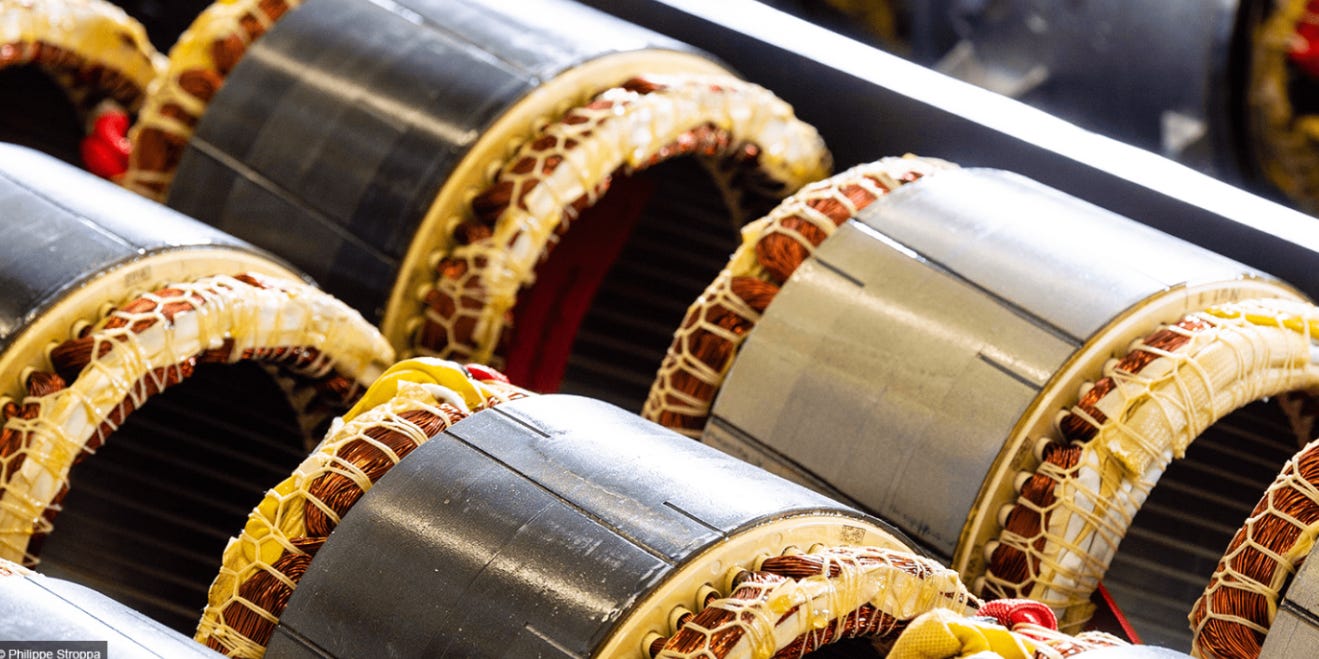
Rare earth minerals sit beneath much of modern technological life, but usually out of sight. They are not consumer-facing products, and they are rarely discussed in ordinary political language. Yet they are embedded in permanent magnets used in electric vehicle motors and wind turbines, and they also appear in a range of sensors, displays, guidance systems, and other advanced components. This means that technological dependence does not begin with the visible factory, the finished device, or even the semiconductor plant. It begins earlier, in the material layer that determines what can be produced in the first place.
That layer is often missing from public discussion. The modern technology debate usually begins at the level of fabrication, design, export controls, or industrial policy. But advanced products do not emerge from fabrication alone. They depend on upstream extraction, chemical separation, mineral processing, metallurgical refinement, and the energy required to sustain all of them. As examined in Semiconductors and the Architecture of Technological Power, dependence is already concentrated at the processing stage. Rare earth minerals show that the dependence often begins further upstream still. In practice, the critical bottleneck is frequently not the existence of deposits, but the ability to separate, refine, and convert those deposits into oxides, metals, and magnets at industrial scale.
The phrase “rare earths” can obscure as much as it reveals. The issue is not simply geological scarcity. Some of these elements are not especially rare in absolute terms. The real constraint lies in economically viable extraction, complex separation chemistry, purification, environmental burden, processing capacity, and the technical knowledge needed to carry those stages out reliably at scale. A country may possess deposits and still depend on foreign refinement. A firm may design advanced products and still remain exposed to material chains it does not control. Apparent abundance can therefore coexist with real dependence.
This is what makes rare earth minerals a structural issue rather than a commodity story. The dependency does not arise because prices move up and down, as commodity prices always do. It arises because usable supply depends on a narrow chain of technical and industrial processes that cannot be expanded quickly when pressure arrives. New mines require long development periods. Refining capacity takes time, capital, permitting, engineering expertise, and political tolerance for environmental costs. Supply diversification sounds easier in theory than in practice because the chemistry is difficult, the middle stages are hazardous and expensive, and industrial capability cannot be recreated overnight.
That concentration matters because these materials do not sit inside one isolated industry. They run across multiple strategic systems at once. The same upstream chain supports electronics, industrial equipment, energy infrastructure, transport technologies, communications hardware, and military procurement. What appears diversified at the level of finished products can therefore be highly concentrated at the level of indispensable inputs. A disruption in one upstream layer can move outward across several sectors simultaneously. The problem is not merely higher prices. It is synchronized vulnerability.
This pattern is familiar across modern industrial systems. Public rhetoric emphasizes innovation, resilience, transition, and sovereignty. The underlying architecture often remains dependent on narrow upstream chains that are geographically concentrated, technically complex, environmentally difficult, and only partially controlled by the states and firms most dependent on them. Downstream sophistication is then mistaken for independence. In normal conditions that mistake can persist for years, because functioning trade flows conceal the dependence. Under pressure, the structure becomes visible very quickly.
Once visible, the consequences spread well beyond the materials sector itself. Lead times lengthen. Procurement becomes uncertain. Industrial planning becomes harder. Energy transitions slow. Manufacturing timetables slip. Essential equipment becomes more expensive or harder to obtain. The public usually encounters this not as a theory of material dependence, but as delay, cost, exposure, and the quiet recognition that supposedly advanced economies do not control the foundations of many of their own technologies. Businesses absorb uncertainty they did not create. Workers bear disruption they cannot influence. Households pay more for systems presented to them as necessary and modern, while having no meaningful voice over the material arrangements that make those systems fragile in the first place.
That is where the issue becomes a matter of institutional accountability rather than industrial technique alone. A system built on concentrated upstream dependence may remain commercially efficient for long periods, but it is not proportionate if the risks are widely socialized while the control points remain narrow and remote. Nor is it fully consistent with the protection of the vulnerable when entire populations are made dependent on material chains they neither see nor govern, and when failures in those chains are experienced downstream as higher costs, stalled infrastructure, weakened resilience, and reduced room for ordinary economic security. Legal ownership of assets and formal compliance with market rules do not answer that problem. The more serious question is whether the structure distributes power, exposure, and consequence in a way that remains justifiable under stress.
Rare earth dependency also clarifies the difference between symbolic control and operational control. Governments can subsidize domestic industry, restrict exports of finished technologies, announce industrial strategies, and speak confidently about national resilience. But where the material base remains externally processed or strategically exposed, that control is conditional. The appearance of sovereignty exceeds the reality of it. The system retains administrative authority over downstream activity while remaining vulnerable at the upstream level that determines whether production can continue under stress. Procedure and planning can therefore give an impression of autonomy that the material structure does not fully support.
That gap between appearance and structure is why rare earth minerals matter as part of a wider analysis of technological dependency. They show that modern industry is layered, and that the most decisive forms of dependence may exist below the level that receives the most public attention. The question is not simply who assembles advanced products or who designs them most efficiently. The more important question is who controls the material conditions that make advanced production possible. Once that question is asked directly, the map of technological power changes. Fabrication remains important, but it no longer appears primary in any self-sufficient sense. It appears as one stage within a deeper material order.
The broader implication is straightforward. Modern technological systems are only as resilient as their least replaceable upstream layers. This is true of semiconductors, energy infrastructure, transport electrification, communications hardware, and industrial production more broadly. It also fits the larger pattern examined in The Global Supply Chain System, where efficiency expands output while concentrating fragility. Rare earth minerals are one of the clearest examples of that logic. They sit beneath the language of innovation and beneath the politics of technological leadership, quietly governing what remains possible when trade becomes pressure, when interdependence becomes leverage, and when the material bottleneck moves from background condition to operational fact.