

If you want to understand how regulation became performative, you don’t need a financial crisis or a complex corporate scandal. You only need to interact with Comcast Xfinity as an ordinary customer.
Start with the simplest task: speaking to a human being. Comcast’s systems are famously designed to prevent this. Automated menus loop endlessly. Chat systems masquerade as support while refusing to answer basic questions. Requests to speak to a representative are ignored, deflected, or quietly terminated. This is not a technical failure. It is a deliberate architecture of friction.
If you persist long enough to reach a human, a second pattern emerges. The person you finally speak to is polite, scripted, and powerless. They cannot fix billing errors. They cannot reverse charges. They cannot apply credits without “system approval.” Escalation does not lead to authority. It leads to another person reading from the same system that caused the problem.
Managers, when reached, are no different. They cannot override their own software. They cannot correct obvious mistakes. They cannot exercise discretion even when the error is admitted. The system, they explain, will not allow it.
This is a remarkable admission when you pause to consider it. A multi-billion-dollar corporation operates customer-facing systems that no employee is empowered to correct. Authority has been displaced upward into opaque processes that no one can reach and no one can challenge. Responsibility dissolves into architecture.
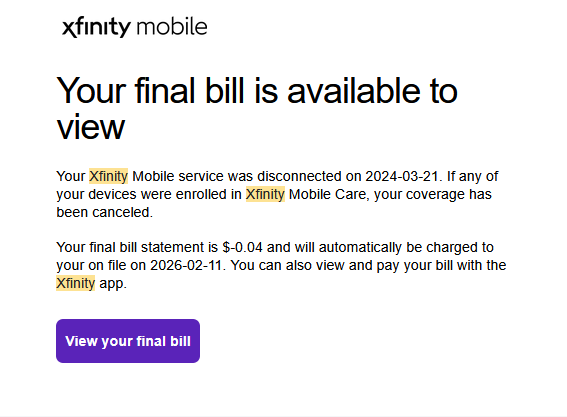
The logic reveals itself most clearly at the margins. Recently, Comcast issued a billing notice for four cents on a mobile account that had been closed for years. There had been no billing activity in the interim. No balance. No contact. Then, suddenly, a four-cent receivable appeared, attached to an account that no longer existed.
No human decided this was worth doing. No human can meaningfully stop it. The cost of generating the notice exceeds the amount claimed, yet the system proceeds anyway. Closure, in this architecture, is never final. Residue persists indefinitely. The machine does not know when something is finished, and no one is empowered to tell it to stop.
Even physical presence offers no relief. Comcast stores, once places where problems could be resolved, now require appointments. Walk-ins are discouraged or refused. Staff are trained to redirect customers back to the same online systems that failed them in the first place. The store exists, but access is conditional. Resolution remains elusive.
Every customer knows this pattern. Every regulator does too.
Comcast has been one of the most complained-about companies in America for decades. Billing errors, phantom fees, silent price increases, equipment charges for returned devices, cancellation resistance bordering on obstruction — none of this is disputed. The complaints are not novel. They are repetitive, consistent, and boring.
And that is precisely why they matter.
These are not edge cases. They are the dominant experience. They represent a stable operating model that persists year after year without meaningful regulatory interruption. State attorneys general receive complaints. The FCC receives complaints. Consumer protection agencies log complaints. Studies are written. Hearings are held. Nothing structural changes.
From time to time, there is action. A fine. A settlement. A consent decree announced with solemn language about accountability. Comcast pays, issues a statement, and continues exactly as before. The penalties are trivial relative to revenue. The practices remain intact. The incentives are untouched.
This is not deregulation. It is regulation emptied of consequence.
What Comcast demonstrates is that regulation now operates safely downstream of harm and carefully upstream of reform. It reacts after abuse is normalized and resolves itself before incentives are disturbed. Regulators intervene just enough to signal relevance, never enough to force redesign.
The crucial shift is that regulation has become procedural rather than judgment-based.
Comcast complies perfectly with procedure. It files reports. It responds to inquiries. It maintains compliance departments staffed with professionals who understand regulatory expectations precisely — including where enforcement stops. The relationship between regulator and regulated entity is continuous, professional, and mutually intelligible.
No one is confused.
Regulators know Comcast’s market power. Comcast knows the regulator’s tolerance. Both sides operate within those boundaries. The question is never whether conduct is acceptable. It is whether it crosses a threshold that triggers escalation. Comcast has mapped those thresholds with care.
Individual customers do not matter. Volume does not matter. Patterns do not matter. Only moments of political visibility or reputational embarrassment do. Even then, the response is calibrated to restore quiet, not impose discipline.
This is why Comcast’s dysfunction feels intentional. The endless transfers, the refusal to allow discretion, the systems that always err in the company’s favor — these are not accidents. They are rational behaviors in an environment where enforcement is predictable and weak.
Regulators are not naïve. Many understand exactly what is happening. But the cost of decisive action is personal and institutional. Forcing Comcast to simplify billing, allow genuine cancellation, empower staff to correct errors, or face penalties that exceed the profits of abuse would provoke litigation, political pressure, and industry backlash.
Doing nothing carries no such cost.
So regulators adapt. They issue guidance. They encourage best practices. They negotiate behavioral commitments that quietly expire. They convert public anger into administrative process. They substitute motion for effect.
The result is regulation as theater.
This is why public trust collapses even as regulatory frameworks expand. People are not angry because there are no rules. They are angry because the rules are irrelevant to their lived experience. They feel the gap directly — in hours wasted on hold, in money wrongly taken, in systems that never correct themselves.
At some point, regulation ceases to constrain power and begins to manage perception. It reassures the public that someone is in charge while ensuring that no one truly is. It absorbs outrage and converts it into paperwork.
Calls for “stronger regulation” miss the point if they mean more rules layered onto a system that refuses to enforce the ones that matter. Comcast does not exploit loopholes. It exploits tolerance. It operates precisely where enforcement ends.
Real regulation would be disruptive. It would force Comcast to change how it makes money. It would empower humans over systems. It would impose penalties that outweigh the gains from abuse. It would treat repetition as intent.
A system unwilling to do that has already chosen continuity over legitimacy.
Regulators who won’t regulate are not failing. They are performing the role they have been structurally assigned: to process complaints, manage appearances, and preserve stability.
Comcast is only the most obvious illustration of a system that now governs airlines, banks, insurers, healthcare intermediaries, data brokers, and utilities alike — a world where regulation remains visible everywhere except where it would need to act.