

This essay is part of William J. Teesdale’s Structural Inquiry archive at strategicintentanalysis.com. The method is simple: begin with what is observable, then follow the pattern through recurrence, constraint, and consequence.
The number three appears throughout sacred architecture, religion, philosophy, testimony, family structure, and government. It is called sacred, complete, harmonious, or divine. Usually the explanation ends there. Three matters because tradition says it matters.
That reverses the inquiry. The better question is whether three possesses structural properties that caused separate cultures to recognize its importance.
Geometry provides the clearest answer.
One point establishes position. Two points establish distance and direction. Connect them and they form a line, but nothing is enclosed. Add a third non-collinear point and the structure changes. Three connected points produce the first polygon. A boundary appears. For the first time, there is an inside and an outside.
The third point has added more than itself. It has created a new condition.
A triangle is also inherently stable. If its sides remain fixed, its angles cannot change. A four-sided frame can lean and deform without altering the length of any side; brace it diagonally and it becomes two triangles. Roof trusses, bridges, transmission towers, cranes, and gates rely upon this property. The importance of the triangle begins in load, constraint, and resistance to deformation.
Three points also produce three relationships. A dyad contains one connection. A triad contains three, with each point related directly to both others. The resulting interior belongs to none of the points separately. It exists because of the form they create together.
The triangle is also foundational in Plato’s account of the elemental bodies. Three of the five Platonic solids have triangular faces: the tetrahedron, octahedron, and icosahedron. The cube does not display triangular faces, but Plato constructs its square faces from right triangles. The dodecahedron stands apart in the Timaeus, associated obscurely with the ordering of the whole. The precise claim is therefore not that every regular solid visibly consists of triangular faces. It is that Plato placed the triangle beneath the construction of the four elemental bodies, making it the generative unit below much of his solid geometry.
Sacred geometry begins when such properties are recognized as expressions of a wider order. The form acquires symbolic meaning because it already demonstrates closure, proportion, stability, and generative capacity. Belief gathers around qualities that persist regardless of belief.
Plato identified the relational importance of three elsewhere in the Timaeus. Two things, he wrote, cannot be properly joined without a third to bond them. Proportion supplies that bond because the middle term stands in relationship to both outer terms. What had been separate can then enter a coherent order without either term disappearing.
This is more exact than saying that three symbolizes completeness. One remains singular. Two creates polarity. Three introduces a relationship to the relationship itself. Difference can be held within a larger form.
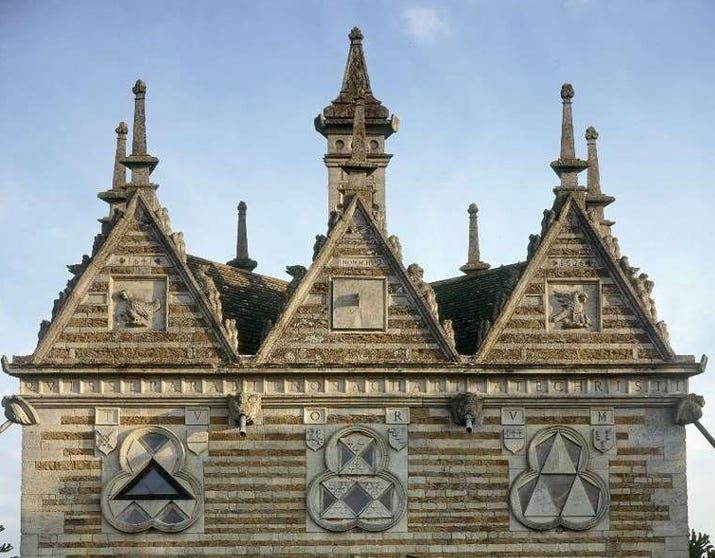
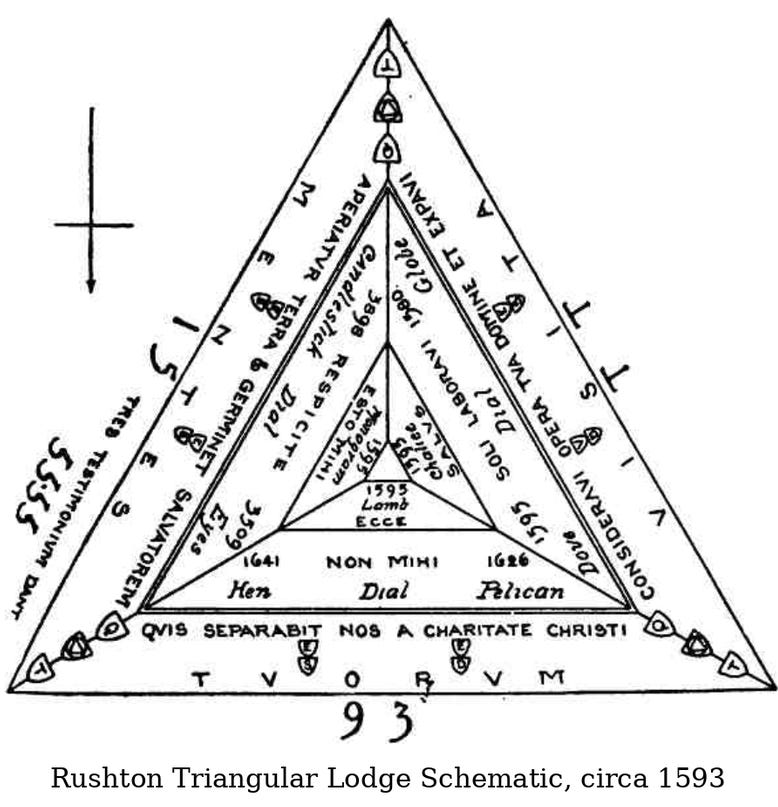
Tresham conceived Rushton Triangular Lodge in 1593 after years of imprisonment and confinement for his Catholic faith. Construction began the following year. The finished building is not a conventional lodge decorated with triangles. Three generates nearly every part of it.
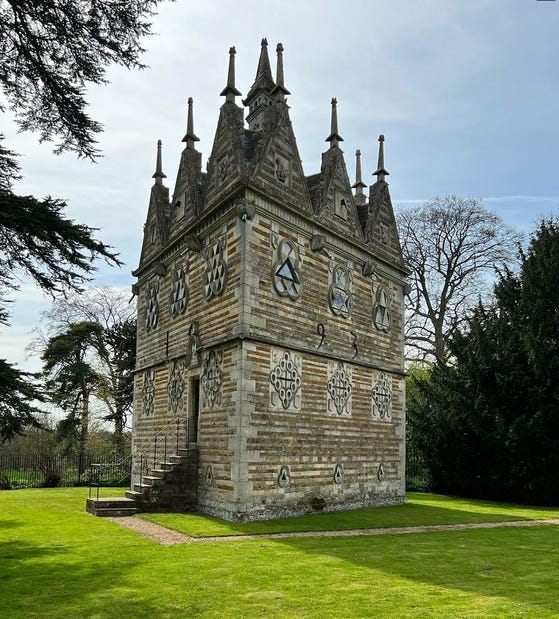
The Lodge has three sides. The official listing records two storeys and a semi-basement, with three windows to each floor on each side. Three pointed gables rise above each face. Each side measures thirty-three and a third feet and carries a biblical text of thirty-three letters. Trefoils, triangular openings, three-sided pinnacles, a triangular chimney, biblical inscriptions, dates, heraldic shields, and family emblems cover the exterior.
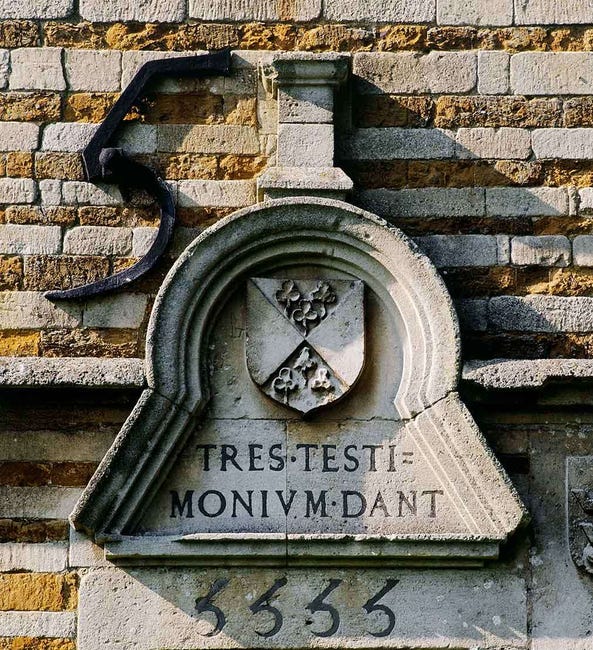
Above the entrance appears Tres testimonium dant: there are three that bear witness. The words refer to the Christian Trinity, but also play upon Tresham’s name. His wife called him “Good Tres.” Faith, family identity, number, resistance, and architecture occupy the same form.
English Heritage describes the Lodge as a “device,” the Elizabethan term for a work carrying concealed or multiple meanings. A viewer could see an elaborate hunting lodge. A person who knew the scriptures, the family history, and the conditions under which English Catholics lived would see much more. The building made a public statement while protecting its full meaning within structure.
Its geometry continues inside. A principal hexagonal room occupies the centre of each floor, leaving three triangular spaces at the corners. One contains the spiral stair. The others form small chambers. The three-sided exterior generates an inhabitable interior.
That may be the building’s most revealing feature. Tresham did not merely carve the number three into stone. He built a place in which three distinct faces create shelter, movement, testimony, and interior life. No wall contains the building by itself. The completed space arises between them.
Tresham left no full explanation of the Lodge, and its documented purpose should remain primary. It expresses Catholic faith, the Trinity, recusant endurance, and family continuity. It cannot prove a universal theory of triadic function. What it demonstrates is more limited and more useful: Tresham understood three as capable of carrying differentiated unity, witness, identity, and habitable form at the same time.
The phrase “three bear witness” introduces a second structural property. Testimony gains force through correspondence among independent observations. A single witness may be truthful, but the account remains singular. Two may corroborate one another, although they may also share the same error, interest, or source. A third independent account adds another line of comparison.
Independence is essential. Three points on the same line enclose nothing. Three witnesses repeating one source add little. The third term completes the structure only when it occupies a genuinely different position.
The sociologist Georg Simmel examined what happens when this geometry enters human relationship. His 1902 paper, The Number of Members as Determining the Sociological Form of the Group, distinguished sharply between the dyad and the triad.
A dyad depends entirely upon its two members. If either leaves, the group disappears. Each confronts the other directly. There is no majority, mediator, coalition, or independent position from which the relationship itself can be observed.
The arrival of a third person changes the group. The third may translate, mediate, preserve continuity during conflict, or reveal common ground that neither member can see from inside the dispute. Simmel noted that a gesture, a way of listening, or the presence of someone trusted by both parties can redirect a conflict before any formal intervention occurs.
He also identified darker possibilities. The third may profit from the disagreement, join one member against the other, or deepen the division in order to control both. Simmel called these forms tertius gaudens, the third who benefits, and divide et impera, divide and rule.
The same structure permits mediation and manipulation. Three is powerful; it is not automatically sacred.
This distinction protects the inquiry from numerology. A triangle can distribute weight or establish hierarchy. Three branches of government can restrain one another or combine to protect the same concentration of power. A third person can reconcile a relationship or govern it through rivalry. The number creates capacity. Alignment determines what that capacity serves.
Charles Sanders Peirce found a comparable structure in meaning. For Peirce, a sign involves three related elements: the sign, the object to which it refers, and the interpretant through which the relationship is understood. Smoke may correspond physically to fire, but it functions as a sign only when something recognizes what the smoke means.
Interpretation is not an ornament added after the relationship. It completes the act of signification.
Peirce called this mediating quality Thirdness. Firstness concerns what is immediately present. Secondness concerns encounter, resistance, or direct relation. Thirdness brings mediation, continuity, law, and intelligibility. An event occurs, something encounters it, and the encounter acquires meaning within a wider order.
This provides a limited bridge to Consciousness as Presence in a Structured World. Peirce does not prove that consciousness is presence. He shows that meaning is not complete as a bare two-term relation between sign and object. Something must interpret the relation. The earlier essay makes a related claim at the level of awareness: presence appears where structure is coherent enough for relation, consequence, and meaning to be held together.
Corrective systems display the same pattern in practical form. A deviation must be detected, compared with a standard, and acted upon. Without detection, the error remains invisible. Without a standard, the system cannot determine whether the observed condition is wrong. Without action, recognition changes nothing.
The functions may operate inside one body, machine, institution, or person. They may also be distributed among several participants. Their significance lies in the fact that none can be reduced to the others. Observation is not judgment. Judgment is not correction.
The constitutional division among legislature, executive, and judiciary reflects this recognition. Federalist No. 51 argued that government must contain internal checks because power will not reliably restrain itself. The three branches make law, execute it, and interpret its limits through separate institutions. The arrangement often fails, but its structure acknowledges that correction becomes difficult when one authority controls rule, application, and judgment.
Religious traditions preserve other triadic forms. The Christian Trinity joins three persons within one divine unity. A Late Period Egyptian figure held by the Metropolitan Museum presents Osiris, Isis, and Horus standing upon one base, joining death, restoration, and living succession within a divine family. One Hindu formulation places creation, preservation, and dissolution in the differentiated forms of Brahma, Vishnu, and Shiva.
These traditions are not versions of a single doctrine. Their differences matter. Their recurrence nevertheless records the same difficulty: a complete process often cannot be represented by singularity or polarity alone. Creation without preservation does not endure. Preservation without transformation hardens into stagnation. Dissolution without renewal ends in destruction.
Three also appears wherever a process must be understood across time. Beginning, middle, and end describe the minimum form of completed movement. Past, present, and future place experience inside continuity. Perception, interpretation, and response carry an encounter into action.
Not every process divides naturally into three. A theory determined to find triads will manufacture them. The relevant test is functional: does the third term perform work that neither of the first two can perform?
Where it does, the triad is structural.
This test also explains why the third position is frequently captured. The interpreter can clarify or distort. The judge can restore proportion or provide legal cover for power. The mediator can end conflict or prolong it for advantage. A religious institution can help people articulate their relationship with the Creator or insert itself into that relationship and claim exclusive control.
The third position often governs how the other two understand one another. Whoever controls it may redirect the whole structure.
A coherent triad therefore requires more than three participants or symbols. Its elements must remain differentiated, independently grounded, and ordered toward a purpose unavailable to any one of them. The whole emerges through relationship. It cannot be imposed by one point absorbing the others.
This opens a limited extension into lineage and incarnation. Lineage as Control and Correction described lineage as a carrier of continuity rather than an inherent source of status. Families and traditions may preserve memory, vocation, protection, healing, judgment, or unresolved work across generations. Different lines may carry different functions without any one becoming complete in itself.
Reincarnation and the Formation of the Soul extends continuity beyond a single embodied life. If consciousness returns, incarnation may carry unfinished relationships and functions back into material form. That does not establish pre-incarnational triads. It permits a narrower question: might some work require complementary capacities to develop separately before they can operate together?
Contact, discernment, and embodiment offer one possible model. They satisfy the same test only if each performs work the others cannot perform. Contact receives what lies beyond the existing frame, but reception alone cannot determine whether what enters is truthful, deceptive, dangerous, or incomplete. Discernment tests what has been received against truth, consequence, and natural law, but judgment alone does not give the result a place in the world. Embodiment carries what survives judgment into action, relationship, institution, household, practice, or memory.
The pairings reveal the incompleteness. Contact and discernment can recognize a signal without changing anything. Contact and embodiment can enact deception with great force. Discernment and embodiment, without contact, may preserve a closed order after reality has already moved beyond it.
Together, the three functions create the possibility of correction. The model remains a thesis, but it is not arbitrary. It follows the same structure visible in geometry, testimony, interpretation, social mediation, and systems capable of detecting and correcting error.
This may have limited relevance to The Turning of the Age. A transition requires more than the failure of an old order. Change must be perceived, judged, and carried into whatever follows. Whether those functions can be distributed across particular people or lineages remains an open question. Sacred geometry establishes no such assignment. It shows why three differentiated functions might form the minimum complete structure through which correction becomes possible.
Rushton Triangular Lodge leaves the question in its clearest form. Three walls face in different directions. Each bears its own windows, inscriptions, shields, and devices. None is the building. Together they enclose a room, support a roof, contain a stair, and preserve a testimony that has survived for more than four centuries.
The interior belongs to no single side.
Three may recur in sacred tradition because it is the first number that turns relation into structure. It holds difference without reducing it to opposition and creates a field in which something new can live.
Source note: Historical and conceptual details were checked against Historic England’s official listing for Rushton Triangular Lodge, English Heritage’s account of the Lodge, Plato’s Timaeus, Georg Simmel’s 1902 study of dyads and triads, Charles Sanders Peirce’s semiotic theory, Federalist No. 51, and museum records for Egyptian triadic figures.