

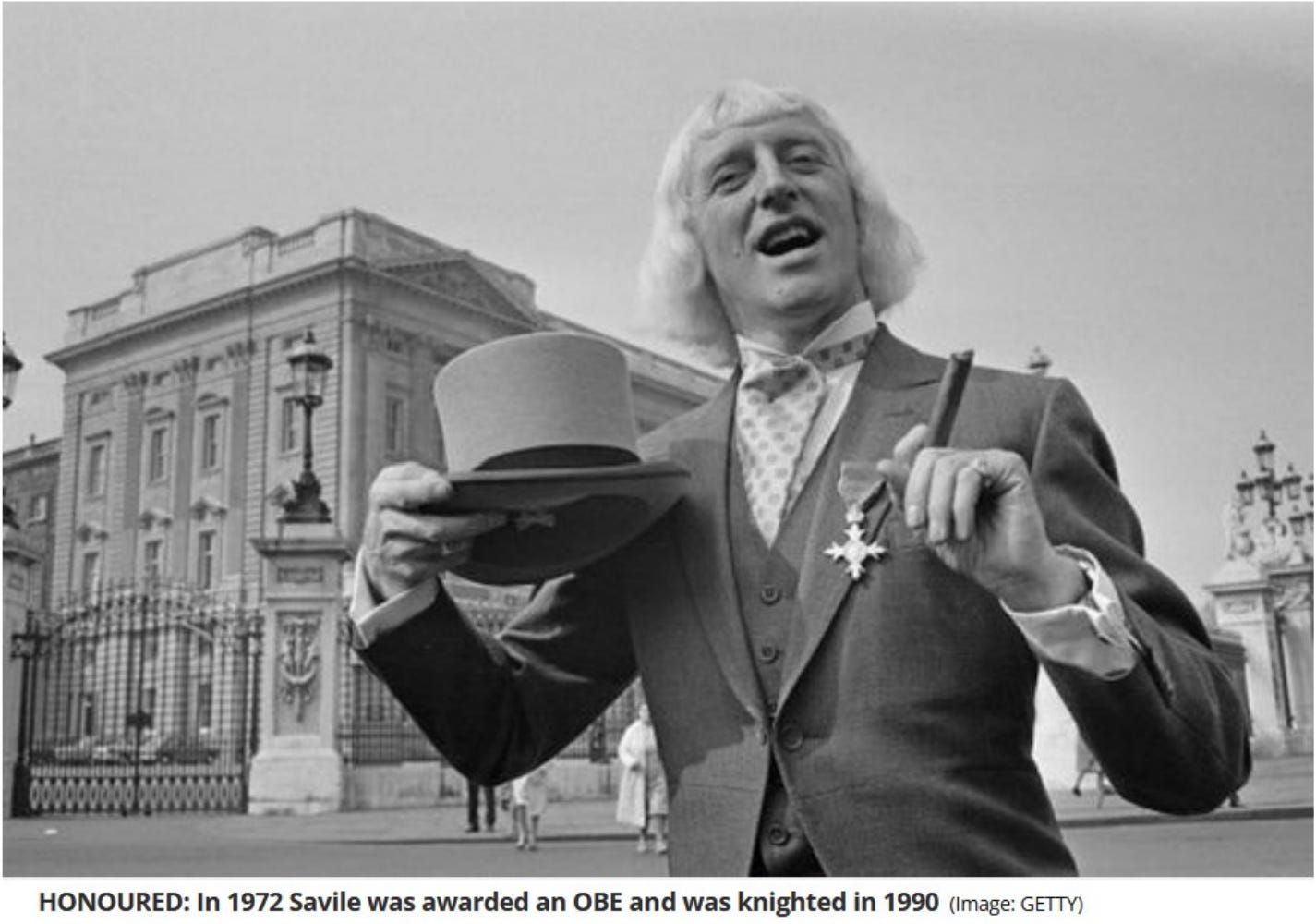
Jimmy Savile was not hidden. He was not subtle. He did not operate in shadows. He operated in full view of the British establishment, making sexual remarks about children on television, touching people in public, cultivating access to hospitals, schools, and youth institutions, and surrounding himself with minors for decades. This was not a man who slipped through cracks. This was a man who was allowed to operate because those in authority chose not to stop him.
The standard story says institutions “failed.” That is false. Failure implies error or incompetence. What occurred was neither. Savile was repeatedly reported. Complaints were filed. Staff raised concerns. Police officers attempted inquiries. Those inquiries were discouraged, downgraded, or closed. Files went nowhere. Witnesses were not pursued. This is not the behavior of a system that lacks information. It is the behavior of a system that has decided that this individual will not be touched.
In 2009 the Metropolitan Police submitted a file to the Crown Prosecution Service concerning allegations against Savile. The CPS declined to prosecute. At the time, Keir Starmer was Director of Public Prosecutions. Years later, after Savile’s death and the public emergence of hundreds of victims, Starmer acknowledged that the case had been mishandled and apologized. The structural fact remains: the highest prosecutorial authority applied a standard that produced inaction. The law was not absent. It was used in a way that functioned as protection.
Savile’s insulation cannot be understood without the Crown. He was not merely a celebrity. He was publicly honored by the monarchy with a knighthood. He had sustained personal access to the royal household. He was widely described as close to the man who is now King, appeared with senior royals, visited royal residences, and was treated as a trusted insider. In a hierarchical state, proximity to the Crown is not decorative. It confers legitimacy, status, and immunity. Once a figure is woven into the symbolic apex of the system, scrutiny no longer targets the individual alone; it threatens the institution itself. That is when investigations stop moving.
The BBC did not lack knowledge. Savile was described internally as an “open secret.” Journalists and producers have stated that investigations were prepared and then shelved, concerns overridden, programs killed. Savile was a brand, a fundraiser, a national figure. Exposing him would have required the institution to expose itself. Silence was organizational self-protection.
Savile’s access to children was not incidental. It was authorized. He was embedded in institutions that exist to protect the vulnerable: hospitals, charities, youth organizations, boarding schools, psychiatric facilities. He was given keys, rooms, and unsupervised authority. Allegations have come from multiple sites over decades. Staff instructed victims to pretend to be asleep when he arrived. This was not moral weakness. It was operational choice.
The pattern does not end with Savile. The same royal ecosystem that honored him intersects directly with another global trafficking case. The King’s brother maintained a documented relationship with Jeffrey Epstein, a convicted sex trafficker of minors, and that relationship continued after Epstein’s 2008 conviction. Virginia Giuffre testified under oath that Epstein trafficked her to Prince Andrew while she was underage. Andrew denied the allegation, but he did not submit to questioning by U.S. authorities who sought to interview him and ultimately settled the civil case out of court and withdrew from public duties. Proximity to the apex of power again coincided with insulation from consequence.
This is not about two men. It is about a structure. In each case the same elements appear: privileged access to vulnerable populations, early reports that go nowhere, investigations stopped from above, media suppression, legal thresholds applied to ensure inaction, and after exposure, responsibility isolated to individuals while the architecture remains untouched. This is not incompetence. It is containment.
What remains is convergence: independent testimony, repeating institutional behavior, identical outcomes across different domains. The system does not ask whether allegations are true. It asks whether it can afford for them to be true. When the answer is no, the machinery activates—jurisdictional fog, evidentiary thresholds, reputational risk, internal loyalty—and the vulnerable are left unprotected.
Others will see something colder: a pattern that reproduces itself, feeds on secrecy and trauma, and inverts what institutions claim to exist for. Whether one interprets that pattern as purely human or as something more is not the claim being made here. What is claimed is simpler and harder to dismiss. The protection is real. The access was real. The suppression was real. The inversion is real.
Savile did not evade authority. He was carried by it. He was knighted, welcomed, embedded, and protected while children were placed in his path and investigators were turned away. Andrew was not compelled to answer questions while a trafficked victim named him. That is not coincidence. That is design.
Savile was not an anomaly. He was a demonstration.