

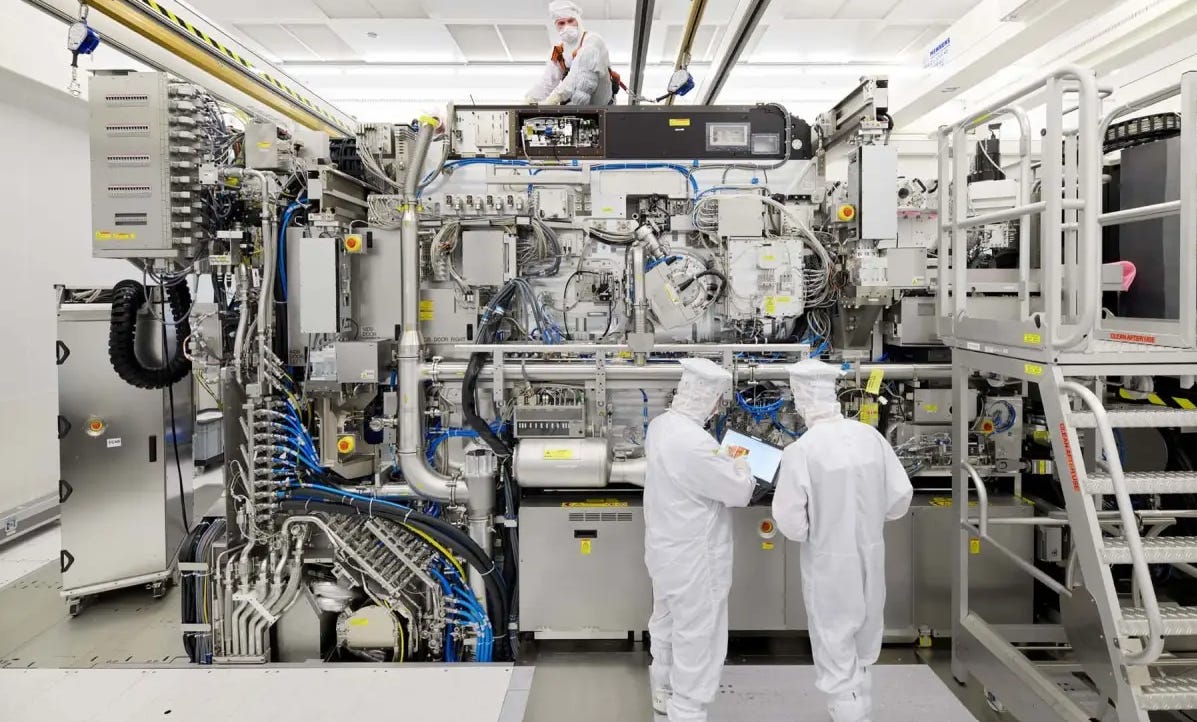
Modern technological systems are often discussed in terms of software platforms, digital services, artificial intelligence models, and networked communication. Beneath these layers sits a physical substrate that receives comparatively little public attention: semiconductor manufacturing.
Semiconductors form the material basis of modern computation. They appear inside servers, telecommunications equipment, medical devices, industrial machinery, transportation systems, weapons platforms, and consumer electronics. They function as a foundational input across the technological economy rather than as a discrete industrial sector.
The strategic importance of semiconductors arises not only from their ubiquity but from the structure of their production. The most advanced chips are manufactured in a remarkably small number of highly specialized fabrication plants supported by an equally narrow ecosystem of lithography tools, materials supply chains, process engineering expertise, and design integration.
As a result, advanced technological capability depends on a limited set of industrial nodes.
This structure contrasts with the common perception of the digital economy as inherently decentralized. Information flows easily across networks and software can be replicated globally at minimal cost. The manufacturing processes that enable computation, however, remain highly concentrated.
Advanced semiconductor production operates within a layered industrial architecture. Chip design, lithography equipment, fabrication facilities, packaging, testing, materials purification, and process control each contain technical bottlenecks. Only a small number of firms and facilities possess the capability to operate at the leading edge of these processes. The resulting system resembles a narrow manufacturing stack rather than a widely distributed industrial base.
This concentration has structural consequences because semiconductors function upstream of many other capabilities.
Artificial intelligence development depends on computing power. Computing power depends on advanced processors. Advanced processors depend on specialized fabrication processes. Military systems rely on sensing, signal processing, communications hardware, and embedded computation, all of which require semiconductor components. Telecommunications infrastructure, cloud services, and industrial automation similarly depend on integrated circuits.
In this sense semiconductor fabrication functions as a governing layer beneath multiple technological domains.
Countries may possess strong research institutions, substantial capital resources, and skilled engineering workforces yet still remain dependent if they lack access to advanced fabrication capacity. Design capability, assembly capability, and domestic consumption do not substitute for manufacturing depth at the highest process levels.
Technological sovereignty therefore includes an industrial dimension that is sometimes overlooked in discussions focused primarily on software, data, or digital services.
The concentration of fabrication capacity also changes how disruption propagates through modern systems. Interruptions in semiconductor supply affect far more than consumer electronics. They influence vehicle production, industrial control systems, telecommunications equipment, and computing infrastructure. Delays at the manufacturing layer can therefore propagate across multiple sectors simultaneously.
This characteristic makes semiconductor production infrastructure unusually consequential.
A fabrication facility is not simply a factory producing interchangeable goods. It operates within a complex environment of precision manufacturing, advanced materials science, specialized equipment, and accumulated process knowledge. These facilities require extensive capital investment, stable power infrastructure, ultra-clean manufacturing conditions, highly trained personnel, and long development timelines.
Because the knowledge embedded in semiconductor manufacturing processes accumulates slowly, the ecosystem surrounding existing fabrication centers tends to reinforce itself over time. Tool suppliers, engineering talent, supplier networks, and supporting industries cluster around established production locations.
The geography of fabrication therefore shapes the geography of technological capability.
Ownership and governance of fabrication ecosystems add an additional layer of significance. Semiconductor production exists within legal frameworks governing export controls, intellectual property, national security restrictions, and industrial policy. The interaction of corporate ownership, state regulation, financial support, and political alignment influences who ultimately controls access to advanced manufacturing.
Technological capability is therefore partly determined by institutional arrangements surrounding production infrastructure.
The semiconductor system illustrates a broader pattern visible across modern infrastructure networks. Many systems that appear globally distributed depend in practice on narrow physical bottlenecks. Container shipping routes, energy transit corridors, undersea communication cables, and cloud computing infrastructure display similar structural characteristics. As explored in The Physical Internet: Submarine Cables and Global Communication, global digital communication relies on a relatively small number of undersea fiber routes linking continents. A comparable pattern appears in maritime trade, where a limited set of ports and shipping corridors dominate global logistics, as examined in Container Shipping and the Hidden Architecture of Global Trade.
Semiconductors represent one of the most technically sophisticated examples of this pattern.
Infrastructural concentration does not necessarily reflect intentional design. It often emerges from economic incentives favoring scale, specialization, and efficiency. Over time these incentives can produce production architectures that are highly efficient under normal conditions but sensitive to disruption at key nodes.
Semiconductor manufacturing reflects this dynamic particularly clearly because the technical barriers to entry are extremely high.
A leading-edge fabrication facility represents the visible portion of a dense industrial ecosystem. Equipment manufacturers, specialty chemical suppliers, precision engineering firms, process engineers, and research institutions all contribute to the functioning of the system. Replicating such an ecosystem requires not only capital investment but also long periods of knowledge accumulation and workforce development.
This is why semiconductor geography tends to change slowly.
Once established, fabrication clusters become embedded within broader technological systems. Industrial policy initiatives may seek to expand capacity or diversify manufacturing locations, but the process of building a fully functioning semiconductor ecosystem typically unfolds over many years.
The result is that a relatively small number of fabrication facilities exert disproportionate influence over global technological production.
Semiconductors therefore occupy an unusual position within modern infrastructure. They are both a component within individual devices and a structural layer supporting entire technological systems. The architecture of their production—where fabrication occurs, who controls the facilities, and how the surrounding ecosystem operates—shapes the distribution of technological capability across the global economy.
Understanding this structure clarifies why semiconductor manufacturing has become central to contemporary discussions of technological power. The most advanced computing systems, communications networks, and industrial platforms ultimately depend on a manufacturing process that occurs in only a small number of locations.
Technological sovereignty is therefore not determined solely by innovation, capital, or market demand. It is also shaped by access to the industrial processes that transform designs into functioning hardware.
In practical terms, global technological capability rests on a remarkably small number of fabrication plants.