

There is a quiet doctrine sitting at the heart of modern law that would be rejected instantly if it were proposed today. It is not obscure. It is not meaningfully technical. And yet it remains largely unquestioned. Sovereign immunity is the principle that the state cannot be sued without its own consent. In practice, it means that the actor with the greatest power, the widest reach, and the most capacity for harm is often the least accountable.
This is not a marginal feature of the legal system. Sovereign immunity shapes how governments interact with citizens, how agencies behave when they err, and how harm is allocated when the system fails. It is one of the clearest examples of law functioning not as a constraint on power, but as a mechanism for preserving it.
The doctrine is usually justified on historical grounds. It descends from the medieval maxim that the King can do no wrong. That phrase is often treated today as a metaphor or an anachronism, but its legal consequences remain literal. The sovereign—whether monarch or modern administrative state—is insulated from ordinary legal accountability. Not because it is always right, but because allowing it to be wrong, in a legally consequential way, is said to threaten governance itself.
What makes the persistence of this doctrine especially striking in the United States is the story Americans tell themselves about their founding. The settlers did not claim to be refining English authority; they claimed to be escaping it. They left to avoid arbitrary power, unaccountable rulers, and inherited privilege. And yet one of the most consequential relics of that system—the idea that the sovereign stands above the law—was carried across the Atlantic intact, quietly embedded in a republic that purported to reject the premise entirely.
This was not an accident. New systems often overthrow old symbols while preserving old power mechanics. The crown disappeared; the insulation remained. Sovereign immunity survived not because it was philosophically coherent with republican government, but because it was administratively useful.
That utility comes at a cost that lawyers recognize instinctively. In every other domain of law, greater power brings greater responsibility. Corporations are regulated precisely because of their scale. Fiduciaries are held to higher standards because of their authority. Professionals are disciplined because their errors carry outsized consequences. Yet the state—which monopolizes lawful force, taxation, regulation, and land adjudication—claims exemption from the very accountability it imposes on others.
Defenders of sovereign immunity argue that without it, governments would be paralyzed by litigation. Officials would become risk-averse. Public resources would be drained by lawsuits. But this argument quietly assumes something revealing: that the state expects to cause harm at a scale that would be intolerable if fully exposed. Immunity is framed as protection against frivolous claims, but in practice it functions as a hedge against systemic wrongdoing.
Where immunity is waived, it is done selectively and conditionally. In the United States, the Federal Tort Claims Act permits suits in limited circumstances, while excluding vast and consequential categories of state action—discretionary functions, policy decisions, enforcement conduct, and most constitutional violations. The closer the conduct lies to actual power, the more likely immunity applies. For lawyers, the pattern is unmistakable.
This asymmetry is not merely inefficient; it is formative. When private actors cause harm, law intervenes. When the state causes harm, law often retreats. Over time, institutions learn. Risk is externalized downward. Errors are absorbed by individuals. Accountability becomes rhetorical rather than operative.
This structure becomes even more revealing when the harmed party is itself a sovereign.
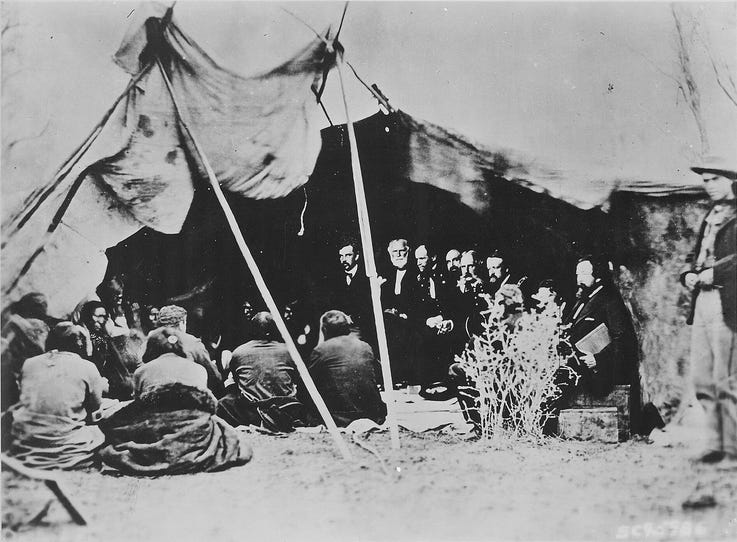
Indigenous Nations were not merely populations encountered by the expanding state; they were organized political communities exercising sovereignty over land, law, and people. Yet from the earliest period of expansion, American law refused to recognize that sovereignty on equal terms. Doctrines such as the Doctrine of Discovery and Manifest Destiny operated to reduce Indigenous Nations to a diminished legal status—neither foreign states nor equal domestic sovereigns, but entities whose rights existed only to the extent the conquering power chose to acknowledge them. This was not incidental prejudice; it was legal architecture. Indigenous peoples were treated as wards, obstacles, or occupants, rather than as coequal sovereigns—rendering their dispossession not only possible, but administratively manageable.
Nowhere is this structure more clearly exposed than in the treatment of treaties with Indigenous Nations.
These were not aspirational commitments or vague policy statements. They were negotiated agreements between sovereigns, ratified by the United States, and expressly declared to be the supreme law of the land. Many predate statehood itself. They involved explicit promises concerning land, jurisdiction, self-governance, and mutual obligation. And yet they have been violated repeatedly, openly, and often permanently.
Sovereign immunity plays a central role in this outcome. It allows the state to acknowledge breach while resisting consequence, to concede injustice while refusing restitution, and to substitute monetary settlements for obligations that were never reducible to money—particularly land, sovereignty, and self-determination. The government becomes, simultaneously, the breaching party and the arbiter of remedy.
For lawyers, this should be deeply unsettling. If even treaties—the highest form of legal commitment—are unenforceable against the state absent its consent, then sovereign immunity is not a procedural doctrine. It is a hierarchy. And it places the sovereign above the law it claims to administer.
The result has been the structural subjugation of Indigenous peoples through law rather than despite it. Land is taken and not returned. Jurisdiction is narrowed and not restored. Promises are acknowledged and then declared nonjusticiable. The inhumanity lies not only in the outcomes, but in the legal architecture that renders those outcomes permanent.
Sovereign immunity also distorts constitutional law more broadly. Rights are articulated as fundamental, but their enforcement depends on whether the state has consented to be held accountable for violating them. This converts rights into aspirations rather than guarantees. From a legal standpoint, the implication is stark: a right without a remedy is not a right at all, but a statement of values without binding force.
Seen through a systems lens, sovereign immunity is a form of option removal as strategy. By eliminating the possibility of suit, the system removes a critical corrective feedback loop. Errors do not propagate upward. They are contained, individualized, and normalized. The institution remains stable precisely because it does not have to learn.
This is why reform efforts focused on training, ethics, or leadership routinely disappoint. The problem is not primarily bad actors. It is structural insulation. A system that cannot be meaningfully challenged will eventually behave as though it cannot be wrong.
The deeper issue is legitimacy. Governments derive authority from the claim that they act on behalf of the people and under law. Sovereign immunity contradicts that claim. It asserts that the state is not merely a delegated agent, but a distinct legal entity elevated above those it governs. Once accountability becomes discretionary rather than inherent, legitimacy erodes—even if formal legality remains intact.
If law is to function as more than procedural compliance, sovereign immunity must be reexamined. Not abolished reflexively, but constrained seriously. Immunity should be exceptional, narrowly justified, and transparently defended—not inherited uncritically from feudal logic that a modern constitutional state claims to have rejected.
A system that cannot be sued is a system that cannot be corrected. And a system that cannot be corrected does not deserve the moral authority it claims. Sovereign immunity is not a technical necessity. It is a remarkable injustice—one that has long enabled the legal subjugation and inhumane treatment of Indigenous Nations, and continues to do so in plain sight.