

Long before the world was described in equations, it was experienced as ordered.
Not ordered by control or force, but by rhythm. By balance. By patterns that appeared consistently in nature, the body, the sky, and sound. Ancient cultures did not separate the physical from the spiritual because they did not experience them as separate domains. The world behaved as though it were structured from within.
Modern science, for a long time, taught the opposite. Matter was inert. Energy acted upon it from outside. Structure was imposed, not revealed. Meaning was projection.
But certain observations never fit that picture.
Cymatics is one of them.
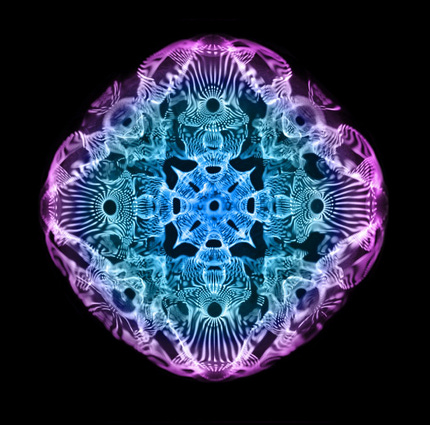
When vibration is introduced into matter — sand on a plate, powder on metal, water in a vessel — the material organizes itself into precise, repeatable geometric forms. Each frequency produces a distinct pattern. Change the frequency, and the form changes. Remove the vibration, and the geometry dissolves.
Nothing is assembled.
Nothing is instructed.
Order arises naturally from oscillation.
Science describes this as standing waves and resonance. But what it is showing is older than the language used to explain it: form is an expression of underlying order, not an accident of collision.
Structured water reveals the same principle at the foundation of life.
Within living systems, water does not behave like bulk liquid. Near biological surfaces — membranes, proteins, connective tissue — water spontaneously organizes into ordered, layered states. These regions exclude impurities, maintain electrical separation, and persist dynamically as long as energy flows through the system.
This is not mystical speculation. It is measurable. But its meaning extends beyond measurement.
Water, in these states, behaves less like a passive substance and more like a responsive medium. It holds alignment. It carries continuity. It sustains pattern. In other words, it behaves as though it participates in order rather than merely containing it.
Cymatics explains how such order can arise without force. Structured water explains how it can persist.
Together, they point to a world in which structure is primary, and matter conforms to it.
This does not require belief in an invisible hand manipulating particles. It requires recognition that reality is organized by fields, rhythms, and relationships before it is expressed as objects. Geometry appears not because matter is commanded, but because it is tuned.
This is why rhythm matters biologically. Heartbeat, breath, circulation, circadian cycles — these are not secondary processes layered onto a mechanical body. They are stabilizing oscillations that maintain form. When rhythm degrades, structure follows. Long before chemistry fails, coherence does.
Ancient practices now read less like superstition and more like practical alignment with this reality. Chanting, bells, bowls, flowing water, immersion, movement — these were ways of maintaining resonance within a living, water-rich body. Springs were sacred because water that moved, interacted with stone, and remained exposed to natural fields retained vitality. Still, stagnant water did not.
They did not need to speak of “structured water” or “standing waves.” They observed effects and respected causes.
Modern systems inverted this relationship. Water was isolated, pressurized, chemically altered, and stripped of movement. Sound was dismissed as subjective. Rhythm was treated as incidental. Structure was ignored — and then endlessly repaired after the fact.
Science now finds itself rediscovering what was always implicit: matter is not indifferent to order. It responds to it. It expresses it.
Cymatics and structured water do not reduce spirituality to physics. They do the opposite. They show that the physical world behaves as though it is shaped by meaning, pattern, and coherence at a fundamental level.
Not imposed meaning.
Inherent order.
The spiritual is not floating above the material. It is the architecture the material follows.
Life does not need to be mythologized to be sacred.
It only needs to be understood as structured from within.
And that structure — rhythmic, geometric, coherent — is still visible to anyone willing to look.