

Britain is often described as becoming a surveillance state, as though the shift were sudden, recent, or caused by a single political turn.
The historical pattern suggests something else.
The United Kingdom did not adopt domestic surveillance through emergency transformation. It built a monitoring environment gradually, through successive legal, technological, and administrative expansions over several decades. Each measure was presented as limited, targeted, or necessary. The cumulative effect was structural.
What now exists is not an exceptional capability held in reserve. It is a normal operating condition.
To understand that condition, surveillance has to be placed within the broader direction of governance rather than treated as a separate development.
The structural trajectory of demographic change was examined in UK Immigration: Policy Failure or System Direction? That analysis reviewed more than two decades of sustained high inflow across governments and political cycles despite repeated official warnings about integration capacity, pressure on services, and social cohesion. The central finding was persistence under negative feedback. Under Strategic Intent Analysis, continued movement along a repeatedly warned-against trajectory indicates system direction rather than policy drift.
Once that direction is established, the question changes. The issue is no longer whether social complexity will increase, but how the governing system prepares to operate within a more fragmented environment.
The constitutional setting for that preparation was examined in Britain Has Never Had Freedom of Expression: Parliamentary Sovereignty and the Permission Model. That essay showed that expressive liberty in the United Kingdom has never been placed beyond legislative reach. Speech exists by statutory tolerance rather than constitutional protection. Intervention does not require conviction. Investigation, record creation, warning, and administrative burden can all function as mechanisms of behavioural adjustment. The structure permits compliance without requiring overt repression at scale.
The operational consequences of those conditions were examined in Governance Under Permanent Friction. That analysis concluded that sustained demographic transformation, combined with institutional preparation for public disorder and expanded authority over protest and communication, points to planning for a higher-friction social environment rather than an unexpected outcome.
The surveillance architecture completes that pattern.
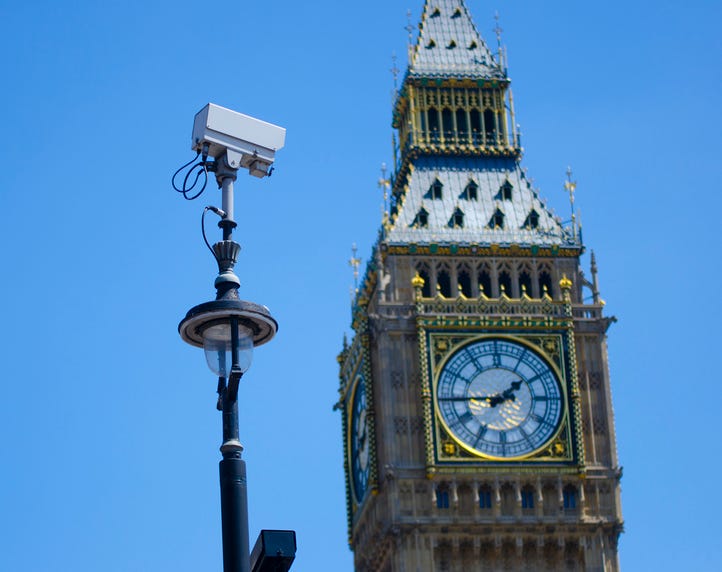
The United Kingdom has one of the most extensive public camera environments in the world. Closed-circuit television expanded through public safety initiatives, urban regeneration programmes, transport security, and local authority deployment. Over time, these systems spread across policing, traffic management, retail environments, transport infrastructure, and private premises. More recently, automated facial recognition trials and live deployments have extended the capability from passive recording to real-time identification.
Physical observation is only one layer.
Successive legal frameworks expanded the retention and accessibility of communications data. Law enforcement and intelligence agencies gained wider authority to access metadata relating to phone use, internet activity, location information, and digital interaction patterns. Data-sharing arrangements widened across policing, security services, local authorities, health systems, safeguarding bodies, and administrative agencies. Identity verification requirements increased across banking, housing, employment, and public services, binding individuals more tightly to institutional records.
At the same time, the Online Safety framework extended regulatory oversight into lawful digital communication on the basis of risk assessment rather than criminal threshold. Platform compliance duties, reporting structures, and monitoring expectations widened system awareness into ordinary communication environments.
Each of these measures was introduced separately. Together they make continuous observation part of ordinary governance.
The defining feature of this system is permanence. Surveillance powers are embedded in standing legislation rather than emergency provisions. Data retention functions as routine administration. Camera networks and digital monitoring systems are maintained as long-term capital infrastructure. Cross-agency information exchange is institutionalised rather than exceptional.
Systems do not build enduring observation capacity for temporary conditions.
The timing of this expansion aligns with the wider governance environment. As population size increased, social composition diversified, and geographic concentration intensified, the informational requirements of governance changed. More fragmented societies generate more localised risk, faster information flows, and greater potential for rapid mobilisation. Consensus-based stability becomes less reliable. The governing value of continuous awareness rises.
Observation reduces uncertainty.
When monitoring is widespread, tension can be detected earlier. When data integration expands, behavioural patterns become visible across multiple domains. When authority over expression and assembly remains flexible, intervention can occur at lower thresholds through administrative means rather than overt force.
Large-scale coercion is rarely the first requirement. Behaviour is often stabilised through visibility, record persistence, and uncertainty about consequences.
Public-order doctrine, national risk registers, and inspection regimes increasingly treat large-scale disruption not as a remote contingency, but as a condition the governing system expects and prepares to manage. That planning posture is itself evidence of anticipation. Surveillance capacity belongs within that same pattern. Monitoring infrastructure does not create friction by itself, but it does give the state the ability to detect, map, and manage instability once it appears. The pattern is not one of improvised response, but of deliberate preparation for conditions that were expected in advance.
Public language has moved in parallel. Official and academic discussion increasingly refers to polarization, extremism risk, misinformation, community tension, and the need for early intervention. Measures that expand monitoring are framed as preventative rather than exceptional. Over time, continuous observation comes to be understood as a normal condition of safety.
Viewed in isolation, any single surveillance measure can appear limited.
Viewed alongside sustained demographic expansion, permission-based expression, expanded protest regulation, and institutional planning for recurring disorder, the pattern is coherent.
The United Kingdom did not drift into extensive monitoring.
It built the informational capacity required to govern a larger, more fragmented, and less cohesive social environment.
The significance of this trajectory lies not in any single technology or legal power, but in the operating assumption it reveals. Continuous monitoring is no longer a contingency capability reserved for crisis.
It is part of the baseline machinery of governance.
When a system expands population scale and diversity despite repeated warnings about cohesion, retains legislative flexibility over speech and assembly, plans operationally for sustained internal friction, and simultaneously builds permanent population-level observation capacity, the pattern is not one of isolated policy decisions.
It is one of preparation.
The United Kingdom did not simply respond to the tensions of a more divided society. It sustained the policy direction that made those tensions more likely, then built the surveillance architecture required to govern the outcome. Under Strategic Intent Analysis, the pattern is not one of error followed by adaptation, but of deliberate trajectory: fragmentation reinforced, monitoring expanded, and the resulting environment made governable through permanent observation.