

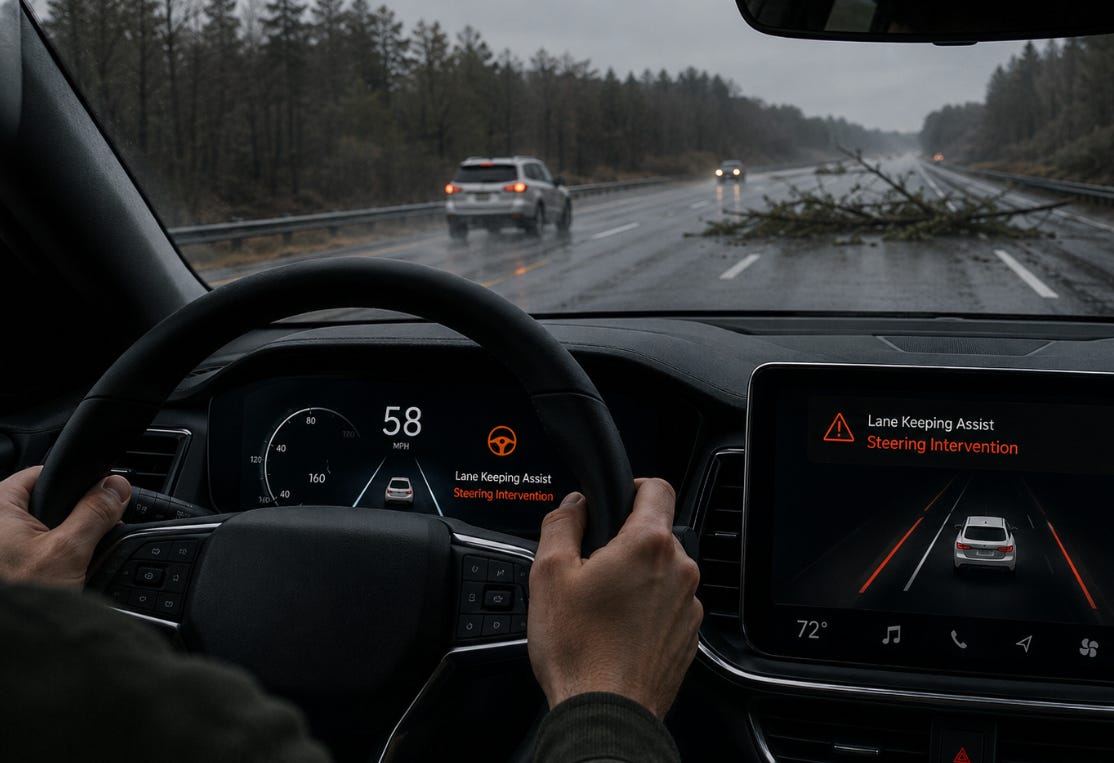
For most of the automobile’s history, the driver’s relationship with the machine was plain enough. The car responded to pedals, wheel, gearshift, brake, and hand. It could fail mechanically. It could skid, stall, overheat, or break down on the shoulder. But it did not watch the driver’s face. It did not judge attention. It did not issue behavioral correction. It did not tug the wheel because software believed the human being had made the wrong decision.
That has changed.
The modern car is no longer only a machine. Increasingly, it is a rolling software environment. Cameras, sensors, driver-monitoring systems, lane-assistance features, telemetry, over-the-air updates, subscription locks, remote diagnostics, and automated intervention systems have altered the basic character of the vehicle. The change has arrived gradually, feature by feature, always wrapped in the language of safety, convenience, or efficiency. But the cumulative effect is larger than any one feature. The privately controlled mechanical object is being replaced by a monitored, software-governed mobility platform.
Most people notice the shift first as irritation.
A new vehicle beeps because the driver looked away for a moment. A warning flashes because the steering wheel was held too lightly. A camera decides the driver’s eyes moved incorrectly. Lane assistance resists a maneuver that the driver intended. The machine is no longer passive. It is now an evaluator, a supervisor, and at times an opponent.
Some of these systems provide genuine safety benefits. Blind-spot warnings can help. Collision alerts can prevent accidents. Fatigue detection may protect a driver who should not be on the road. Modern vehicles are safer than older vehicles in many measurable respects. They are often more crashworthy, more efficient, and more technically capable.
The problem is not technological improvement. The problem begins when improvement becomes supervision, and supervision becomes control.
Lane-keeping assistance is not merely a dashboard suggestion. NHTSA describes it as a system that can correct steering, brake or accelerate one or more wheels, or combine these actions to return the vehicle to its lane. NHTSA separately describes Level 2 driver-assistance systems as systems that may perform steering, acceleration, and braking while the human driver remains responsible for monitoring the road.
That is the structural break. The driver remains responsible, but the machine is now allowed to participate in control.
This is the automotive version of the pattern examined in When Systems Make Decisions. Once institutions depend on systems that can process, classify, and act faster than human judgment, authority migrates toward the system itself. Human beings are left supervising outputs they may not fully control or understand. The earlier essay described the deeper problem clearly: responsibility remains with the institution, while decision power relocates into processes no individual can directly exercise.
On the road, this is not an abstract governance problem. It is physical.
AAA found in 2020 real-world testing that active driving-assistance systems experienced problems about every eight miles, and that nearly three-quarters of public-road errors involved lane departure or erratic lane position. NHTSA’s Office of Defects Investigation opened a preliminary evaluation into VinFast VF8 vehicles after fourteen owner complaints alleged lane-keeping assist problems, including improper steering inputs and difficulty overriding the system. NHTSA’s opening resume stated that improper steering inputs can require high driver-control effort and increase the likelihood of crash or injury.
That is not annoyance. That is a driver fighting the car.
The danger appears most clearly in the ordinary emergencies that do not fit the software model: debris in the road, a fallen branch, a cyclist too close to the lane edge, an animal, construction markings, faded paint, snow, a drifting truck, a stopped vehicle, or a driver forced to cross a line to avoid something worse. Lane departure is not always error. Sometimes it is competent driving.
A system built to treat lane departure as a mistake can become dangerous precisely when leaving the lane is the safest available act.
This is why the Boeing 737 MAX comparison is direct. The comparison is not between cars and airplanes as objects. It is between two classes of software intervention systems. In both cases, software introduced under a safety rationale can impose physical control on the basis of sensor interpretation. In both cases, the machine can misread reality. In both cases, the human operator may have to overcome the machine under stress. And in both cases, the person left responsible for survival may be required to fight a system that should never have been allowed to become an adversary.
The MAX disasters showed what this architecture can produce when failure mode, disclosure, override, training, and institutional accountability are mishandled. The FAA later identified erroneous angle-of-attack data activating MCAS and causing nose-down stabilizer trim as one of the safety issues that had to be addressed before the aircraft returned to service. The Department of Justice charged Boeing in 2021 with conspiracy to defraud the FAA’s Aircraft Evaluation Group, and Boeing entered a deferred prosecution agreement involving more than $2.5 billion. The DOJ’s own statement described deception concerning MCAS-related information.
The lesson is not that every lane-assist system is MCAS. The lesson is sharper than that. Automated safety systems are not benign because they are called safety systems. Once software can influence or seize physical control, the relevant questions are failure mode, notice, disclosure, override, and accountability.
The automotive version may be more dangerous at the level of systemic exposure. Aircraft operate in a specialized environment, in limited fleets, under professional training regimes. Lane-assistance systems operate on wet roads, dark roads, rural roads, icy roads, poorly marked roads, city streets, highways, construction zones, and school zones. They operate around ordinary drivers, tired drivers, frightened drivers, elderly drivers, new drivers, distracted drivers, and drivers reacting to sudden danger. They are not waiting for rare aviation conditions. They are continuously reading lanes, continuously evaluating road position, and in many vehicles continuously prepared to intervene.
At that scale, low-frequency failure is not small. It becomes distributed risk built into ordinary life.
This is a concrete version of Risk Without Owners. The system intervenes, but the driver absorbs the consequence. Decision power and risk exposure are being separated. The broader pattern is the same one identified there: authority concentrates while responsibility disperses, and the people exposed to the consequences are not the ones who designed, mandated, or normalized the risk architecture.
The change also alters the meaning of ownership.
Older vehicles were not perfect, but ownership carried a recognizable practical meaning. The owner could maintain the car, repair it, modify it, understand it, and operate it with relatively direct control. Increasingly, the owner of a new vehicle participates in a managed environment. Features can be locked behind subscriptions. Software can be updated remotely. Diagnostics may require proprietary systems. Driver behavior can be monitored. The vehicle may record, transmit, classify, warn, limit, or intervene.
The car is still purchased as property. It increasingly behaves like access.
That is why this issue belongs with Behavioral Scoring and Conditional Participation. That essay examined a broader shift in which participation is no longer simply granted and held, but monitored continuously and made capable of suspension, downgrade, or withdrawal. The sequence matters: first monitoring becomes permanent, then scoring becomes continuous, then participation becomes conditional.
The automobile is entering that sequence.
This transformation was not meaningfully chosen by drivers. Consumers can choose brand, color, trim, financing, warranty, and wheel package. They are rarely offered a meaningful choice between a privately controlled mechanical vehicle and a supervised software platform. The direction is set by regulation, liability management, insurance economics, emissions policy, data integration, fleet logic, and manufacturer design. The market still offers options inside the system. It does not offer real consent to the system itself.
No single institution needs to intend the final result. Regulators seek lower fatalities. Manufacturers seek liability protection. Insurers seek more predictable risk. Software vendors seek data and recurring revenue. Fleet operators seek standardization. Environmental authorities seek compliance. Each incentive can be defended within its own narrow frame. Taken together, they move the automobile away from autonomy and toward managed behavior.
This is why the modern automobile matters as more than a consumer complaint. Driving has long represented one of the last ordinary forms of decentralized physical autonomy. A person could enter a machine, turn a key, and move through the world without asking a platform for permission. That practical freedom had psychological weight. The car was not only transportation. It was one of the remaining spaces where action still felt direct.
Continuous monitoring changes that feeling.
A society can reduce risk by reducing discretion. It can reduce error by narrowing judgment. It can produce more predictable behavior by treating human choice as a hazard to be managed. But at some point, the safety system stops protecting the driver and begins disciplining him.
The danger is not that software sometimes fails. Everything fails. The danger is that imperfect software is being given authority to interfere with human operators across millions of continuous real-world interactions, while the human being remains responsible for consequences the machine helped create.
Most drivers will not describe the problem in legal or structural terms. They will say the car feels annoying, intrusive, overbearing, or no longer fully theirs.
That intuition is correct.
The car is no longer merely being improved. It is being governed.
The method, subjects, and selected essay index for Strategic Intent Analysis are organized at strategicintentanalysis.com.