

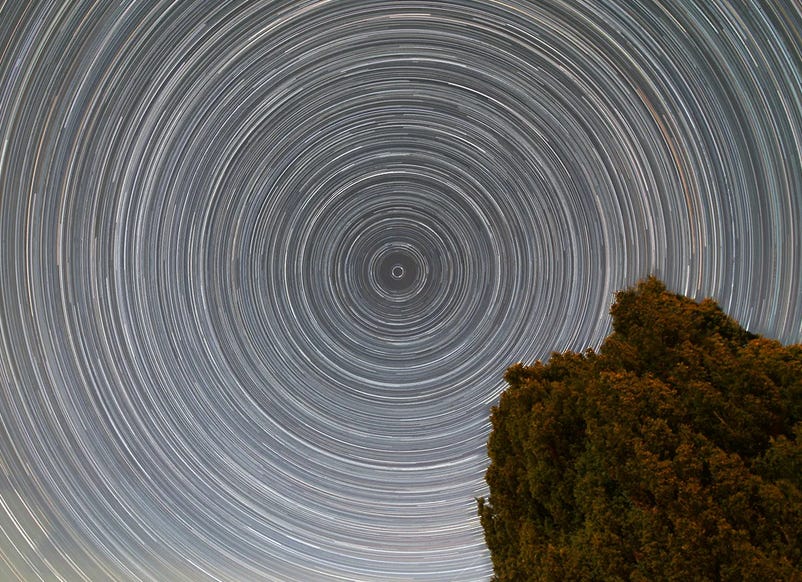
Anyone who watches the night sky over time encounters the same pattern. The stars move, but they do not move randomly. Night after night, season after season, the heavens repeat themselves.
At the center of this pattern lies a simple observation.
Each night, the stars appear to rotate around a fixed point in the northern sky. Within human experience, that point remains constant and is marked by Polaris. The constellations wheel slowly around it, night after night, season after season. Nothing in the visible sky appears more stable. Nothing provides a more reliable reference.
Even the modern name of the star reflects this ancient understanding. “Polaris” comes from the Latin stella polaris — the pole star. The word “pole” derives from the Greek polos, meaning a pivot or axis, the point around which something turns. In ancient usage, the pole was not a geographic location but the celestial pivot — the fixed point around which the heavens appeared to rotate. The name Polaris therefore preserves the same perception found in early cosmologies: a stable center, a turning sky, and a world organized around a cosmic axis.
Ancient cultures recognized this immediately. They did not describe it as a coordinate or a measurement. They described it as the Axis Mundi — the world axis, the still point around which the heavens turn.
This understanding arose from repeated observation.
The same center.
The same rotation.
The same sky across generations.
From this stable reference, a second structure became visible.
The Sun does not rise and set at the same points throughout the year. Its path along the horizon shifts gradually northward, then southward, reaching four natural turning points:
Spring equinox
Summer solstice
Autumn equinox
Winter solstice
At the equinoxes, day and night are equal. At the solstices, the Sun reaches its furthest extent before reversing direction. These four moments divide the year into a stable and recurring cycle.
Ancient observers did not separate these solar events from the surrounding heavens. At each turning point, the night sky displayed characteristic constellation positions. Certain star patterns appeared in the evening sky during summer, others during winter. Over time, the relationship between season and star field became predictable and reliable.
The sky therefore revealed a coherent geometry:
A fixed center in the north.
Circular motion around that center.
Four solar turning points structuring the year.
Seasonal constellation positions marking each phase.
The Big Dipper illustrates this structure clearly. Over the course of a year, it appears at different orientations around Polaris. In spring it stands upright in the evening sky. By summer it has rotated to one side. In autumn it appears inverted. By winter it lies low near the horizon. The constellation does not wander randomly. It turns around the fixed center, marking the passage of time through its changing position.
Anyone who watches the sky over months or years sees this slow rotation. The heavens function as a clock.
From these recurring relationships — center, rotation, fourfold solar division, seasonal star position — ancient cultures derived visual forms that expressed the structure of the world as they encountered it.
These forms were not symbols in the modern decorative sense. They functioned as memory systems — compact visual models of the sky that could be preserved and transmitted across generations. The center marked the fixed axis of the heavens. The four arms marked the solar turning points. Rotational forms reflected the motion of the stars around that center. In cultures without instruments or formal astronomical education, such images served as portable maps of time, direction, and cosmic structure.
Across civilizations, remarkably similar images appear:
The four-armed cross of early Mediterranean and Near Eastern cultures
The solar wheel of Indo-European traditions
The medicine wheel of North American peoples
The world tree of Norse and Siberian cosmology
The four-direction mandala of Hindu and Buddhist systems
Rotating cross forms found across Europe and Asia
The swastika of India, Central Asia, and many early European cultures
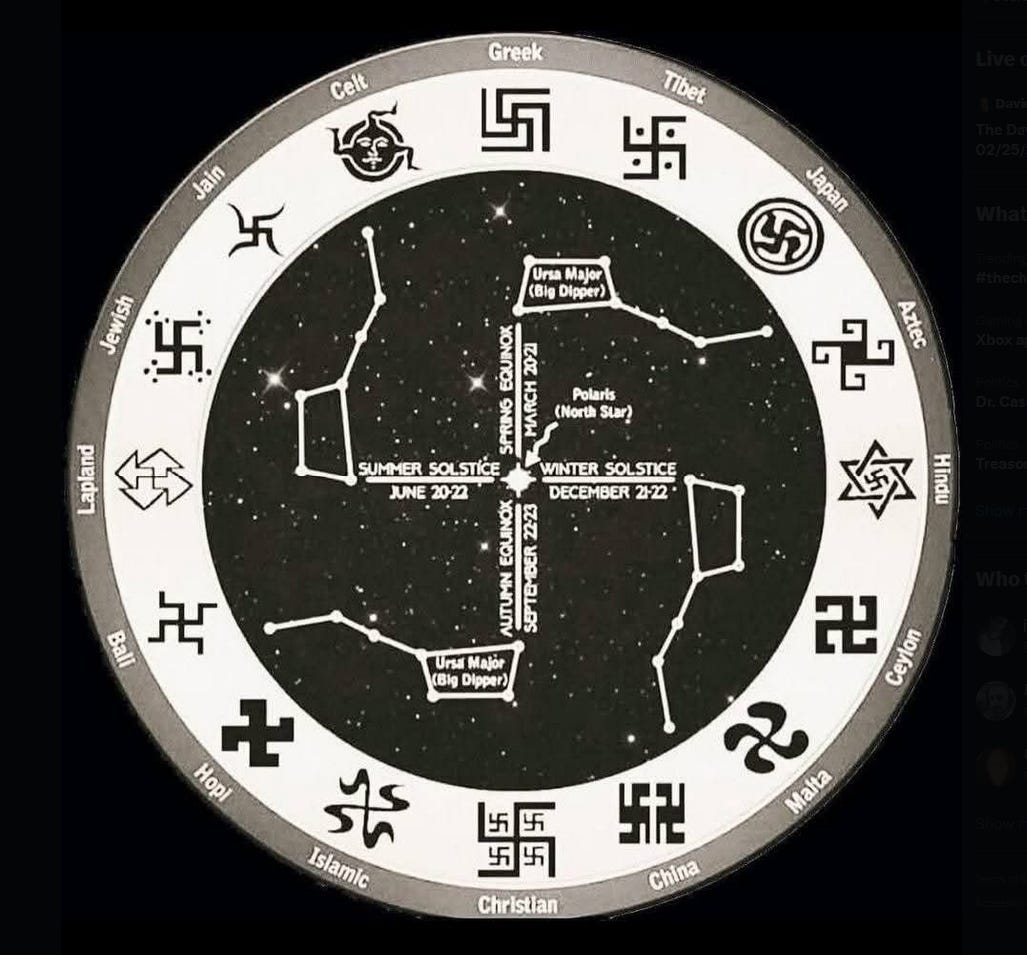
Despite cultural distance, these forms share a common geometry:
A center.
Four directions or arms.
Often a sense of turning or rotation.
In their original context, these forms were cosmological diagrams — visual expressions of a centered universe ordered by cycles and animated by motion around a fixed axis.
The swastika, in particular, appears across many early cultures as a rotating cross or turning wheel. In its ancient usage, it represents cyclical motion around a center — the turning of the heavens and the continuity of seasons. It is one expression among many of the same underlying perception.
The consistency of these forms across cultures suggests a shared encounter with the same celestial structure. Any community that watched the sky long enough would see the same center, the same rotation, the same fourfold solar cycle, and the same seasonal pattern of stars.
The Axis Mundi is therefore not an abstract idea. It is the human response to a stable and ordered sky.
Even today, the pattern remains visible. The stars drift westward each night. The constellations rotate slowly around the northern center. Sunrise shifts along the horizon, reaches a limit, reverses, and repeats. The structure is simple, stable, and precise.
But there is something else revealed in this pattern.
The sky is not random.
It is not chaotic.
It is not empty.
It moves with order, symmetry, and rhythm.
For ancient observers, this was not merely a navigational aid. It was a revelation of structure — a world organized around a center, governed by cycles, and sustained by recurrence. Time itself appeared as a turning wheel. Stability and motion existed together. Change occurred, but within a larger continuity.
Across cultures separated by geography and time, the same celestial structure was observed and encoded. That shared recognition formed the foundation of orientation — not only in space and time, but in the human sense of place within a coherent world.
Today, this observational framework is largely absent from everyday awareness. A system of orientation once shared across civilizations has become culturally distant.
Yet the structure itself has not changed.
The heavens still turn.
The center still holds.
The year still divides into four.
The constellations still mark the cycle.
What has changed is not the sky, but our attention to it.
When a pattern once recognized across civilizations becomes unfamiliar, the loss is not only symbolic. It is a loss of orientation — a diminished awareness of the order, scale, and beauty that surrounds us.
The Axis Mundi reminds us of something simple and profound:
We do not live in a featureless void.
We live within a structured and luminous order — a world of cycles, symmetry, and quiet majesty, turning steadily around a still and enduring center.
What survives in ancient art is not myth, but memory — a record of a sky every generation once knew how to read.