

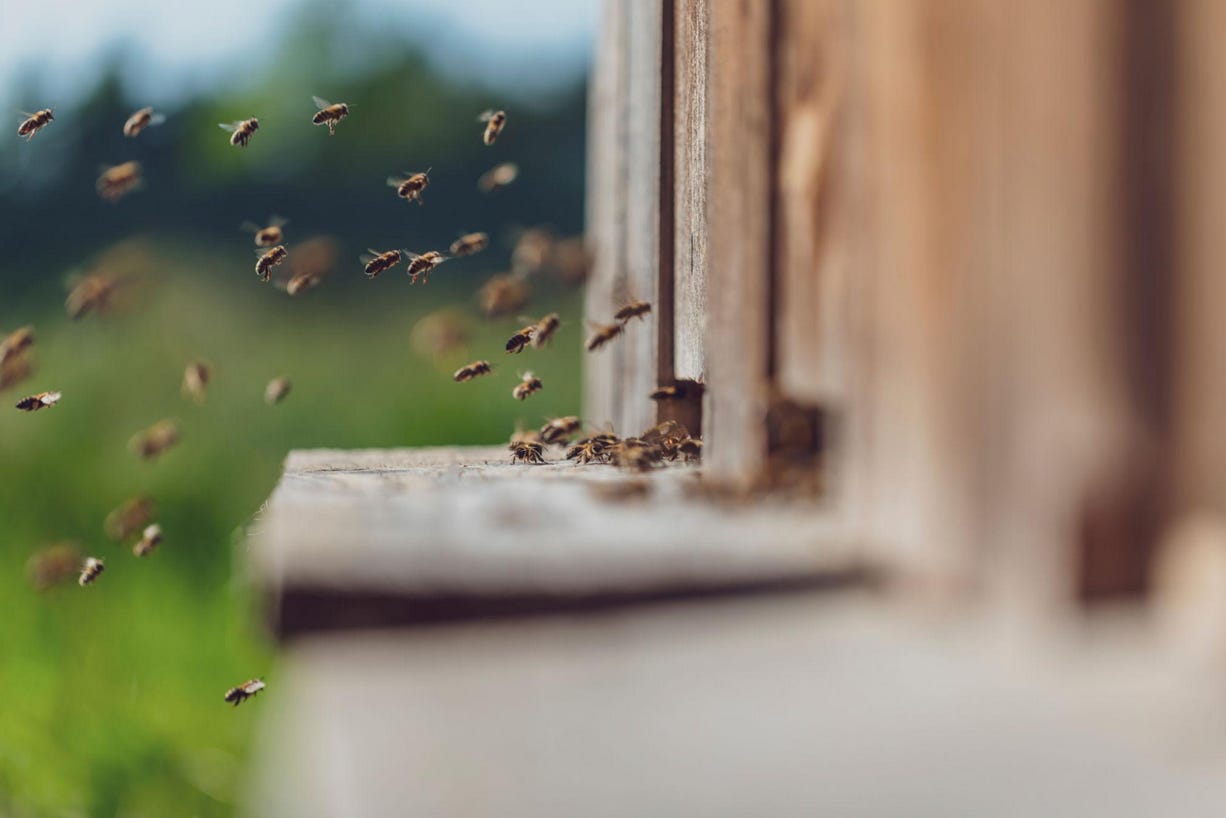
The honey bee navigates by the world it encounters. It leaves the hive, crosses fields and trees, finds forage, returns with precision, and tells the colony where to go through patterned movement on the comb. The process is not ornamental. It is not decorative symbolism. It is work. The colony survives because the navigation works.
The bee orients through the observed position of the sun, the angle of light, scent, terrain, timing, and memory of place. The waggle dance carries directional information relative to the visible solar path. Other bees receive the signal through contact, vibration, repetition, and scent. No central command is required. The colony reaches usable orientation through repeated contact with the structure of the world.
No abstraction is needed for the act itself. The bee does not calculate a cosmological model before leaving the hive. It does not infer hidden machinery beyond experience. It moves through the world as encountered. Stable land, recurring solar movement, directional relationship, and environmental memory are enough.
The same pattern appears across the living world. Migratory birds follow light, season, terrain, and field sensitivity. Salmon return through water, scent, current, and place. Sea turtles cross great distances and still return toward natal beaches. Pigeons find home through sun, landmark, smell, and memory. These systems differ in mechanism, but they share a structural property: orientation through recurrent environmental relationship rather than abstract model. Living beings do not explain the world before moving through it. They respond to recurrence, rhythm, field, scent, light, and place.
The bee also reveals a deeper property of living systems. The colony exhibits orientation, communication, memory, distributed consensus, adaptation, and collective coherence without centralized command. Each bee is small. The colony is not. Its order forms through relationship, rhythm, and environmental correspondence. Navigation is not an isolated mechanical trick. It is a living system reading an intelligible world.
This matters because the bee is one instance of a wider evidentiary pattern. In Truth Has a Coherent Structure, coherence is treated as a diagnostic property of accurate description. A true account holds together under use because it corresponds to structure. The bee shows the same principle in action. Its orientation works because sun, place, memory, movement, and communication remain coherent enough to be acted upon.
Human inquiry can move in the opposite direction. The model can gradually become primary. Observation is then forced back into the model. When contradictions appear, additional mechanisms may be introduced to preserve the frame. Over time, the explanation can become more authoritative than the observed behavior that gave rise to it.
That problem is developed more directly in Permission to Observe, where the issue is whether people feel permitted to trust what they see. The bee has no such hesitation. It does not wait for authority before orienting. It encounters the world, reads the pattern, and moves.
This is why the bee provides such a clean contrast. Its navigation remains visibly grounded in direct environmental relationship. The sun provides orientation. The landscape provides continuity. The hive provides reference. Successful navigation emerges from coherence between organism and environment, not from theory imposed afterward.
Measurement, inference, and modeling all have their place. They become useful when they remain answerable to observed structure. They become dangerous when observation is no longer allowed to discipline them. At that point the model does not explain the world. It protects itself from the world.
Most people recognize this tension in ordinary life. A bridge holds under load or it does not. A season arrives or it does not. A living system remains coherent or fragments under stress. Observation establishes the boundary conditions within which explanation must operate.
The bee illustrates this with unusual clarity. Its life depends on what can be directly encountered: solar position, terrain, timing, rhythm, scent, and spatial memory. The navigational system is neither speculative nor ideological. It works because it corresponds with the experienced world.
This is why the bee carries significance beyond biology. In Consciousness as Presence in a Structured World, consciousness is approached as presence arising where structure becomes coherent enough to support unified experience. The bee does not require that whole argument in order to be understood. But its behavior points in the same direction. Living systems are not isolated mechanisms moving through dead space. They participate in ordered fields of light, rhythm, memory, communication, and consequence.
The deeper question is whether human models remain accountable to observation or gradually detach from the structure they were created to describe. The bee resolves that question operationally. It does not argue. It orients, returns, and communicates. The colony survives because its orientation remains aligned with the world as encountered.
That is a clear test for inquiry itself. Coherent systems persist because they maintain correspondence with reality under constraint. Where explanation departs too far from observable structure, increasing complexity becomes necessary merely to keep the model intact. The bee reveals a simpler order: orientation first, explanation after.