

The first fact is not the story. The first fact is the stone.
Before a chronology is assigned, before a culture is named, before a priesthood, dynasty, settlement, or labor system is placed around it, the structure stands in the world as mass, geometry, placement, alignment, and endurance. It may be weathered, broken, buried, robbed, re-used, renamed, or absorbed into a later civilization. It may sit behind a museum label or appear in a guidebook as if the central question has already been settled. But the stone remains older than the explanation placed upon it. It does not begin by asking to be interpreted. It begins by existing.
That is why ancient construction creates a recurring difficulty for modern explanation. The problem is not the absence of explanations. Archaeology, history, engineering, anthropology, geology, and religious studies all provide partial accounts. Some are careful. Some are persuasive. Some explain particular features well. The difficulty begins when the explanatory record is treated as more complete than the surviving structure permits. At that point, the record no longer guides inquiry. It contains it.
Ancient construction often exceeds modern explanation because the surviving works display coordination, technical control, material ambition, geometric discipline, and symbolic integration that strain the smaller accounts placed over them. They do not merely show that ancient people were capable. That should never have been doubted. They show that the past contained forms of knowledge, organization, and perception that modern categories often flatten in the act of describing them.
The modern mind is trained to place the record first. A civilization is assigned a period. A culture receives a tool kit. A site is given a function. A structure is given a probable use. Later interpretation then moves inside those assignments. The result is often circular. A people are said to have possessed only the capacity permitted by the record, and the structure is then explained by reference to that permitted capacity. Where the structure exceeds the record, the excess is softened into ingenuity, ritual, labor abundance, or coincidence. Each may contain truth. None should be allowed to dissolve the problem.
There is a controlled arrogance in assuming that the builders are fully explained by the surviving account of them. The record is not the past. The record is what remains legible after loss. Wood rots. Fiber disappears. Apprenticeships end. Transmission breaks. Conquest overwrites. Later peoples reuse earlier works. Sacred sites are renamed. Foundations vanish beneath temples, churches, mosques, roads, museums, and cities. Whole systems of measurement, alignment, craft, and cosmology may disappear without leaving a manual. What survives may be the structure alone, and the structure may preserve more knowledge than the text.
This is not an argument for fantasy. It is an argument for proportion. The absence of a surviving record does not prove a hidden civilization. It also does not prove the absence of lost knowledge. Inquiry has to remain disciplined in both directions. It should not invent builders because a structure is difficult. It should not diminish builders because the record is incomplete. The surviving work must be allowed to set the scale of inquiry.
Göbekli Tepe illustrates the problem in its cleanest form. Its monumental round-oval and rectangular megalithic structures belong to the Pre-Pottery Neolithic, between 9600 and 8200 BCE, and are associated with hunter-gatherer communities. The site does not need a wild conclusion to be disruptive. Its disruption lies in the fact that monumental symbolic construction appears where older models did not expect it to appear. The stones force a reversal. Instead of settled agriculture simply producing ritual architecture as a late development, ritual architecture may have helped gather, order, and stabilize human communities before the expected sequence had fully formed. The structure changes the direction of explanation.
Newgrange makes the same point through light. The monument is not simply a mound, chamber, tomb, or ritual site. Its roof-box channels sunlight along the passage to illuminate the chamber at sunrise near the winter solstice. Stone, passage, horizon, darkness, and returning light were brought into relation. Whatever else Newgrange was, it was also a construction of time. Its builders encoded recurrence into architecture with enough precision that the structure still performs its alignment across millennia. A label of burial or ceremony may be true. It does not exhaust the work.
The Serapeum at Saqqara sharpens the point underground. Its official frame is ritual: the burial place of sacred Apis bulls, associated with Ptah, with long corridors containing massive stone boxes. That gives the site its religious and historical category. It does not end the engineering question. The boxes still had to be quarried, hollowed, finished, moved, lowered, and placed. Calling them sarcophagi may describe their use. It does not explain the making.
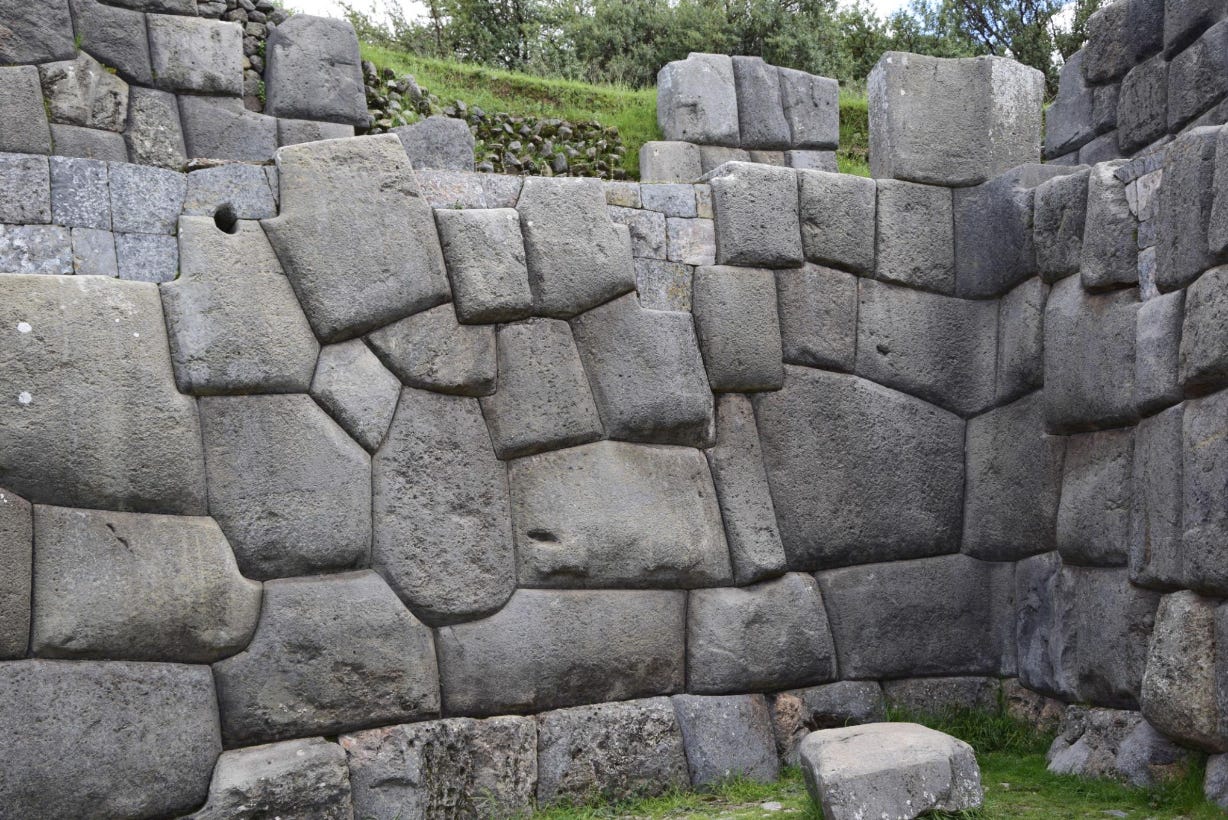
Sacsayhuamán makes the problem visible through fit. The polygonal walls above Cusco do not ask the viewer to understand a chronology before recognizing the difficulty. The stones are massive, irregular, and tightly joined. Their shapes do not repeat. Their contacts turn, bend, lock, and resolve across surfaces that appear at first almost impossible to rationalize. The question arrives before theory: how were these stones cut, moved, fitted, and corrected until irregular mass became coherent wall? The site may be placed within Inca history, and that frame matters. But the frame does not dissolve the visual fact. The wall shows stone disciplined into relation. It is one of the clearest examples of the essay’s central rule: the structure appears before the explanation placed around it.
Derinkuyu and the underground cities of Cappadocia add a different kind of evidence. Here the issue is not monumental display, but subterranean organization: ventilation shafts, passage control, storage, water, living space, concealment, defense, and continuity under pressure. Ancient building did not operate only in the register of monument and visibility. It also operated in the register of refuge, depth, and survival. A civilization capable of building downward into a hidden world was solving a different problem from one building upward toward display.
Together, these cases show that the problem is not one monument, one civilization, or one period. It is the recurring mismatch between surviving structure and the explanatory categories placed over it. Göbekli Tepe challenges sequence. Newgrange challenges any separation between construction and time. The Serapeum challenges the confusion of use with making. Sacsayhuamán challenges the assumption that irregular stonework is technically simple because it is ancient. Derinkuyu challenges the assumption that ancient construction is primarily monumental. The sites differ. The pattern remains. The surviving object often asks a larger question than the accepted explanation is willing to hold open.
Modern explanation tends to divide what ancient construction often unites. Engineering is separated from symbol. Measurement is separated from ritual. Geometry is separated from cosmology. Labor is separated from meaning. Function is separated from alignment. These separations may be artificial when applied backward. The builder may not have experienced mass, number, direction, proportion, season, and sacred order as separate fields. A structure could be practical, ceremonial, astronomical, territorial, initiatory, dynastic, acoustic, mnemonic, defensive, and cosmological at once. Modern explanation weakens when it insists on one function where the structure itself appears integrated across many.
This is why ancient construction can feel strangely alive. People stand before these works and recognize something beyond information. The response is not merely admiration for effort. It is recognition of order. Mass has been brought into proportion. Weight has been disciplined by geometry. Direction has been made meaningful. Stone has been arranged so that it belongs to ground, horizon, recurrence, and memory.
That recognition should not be dismissed as romanticism. A wall fitted with extraordinary care communicates something different from a wall assembled merely to stand. A stone circle aligned to recurrence communicates something different from stones placed without relation. A chamber illuminated by returning solstice light communicates something different from a dark room. An underground city designed for shelter, storage, passage, and concealment communicates something different from an accidental cave. The meaning may remain disputed. The perception of order is real.
The accepted account becomes unstable when it treats that perception of order as a problem to be managed rather than evidence to be considered. The public notices scale. The public notices fit. The public notices alignment. The public notices when explanations lean heavily on labor while leaving technique, sequence, or purpose thinly described. The public notices when a structure is described in ordinary terms but appears extraordinary in fact. That gap creates the space into which weaker speculation enters. When disciplined inquiry does not honor the difficulty of the object, undisciplined inquiry rushes in to claim it.
Anomalies are not always denied. More often they are absorbed. A difficult stone becomes labor organization. A difficult alignment becomes possible coincidence. A difficult chronology becomes a local exception. A difficult construction method becomes practical ingenuity. Each move may contain truth. Accumulated together, they can erase the wider pattern. Institutions prefer stable categories. Museums prefer settled labels. Educational systems prefer teachable sequences. Funding structures prefer questions that remain inside authorized disciplines. Professional caution is necessary, but caution can harden into boundary maintenance. Over time, the explanatory frame may become less a map of what is known than a perimeter around what may be asked without penalty.
A disciplined hidden-history essay must avoid two errors at once. This is the same discipline described in The Method of Structural Inquiry: official narratives are evidence, not verdicts, and explanation has to be tested against observation, structure, omission, consequence, and repeated behavior. The first error is passive acceptance, treating institutional explanation as truth because it comes from authority. The second is speculation, rejecting institutional explanation without doing the harder work of analysis. The task is examination. Where the record fits the structure, it should be retained. Where it fails, its limits should be named. Where evidence is missing, uncertainty should remain visible. Where the structure itself preserves order that the record cannot explain, the structure must be allowed to speak.
That requires a different starting point. Instead of beginning with the accepted timeline and asking how the structure can be made to fit, inquiry should begin with the structure and ask what kind of knowledge, organization, measurement, labor, symbolic world, and continuity would have been necessary for it to exist. The answer need not be exotic. It may be lost craft. It may be longer apprenticeship. It may be seasonal labor organized through religious obligation. It may be tools used with more skill than modern observers expect. It may be methods not yet recovered. It may be earlier phases beneath later surfaces. It may be memory and measurement carried in forms modern literate systems do not easily recognize.
Stone is not an opinion. Weight, fit, orientation, passage, recurrence, and endurance impose their own constraints. An explanation that cannot account for those constraints has not yet become equal to the object. The explanation must rise to meet the structure. It must not make the structure smaller to protect the explanation.
Ancient construction also exposes the weakness of progress mythology. The common assumption is that technical sophistication rises in a straight line toward the present. Older means simpler. Later means better. The material record does not behave so neatly. Some very old works display extraordinary command of stone, mass, siting, and symbolic order. Some later works are less durable, less integrated, or less ambitious. Knowledge can be lost. Civilizations can decline. Techniques can disappear when the social, religious, or ecological conditions that supported them break. The past is not a ladder climbing toward the present. It is a field of formation, loss, recovery, rupture, and recurrence.
Once this is understood, the builders before the record no longer appear as a threat to history. They become a correction to historical arrogance. They remind us that writing is not the only carrier of knowledge. Institutions are not the only custodians of truth. Technical capacity is not always preserved by publication. A civilization may know how to do something without explaining it in terms available to us. A structure may preserve a science of proportion, alignment, and material behavior after the language of that science has disappeared.
The phrase hidden history can mislead. The hidden is not always hidden because someone concealed it. Much is hidden because it has been misclassified, overlaid, simplified, neglected, or interpreted through categories too narrow for the object. Some of it is hidden in plain sight because visibility is not understanding. The stone may be photographed, catalogued, ticketed, and visited by millions while the real scale of the question remains unasked. This is the condition examined in Permission to Observe: people often see before they feel permitted to see, and direct perception can remain suspended until authority grants it legitimacy.
What remains is disciplined recognition. Ancient construction should be approached as surviving structure before it is absorbed into inherited explanation. The builder should not be reduced to the poverty of the record. The record should not be discarded where it has real evidentiary force. But the object must remain primary. Mass, fit, orientation, recurrence, proportion, sequence, and endurance are not decorative facts. They are evidence.
The builders before the record stand at the threshold of a larger inquiry because they expose the limits of modern explanation without requiring immediate replacement by a complete alternative. They show that the past is not fully contained by the categories assigned to it. They show that structure can outlive the story told about it. They show that knowledge may survive materially after it has vanished textually. They show that human beings once organized stone, horizon, labor, depth, protection, and meaning in ways that remain only partially understood.
A serious inquiry into hidden history begins there. Not with the demand that every accepted account be false. Not with obedience to accounts that explain less than they claim. It begins with the structure itself, standing before the record, asking whether the explanation has become equal to the thing explained.