

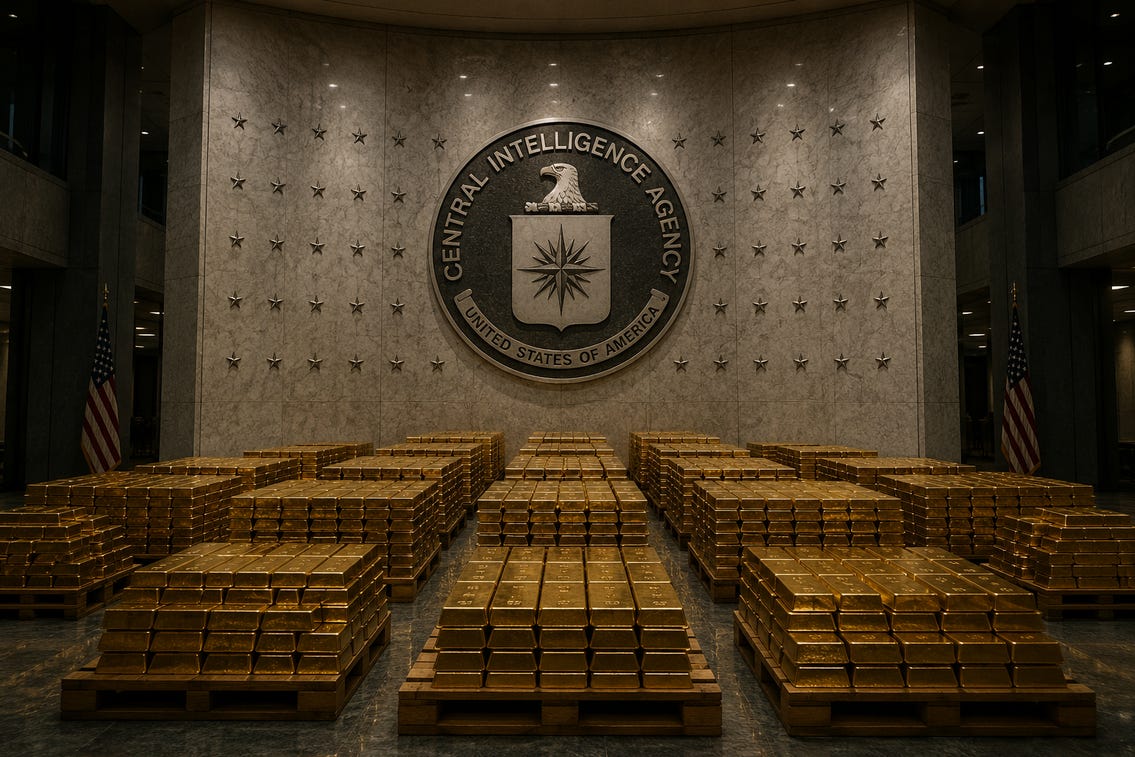
The official story is that David J. Rush, a former Senior Executive Service-level official at a United States government agency, has been charged after federal agents found hundreds of kilograms of gold, millions of dollars in cash, and luxury watches connected to him. The public frame is simple enough. A senior official allegedly lied about his credentials, misrepresented military service, obtained benefits to which he was not entitled, and converted government property.
That frame explains the defendant. It does not explain the gold.
The affidavit is not an expense-account story. It is a probable-cause filing under 18 U.S.C. § 641, the federal statute governing theft or conversion of United States property. It was sworn by an FBI Special Agent assigned to the Washington Field Office’s Counterintelligence Division. It also says, at the outset, that it was submitted only to obtain an arrest warrant and does not include every fact known to the investigation. The document is a charging instrument, not a full institutional account.
Its key section is headed “Unaccounted Bulk Currency and Gold from the USG.” That heading matters. The affidavit does not say Rush was reimbursed for ordinary expenses. It says that between approximately November 2025 and March 2026, Rush made several requests to obtain a significant quantity of foreign currency and tens of millions of dollars in gold bars for work-related expenses. It then says he received the currency and gold bars from the United States Government.
The next paragraph is the hinge. Based on an initial review by Rush’s employer, the government was unable to locate the gold bars or significant amounts of the foreign currency Rush had received pursuant to his requests. It was also unable to identify the intended use of the funds. Nor had it found any record of Rush providing information to his employer about the disposition of the currency or gold bars he had received for work-related purposes.
Then the FBI searched his home. On or about May 18, 2026, agents seized approximately 303 gold bars, each weighing approximately one kilogram. Based on the then-current gold price, the affidavit valued the bars at more than $40 million. Agents also seized approximately $2 million in United States currency and approximately 35 luxury watches, many of them Rolexes.
Those facts do not fit the public frame. The gold was not a bag of coins or a cash reserve in a safe. It was 303 one-kilogram bullion bars. Cash pays expenses. Coins can move portable value. One-kilogram gold bars are reserve-grade instruments: large, indivisible, serializable, institutionally recognizable, and suited to custody, collateral, settlement, or preservation of value. As discussed previously in Gold Without Counterparty Risk, physical gold is trusted differently from currencies, bonds, and paper claims because it does not depend on an institution’s promise in the same way.
These bars were not normal work expenses. They were not field petty cash. They were not the kind of property one expects to see move through ordinary government administration.
The central problem is how they came within Rush’s reach at all.
The CIA is not a reserve bank. It is not the Treasury. It is not the Federal Reserve. It does not publicly operate as a bullion custodian. Yet this case shows that a CIA-linked government-property channel existed through which hundreds of kilograms of gold and large quantities of foreign currency could be requested, issued, moved, stored, lost, or placed under the control of a single senior official. The criminal complaint may describe conversion of government property. It does not explain the government-property architecture that made the conversion possible.
That architecture is the story.
If 303 kilograms of gold can appear in a public criminal affidavit under the language of “work-related expenses,” the explanation has already collapsed. Either the agency genuinely did not know what hundreds of kilograms of gold were for, or it knew and the purpose has been withheld, compartmented, obscured, or translated into administrative language too bland to reveal the underlying function. If the agency did not know, the control failure is catastrophic. If the agency did know, the public record is not describing the real system.
The more coherent inference is a classified hard-asset channel. Not a reserve in the formal monetary sense, but a custody, collateral, settlement, or contingency finance mechanism: physical sovereign value outside ordinary banking rails, available for foreign-facing operations, liaison arrangements, emergency liquidity, denied-area activity, or institutional settlement where conventional transfers would expose too much, fail politically, or leave records that could not be tolerated.
The affidavit proves the channel. It does not prove the purpose. But the asset form narrows the possibilities. Three hundred and three kilogram bars are not used to reimburse travel. They are used to guarantee, settle, collateralize, preserve, or move large blocks of value.
The scale question cannot be avoided. If 303 kilograms of gold were treated as a personnel scandal rather than an institutional emergency, one must ask what scale of hidden hard-asset channel makes that possible. Assume, conservatively, that the exposed gold represented five percent of the relevant pool. That implies roughly 6,060 kilograms of gold, just over six metric tons, with an approximate value of $800 million at the affidavit’s valuation. If the exposed amount were one percent, the implied pool would exceed thirty metric tons.
The exact number is unknowable from the public record. The official posture still implies scale. Three hundred and three kilograms of bullion cannot be both extraordinary and unexplained. If extraordinary, the oversight failure is catastrophic. If not extraordinary, the hidden channel is vastly larger than the public has been told.
The bars may not be the whole structure. They may be the visible piece that broke off.
This links directly to the inversion examined in Classification and the Limits of Public Accountability. Classification is supposed to protect lawful activity from hostile exposure. When it prevents evaluation of whether the activity is lawful at all, it has changed function. It no longer protects legitimate secrecy. It protects the system from judgment.
The gold gives that inversion weight and shape. It is not a redacted paragraph, a sealed finding, or an unnamed budget line. It is metal. Three hundred and three kilograms of it. It asks a blunt question: where does hundreds of kilograms of gold fit in the budget of a non-bank intelligence agency?
The public now receives aggregate intelligence budget numbers. That is not meaningful oversight. A top-line figure does not reveal CIA program allocations, covert-action channels, hard-asset custody mechanisms, contractor flows, cutouts, contingency pools, foreign-liaison arrangements, or classified property movements. It does not say who purchased the gold, who approved its release, what program held it, what purpose it served, what safeguards governed it, or how many similar assets exist elsewhere.
A number is not oversight. A classified budget is not oversight. A closed committee briefing is not oversight if the public cannot know whether the system being described is lawful, proportionate, or real. Oversight cannot verify a budget it cannot see, test a purpose it cannot know, audit assets whose intended use cannot be identified, or evaluate failures that surface only after the property disappears. That is the same structural problem developed in Compartmentalization and the Structure of Classified Power: secrecy does not merely conceal information from outsiders; it can fragment knowledge inside the state itself, preventing purpose, scale, and consequence from being seen together. That is how oversight becomes ceremonial.
The Rush affidavit compresses the problem into one case. A senior official allegedly received bulk foreign currency and tens of millions of dollars in gold from the United States Government. The government later could not locate the gold or significant currency. It could not identify the intended use of the funds. That is not oversight. That is secrecy with a criminal complaint attached after part of the structure became visible.
The personnel side is just as absurd. The public is invited to focus on Rush’s personal defects. Those defects do not absolve the institution. They indict it. If the affidavit is accurate, Rush’s institutional identity was built through repeated false credential claims across applications, clearance paperwork, and Senior Executive Service advancement. He allegedly applied to the agency three times, claimed degrees from Clemson and Rensselaer Polytechnic Institute, repeated those claims on an SF-86 used to obtain TS/SCI clearance, and later made additional claims in connection with Senior Executive Service advancement. The affidavit also states that Clemson and RPI could not verify his attendance or degrees, that his military file did not indicate service as a Navy pilot or pilot evaluations, and that FAA records showed no pilot certificate or license.
That is not a résumé typo. It is an allegedly invented elite-technical identity.
A clean institution treats such a person as a security risk. A corrupt intelligence structure may treat him as controllable.
Weak men are useful. Dishonest men are leverageable. Ambitious men who depend on institutional protection can be advanced, used, and discarded. If Rush was already compromised, the issue is not simply how he fooled the CIA. It is whether his weakness made him serviceable.
That possibility belongs to the deeper history of the institution. James Jesus Angleton, the CIA’s legendary counterintelligence chief, is reported by Joseph Trento to have described the founding culture of American intelligence in terms almost too direct for this case. In Trento’s account, Angleton said that the better one lied and the more one betrayed, the more likely one was to be promoted. He described the founding figures of American intelligence as men bound by duplicity and a desire for power. Whether read as confession, bitterness, or institutional diagnosis, the statement captures the central inversion. In a lawful institution, dishonesty disqualifies. In a corrupted secret institution, dishonesty can become a credential.
The Rush case arises inside the history of an institution whose record defeats any presumption of good faith. The CIA is not a normal public body with a few historical scandals. It does not merely suffer from corruption at the margins. It is structurally corrupt because its normal operating methods are secrecy, deception, deniability, covert finance, cutouts, compartmented knowledge, and precluded accountability. It concentrates power while concealing the facts needed to judge that power. It authorizes deception as a profession. It recruits, handles, and discards compromised people. It does not merely keep secrets. It creates environments in which secrecy becomes the mechanism by which accountability is defeated.
The background record removes any basis for institutional trust. MKULTRA proved that the CIA was willing to conduct covert programs against human beings under classification, including behavioral experimentation on unwitting subjects. The Finders record placed intelligence references, federal fragmentation, computer materials, foreign-travel references, Washington connections, and children inside the same unresolved field of institutional containment. These matters do not carry the proof burden in the Rush case. They establish the context: this is an institution with a record of operating beyond ordinary law, concealing its conduct, and surviving exposure through containment rather than real accountability. Against that record, “classified,” “unclear,” and “work-related” are not explanations. They are warning signs.
The Rush case is about gold, not children. But the pattern matters because the same structure appears across domains. Where the asset is gold, the public is told the intended use cannot be identified. Where the subject is behavioral control, the public receives partial disclosure decades later. Where children appear in intelligence-adjacent records, the record fragments, narrows, or disappears into jurisdictional fog. Where covert action fails, responsibility is personalized. Where institutional architecture is exposed, the visible individual becomes the scandal.
This is institutional inversion. The agency claims legitimacy through national protection, yet its secrecy protects the agency from the consequences of its own conduct. It claims necessity, then uses necessity to preclude judgment. It claims oversight, then hides the substance that would allow oversight to be tested. It claims legality, then places the relevant facts beyond ordinary legal and public review.
The Rush affidavit is powerful because it makes that structure physical. Usually classified power appears as redaction, denial, vague statutory language, destroyed records, unnamed officials, shell entities, covert fronts, or procedural containment. Here it appears as metal. Three hundred and three kilograms of gold in private custody is not an abstraction. It is hidden value movement made visible.
The prosecution may answer what Rush did. It cannot answer what the institution is unless it explains the channel. Was the gold purchased, transferred, seized, recovered, or supplied through a partner? Was it part of a classified finance mechanism, a collateral pool, a contingency reserve, or a settlement channel? How large is the total pool from which these bars emerged? Those are not peripheral questions. They are the oversight questions.
A state cannot claim democratic legitimacy while maintaining channels of value that cannot be publicly located in a budget, tied to a lawful purpose, audited, or explained even after hundreds of kilograms of gold are found in a private home.
The official story cannot escape those questions by pointing at Rush’s dishonesty. His dishonesty is part of the indictment of the system. If he was corrupt, why was he placed in a senior position? If he was compromised, why did the institution tolerate him? If he had access to hundreds of kilograms of gold, why was that access possible? If the budget is classified, the program is classified, the property channel is classified, and the intended use cannot be identified, what exactly is being overseen?
The David Rush case reveals an institution in which compromised personnel, opaque authority, hidden value channels, classified budgets, and selective public accountability appear to belong to the same architecture. The defendant’s guilt, if proven, would not cleanse the institution. It would expose it.
The gold bars were not the scandal in the ordinary sense. They were evidence that the scandal is larger than the man. They show that classified power is financial, material, custodial, and physical. It can hold value outside normal visibility. It can move value through channels the public does not see. And when part of that structure breaks into view, the official narrative tries to reduce the matter to personnel misconduct. As argued in The Sacrificial Prince, powerful institutions often preserve themselves by allowing the exposed individual to become the mechanism of accountability while the surrounding architecture remains intact. Rush may be guilty. A guilty man can still function as the boundary around a much larger scandal. That is controlled accountability.
That reduction should not be accepted. If 303 kilograms of bullion can surface from a classified environment and the public explanation still cannot identify what the gold was for, the problem is not simply theft. The problem is governance by concealed architecture. The public is being asked to trust an institution whose most serious mechanisms become visible only when they fail.
The affidavit supplies probable cause for conversion of government property. It does not supply an institutional explanation for the government-property channel through which hundreds of kilograms of bullion were issued. The prosecution may explain why David Rush is in trouble. It does not explain why the gold existed, where it fits in the classified budget, who authorized its movement, what oversight supposedly governed it, or how many other hard-asset channels remain unseen. Until those questions are answered, the case is not really about one man. It is about the hidden architecture of classified power, and the oversight fiction that allows such architecture to survive.