

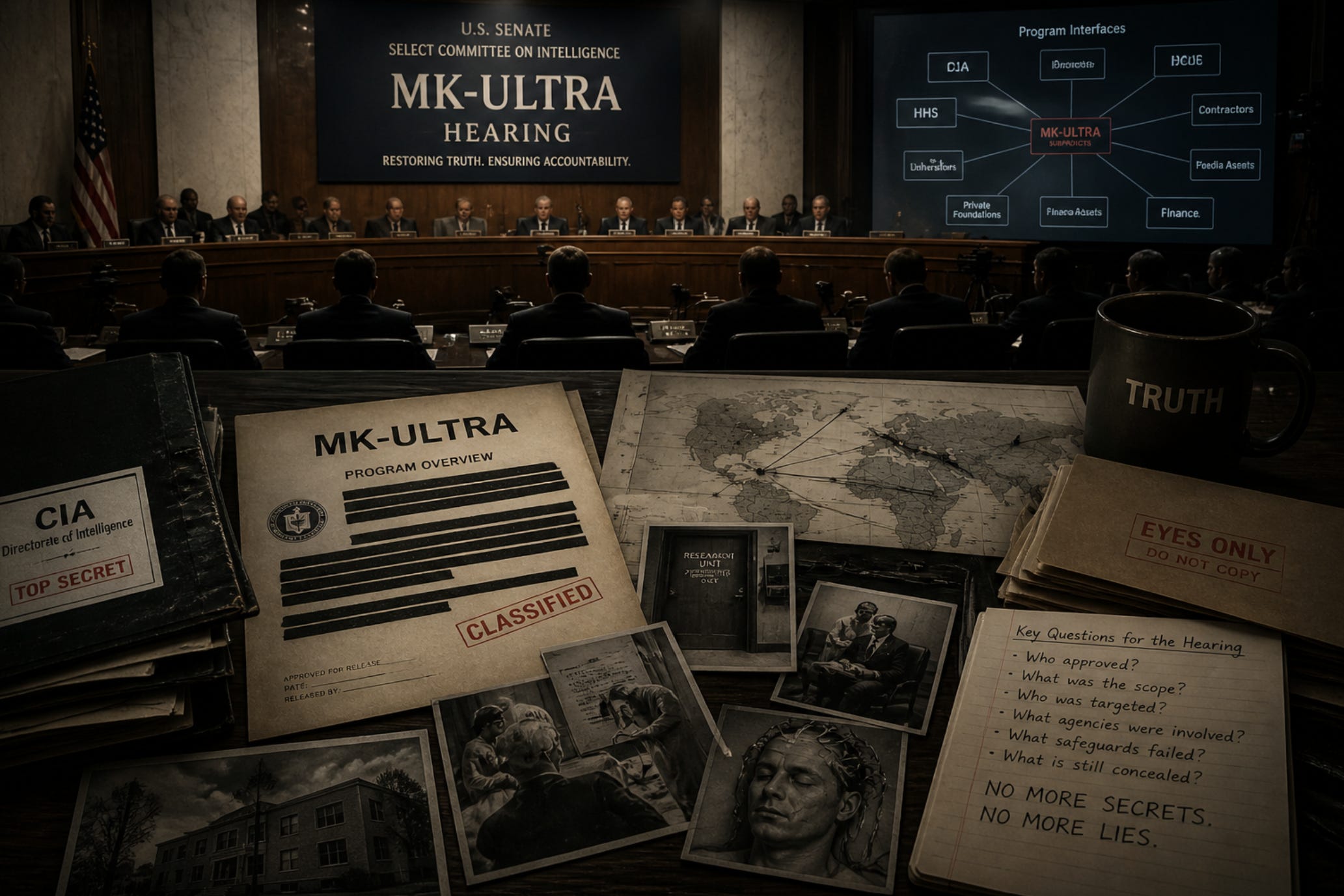
The modern security state presents itself as a system of defense. Its public language is protection, deterrence, stability, and national survival. It exists, officially, to guard the population against external threat. Yet the system operating beneath that language is not merely defensive. It is a classified apparatus joining military capability, intelligence work, energy infrastructure, industrial contracting, surveillance, covert action, and secrecy into a durable structure of power.
The distinction matters. A defensive institution can remain legitimate when it is constrained, accountable, proportionate, and directed toward the protection of the innocent. A classified security apparatus becomes something different when it can act behind walls the public cannot see, produce consequences the public must bear, and then invoke national necessity to prevent meaningful judgment of what has occurred. At that point, the problem is not secrecy alone. The problem is the transfer of power from the public constitutional order to a protected operational domain.
This is the central issue examined in Classification and the Limits of Public Accountability. Secrecy may sometimes be necessary, but once conduct is placed behind a classified wall, the ordinary tests by which a free society distinguishes lawful protection from unlawful abuse become weaker, slower, and sometimes almost unavailable. Public criticism cannot attach fully to what cannot be seen. Courts defer where evidence cannot be examined openly. Legislatures are briefed selectively or late. Citizens are told to trust, not because the conduct has been shown to be lawful, but because the state says the subject cannot be publicly judged.
That is not a minor procedural concern. It changes the relationship between state and citizen. In open government, power must face the possibility of challenge while action is still occurring. In classified government, action often comes first. Scrutiny arrives later, if it arrives at all. By the time the public learns what happened, the objective has usually been pursued, the facts have changed, and accountability has become retrospective. Disclosure does not restrain the system. It becomes part of the aftermath the system manages.
This is why the military-industrial complex cannot be understood only as a matter of contracts or waste. Eisenhower’s warning was not simply that defense firms might become too profitable. It was that a permanent defense structure could acquire enough administrative depth, political protection, economic dependency, and cultural deference to preserve large areas of power beyond ordinary democratic correction. The Military-Industrial Complex and the Persistence of Secrecy develops that point directly: exposure does not necessarily produce control. Programs are renamed, authorities are revised, oversight is ritualized, and the underlying structure remains.
The effect is cumulative. A permanent security system does not need every actor to share a single hidden intention. It needs aligned incentives. Defense agencies are rewarded for continuity. Contractors are rewarded for program survival. Legislators are rewarded for appearing serious about security and protecting local economic flows. Intelligence agencies are rewarded for maintaining capability. Oversight bodies operate under classification barriers and information asymmetry. Together these incentives produce a system that can absorb criticism while preserving direction.
Energy reveals the problem with unusual clarity because energy is where classified power, industrial interest, and civilian life meet. Modern societies depend on energy for food, heat, transport, manufacturing, military readiness, financial stability, and political order. When energy systems are disrupted, the consequences do not remain inside strategy papers. They reach homes, factories, shipping lanes, supermarket shelves, public budgets, and the ordinary margin of life.
That is why Nord Stream, Venezuela, Iran, and Hormuz cannot be treated as isolated policy episodes. Energy Scarcity and Strategic Control sets out the sequence more fully: Nord Stream removed Europe’s cheap Russian pipeline option; Venezuelan oil was brought back through channels shaped or approved by U.S. policy; conflict with Iran and disruption around Hormuz predictably intensified scarcity and route insecurity. Read separately, each event can be explained as crisis response. Read in sequence, they disclose something more coherent: energy flows being redirected, dependencies being altered, and exposure to risk being distributed unevenly across populations.
The European case is especially stark. The destruction of Nord Stream was not good for Europe. It removed a direct energy artery and with it the possibility of returning quietly to cheaper Russian gas. Europe was pushed into a more expensive, more seaborne, more volatile replacement structure, including greater dependence on LNG and Atlantic supply. That did not merely change the source of gas. It changed the structure of European sovereignty. A continent that loses control over affordable energy loses control over industrial policy, fiscal stability, and strategic independence.
The Venezuelan case shows the same pattern from another angle. Control of Venezuelan oil was not primarily a gift to the Venezuelan people. It was a restructuring of access, licensing, profit, and political leverage around one of the world’s major reserve bases. The question was who would control the terms of extraction, who would receive the benefit, and how the resource would be positioned inside a wider energy order. For ordinary Venezuelans, resource control by external power does not automatically mean sovereignty, prosperity, or justice. It often means that the resource beneath the country becomes more important to outside systems than the people living above it.
The Iran and Hormuz component adds the human cost that energy analysis often abstracts away. A war that damages the Middle Eastern energy complex is not merely a market event. It kills people, destroys infrastructure, destabilizes societies, and turns civilian life into a variable inside strategic calculation. The resulting gasoline price shock is not good for Americans either. It burdens the public while expanding the rationale for further security activity, emergency policy, military spending, and industrial protection. The public pays at the pump, pays through taxation, and pays again through the normalization of crisis government.
This is the inversion. A system claiming to protect the public produces conditions in which the public absorbs the harm. Europeans lose cheap energy and industrial stability. Venezuelans lose meaningful control over their own resource destiny. Americans face higher prices and fund the apparatus that helped create the conditions. Iranians and other civilians in the region bear the most direct cost in blood, insecurity, and destruction. The system then describes these outcomes as the price of security.
That claim cannot be accepted merely because the system makes it. A protective institution must be judged by function, not self-description. If a system repeatedly impoverishes allies, subordinates weaker nations, burdens its own citizens, and kills foreign civilians while preserving its own budgets, authority, secrecy, and strategic continuity, then its protective claim has become structurally unstable. It may still defend something. The question is what it defends first.
This is where compartmentalization becomes important. Compartmentalization and the Structure of Classified Power explains that mature secrecy systems do more than conceal information from outsiders. They fragment visibility inside the state itself. Confidentiality withholds information while preserving intelligibility. Compartmentalization breaks intelligibility apart. It limits who can see purpose, scale, and consequence together. Even internal oversight may fail because the knowledge required for judgment has been distributed across compartments that cannot easily be integrated.
The result is a structure in which responsibility becomes difficult to locate. Each participant may see only a piece. Each office may certify only a segment. Each reviewer may be shown only enough to approve a narrow channel. The whole operation becomes visible only to a small circle, if it is fully visible at all. This is not a theatrical hidden government. It is more durable than that. It is a system in which access, not public office, determines who can see; and visibility, not formal authority, determines who can judge.
That structure is hostile to republican self-government even when it is defended in the language of necessity. A free people cannot meaningfully authorize what they are not permitted to understand. They cannot consent to costs whose causes are concealed. They cannot evaluate policies whose operational logic is hidden. They cannot restrain institutions that disclose consequences only after the decisive acts have already occurred.
The classified security state therefore creates a moral and constitutional contradiction. It asks the public to trust a system that reserves to itself the right to conceal the facts necessary for trust. It asks citizens to fund operations they cannot evaluate. It asks allies to accept dependence created by acts they cannot publicly adjudicate. It asks foreign civilians to bear consequences that were never submitted to any lawful moral accounting. The language remains protective, but the structure increasingly operates as power without consent.
This does not mean that every soldier, official, analyst, contractor, or intelligence officer is corrupt or malicious. That would be too crude and too false. Many may believe sincerely that they are serving the public good. Compartmentalization helps explain how that can be true while the structure still produces harm. People can work honorably inside a narrow channel without seeing the full operation their work enables. The problem is not reducible to personal motive. It is structural. A permanent classified apparatus develops its own survival logic. It preserves capability, protects continuity, manages exposure, absorbs scandal, and translates public cost into operational necessity.
That is why the issue must be framed as institutional inversion rather than ordinary policy error. A policy error can be corrected when evidence accumulates. An inverted system metabolizes evidence and continues. A failed war can still expand budgets. A revealed surveillance program can still preserve the surveillance architecture. A destroyed pipeline can still produce dependency consistent with the apparent strategic direction. An energy shock can still strengthen the supply structure that benefits from scarcity. Truth enters the record, but the system remains.
The most dangerous feature of this structure is not that it sometimes fails to protect the public. It is that public harm can become compatible with system success. Higher prices, destroyed infrastructure, foreign instability, civilian casualties, allied dependency, and domestic surveillance can all be treated as acceptable costs if they preserve strategic position, institutional authority, and operational continuity. Once that threshold is crossed, the security state no longer merely risks harming the people it claims to defend. It has become capable of treating them as inputs.
A constitutional order cannot survive indefinitely under that arrangement. Legitimacy requires more than formal elections, committee hearings, classified briefings, and after-the-fact reports. It requires that power remain answerable to the people in substance, not merely in ceremony. Where the most consequential decisions are hidden, where the causes of public harm are obscured, and where accountability arrives only after reality has already been changed, public sovereignty becomes increasingly nominal.
The classified security state should therefore be judged by the same principles it claims to defend: accountability, proportionality, restraint, and protection of the innocent. Where those principles still operate, secrecy may remain a limited tool of legitimate defense. Where they no longer operate, secrecy becomes something else. It becomes the architecture by which a system built to protect the public increasingly preserves itself at the public’s expense.
The method, subjects, and selected essay index for Strategic Intent Analysis are organized at strategicintentanalysis.com.