

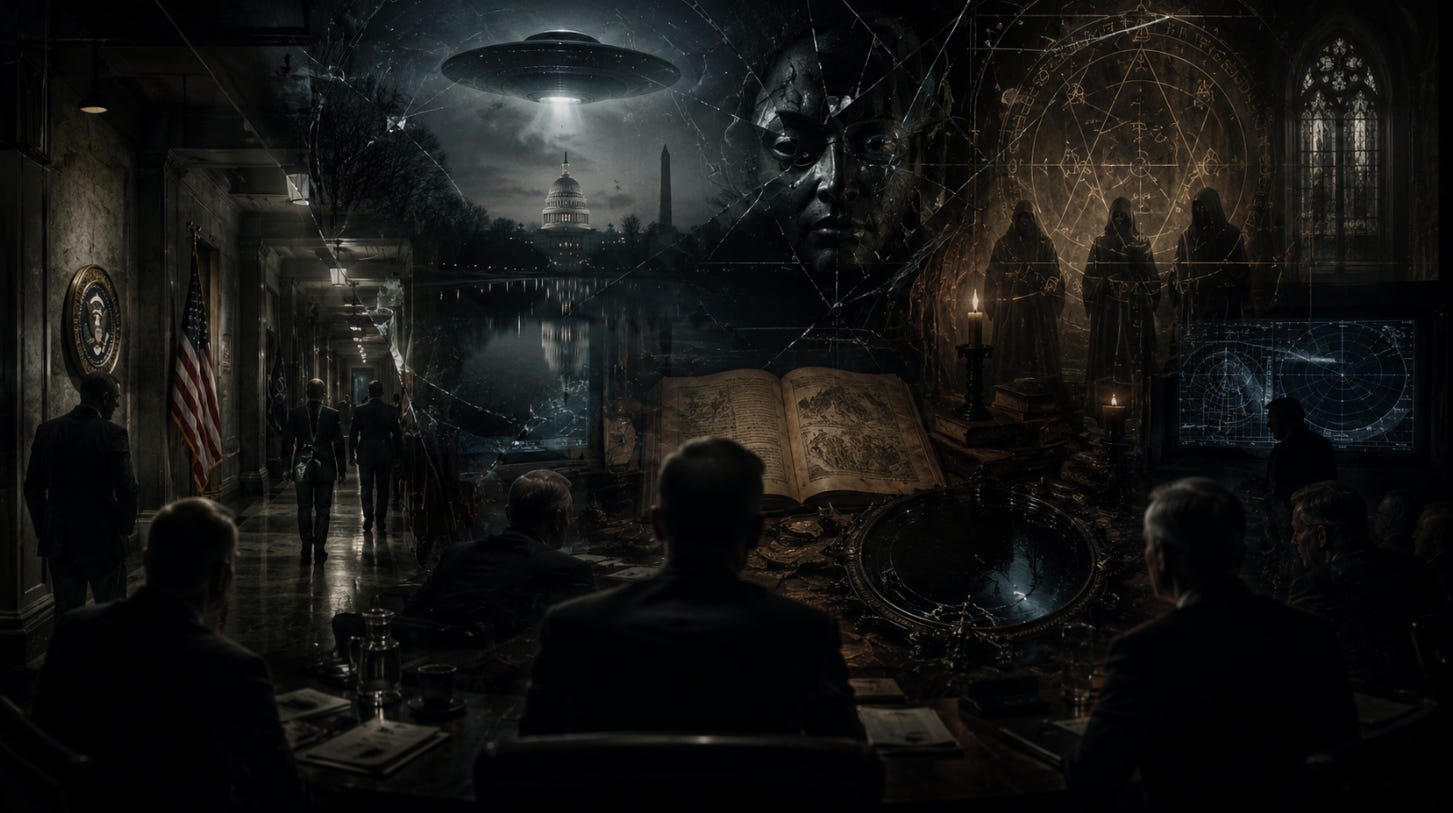
Most people approach the UFO question as a question about technology. Strange craft are seen. Advanced propulsion is inferred. The discussion turns to aerospace engineering, recovered materials, secret programs, and the possibility that humanity is not alone.
That framing is understandable. It is also incomplete.
There is another line of analysis, far less discussed, which does not begin with craft at all. It begins with a different question: what if the central feature of the phenomenon is not what appears in the sky, but how the phenomenon interacts with human beings?
The Collins Elite sits inside that second line of analysis.
The term “Collins Elite” does not refer to a public institution. It refers to a reported internal current within parts of the United States defense and intelligence world. That current became widely known through Nick Redfern’s Final Events, a book that brought together Ray Boeche’s account with a wider theory of government concern over demonic or deceptive non-human intelligences.
Redfern did not invent the issue. His importance is that he assembled the public version of the theory. The starting point remains Boeche.
Boeche was not a casual witness. He was a theologian, Anglican priest, UFO researcher, and long-time investigator of anomalous phenomena. According to his account, two men connected with the Department of Defense contacted him in Lincoln, Nebraska in 1991. They met at the Cornhusker Hotel. They described work involving attempts to contact and utilize non-human intelligences. Their concern was not that the government had merely recovered unusual technology. Their concern was that elements of the defense world had entered into interaction with something they did not understand.
The account is disturbing because it does not remain within conventional categories. It involves non-human entities, psychotronic effects, remote viewing, attempts at control, moral alarm, and alleged ritual methods. Boeche’s sources claimed that some participants believed they were making progress in using the phenomenon. According to Boeche’s account, they later concluded something much darker: they were not controlling the entities. They were being allowed to believe they were in control.
That distinction is central.
If the interaction is asymmetric, then the phenomenon is not a passive subject of study. It is an active participant. It can shape perception, experience, expectation, and interpretation. Under those conditions, what the phenomenon says about itself cannot be treated as reliable. “We are extraterrestrial” becomes part of the interaction, not a settled statement of origin.
The ritual question is often framed too narrowly. Crowley matters in Final Events, but not because he invented the problem. He did not. He belongs to a much older lineage of attempted contact with non-human intelligence through ritual, symbolic language, altered states, and invocation. The important point is not Crowley as an isolated occult figure. The important point is continuity.
The phenomenon is not new, and neither is the human attempt to reach it.
John Dee and Edward Kelley used scrying, angelic language, and ritual communication in the sixteenth century. Crowley used ceremonial magic, altered states, and invocation in the early twentieth. Jack Parsons then carried the same logic into a modern scientific and technological environment, combining rocketry, occult practice, and deliberate contact ritual. In the Collins Elite framework, this lineage matters because it suggests that modern “contact” programs may not be wholly modern. They may be a national-security version of a much older ritual grammar.
That grammar is recognizable. It seeks to open a channel, summon or contact an intelligence, receive knowledge, and gain power or access from the interaction. The language changes. The structure remains.
Such ritual has always appeared in human history in different forms. It is not a modern invention, and it is not a harmless eccentricity. Invocation, sexual magic, blood offering, possession frameworks, and attempts to open channels to non-human intelligences recur because the underlying impulse is ancient: to obtain power or knowledge by crossing a boundary that should not be crossed. In the darkest accounts, including the Boeche/Collins material, that boundary-crossing extends to ritual harm and human sacrifice. Whatever temporary advantage such practices appear to offer, they do not benefit humanity. They invert the proper order. They treat human life, body, will, innocence, and soul as instruments of access. That is why the Collins Elite concern cannot be reduced to religious discomfort. The concern is structural: any practice that seeks power through deception, violation, or sacrifice is already aligned against life.
Dee called the intelligences angelic. Crowley used occult and Enochian frameworks. Parsons pursued Babalon. Modern systems may call the same class of interaction communication with NHI. But the underlying act is similar: humans attempt to cross a boundary and obtain knowledge or power from an intelligence they do not control.
Crowley should therefore be treated as a bridge, not an origin. He shows that ritual contact did not disappear when the technological age arrived. It adapted. It moved into new institutions, new language, and new forms. The Collins Elite concern is that parts of the defense and intelligence world may have entered that same stream while believing they were conducting research rather than repeating an older ritual pattern.
The later discussion in Final Events of what is described as a “Parsons technique” sharpens this concern. The phrase suggests that Parsons was not viewed merely as a historical precursor, but as someone whose methods may have been studied, adapted, or repeated. In that view, ritual contact was not simply an occult episode in early rocketry. It became a model, or at least a reference point, for later attempts to engage the phenomenon.
The issue is not only that Crowley and Parsons may have opened something. It is that later actors, operating under national-security language, may have tried to reproduce the same category of contact while believing they were working scientifically or strategically. If so, the error is profound. They were not escaping ritual by giving it technical language. They were ritualizing contact under institutional cover.
That also explains why Roswell and the Washington D.C. UFO flap matter inside the Collins-type interpretation. They are not treated merely as unexplained events. They are treated as possible manifestations in a sequence: Crowley, Parsons, 1947, Roswell, Washington, and the later normalization of the extraterrestrial frame. For the Collins-type analysis, these are connected events rather than isolated anomalies.
The claim is not merely that UFOs are strange. The claim is that the phenomenon may be deceptive by nature. It presents itself in forms the observer can accept. In a technological age, it appears as advanced visitors from other worlds. In earlier ages, the same underlying pattern may have appeared as gods, spirits, demons, fairies, Watchers, messengers, or monsters. The mask changes. The structure remains.
That structure is why the issue keeps returning to religion.
The Collins Elite interpretation does not treat religion as decorative. It treats religion as one of the primary domains in which the phenomenon operates, because religion addresses meaning, origin, identity, good, evil, death, and the soul. If an intelligence seeks to manipulate human beings at the deepest level, it will not limit itself to machines. It will operate through belief.
The Boeche/Redfern material does not describe a purely technical program. It describes alleged efforts at contact that intersect with older ritual grammars: invocation, symbolic action, altered states, Crowleyan influence, and the attempt to gain access to non-human power. The precise details are less important than the structure. The concern is not that someone used strange language. The concern is that elements of state power may have crossed from observation into ritualized engagement.
That is the point at which the subject becomes morally serious.
If a state studies aircraft, the issue is secrecy. If a state attempts to bargain with or use deceptive non-human intelligences, the issue is corruption. If that engagement involves coercion, sacrifice, or ritualized harm, the issue is evil.
The word evil should not be avoided here. It need not be used as a doctrinal conclusion. It can be used analytically. Evil describes conduct that is deceptive, parasitic, exploitative, and oriented toward harm. It describes a pattern that feeds on vulnerability, reverses moral order, and presents corruption as knowledge or power.
That is exactly why the Collins Elite interpretation matters. Whether one accepts its theology or not, it identifies the central risk: the phenomenon may not merely be unknown. It may be adversarial.
This produces two possible institutional responses.
One response is engagement. If the phenomenon possesses capabilities beyond human systems, then military and intelligence actors may seek advantage from it. That logic is familiar. States seek power. They study whatever may produce power. They often persuade themselves that risk can be managed if the potential advantage is large enough.
The second response is refusal. If the phenomenon is deceptive, then engagement itself may be the trap. A system that believes it is acquiring knowledge may instead be absorbing false premises. A program that believes it is using the phenomenon may itself be used.
The Collins Elite appears to represent this second response.
Later material in Final Events complicates the environment around the Collins Elite, rather than the Collins position itself. The Collins view appears comparatively uniform: the UFO phenomenon is not simply extraterrestrial, but demonic or deceptive in nature. What varies is the response among other groups inside the defense and intelligence world studying the same problem.
Some appear to have favored engagement. Some appear to have favored containment. Some appear to have favored public or managed disclosure. Others seem to have believed the entire project of engagement was already compromised. That distinction matters. The Collins Elite were not skeptics. They accepted the phenomenon as real. Their argument was that other elements of the system had misunderstood what was real, engaged it, and possibly become entangled with it.
In that reading, the Collins Elite are best understood as a warning faction inside a broader hidden struggle. Their concern was not merely that the public had been misled by an extraterrestrial narrative. Their concern was that elements of the state had attempted to use the phenomenon and had mistaken permission for control.
But Final Events also reads, in part, as the story of the Collins Elite becoming endangered by its own conclusion. A group that begins by warning against deception can itself become corrupted if it adopts deception as a tool. Once the response moves from discernment into management — from warning into staged events, coercive religious programming, emergency rule, or the sacrifice of innocents for some imagined higher purpose — the moral line has already been crossed. At that point, the anti-demonic faction begins to imitate the logic it claims to oppose.
The deeper problem is that these responses do not remain confined to secret programs. They can influence policy, culture, and strategic judgment.
This is also where the Collins Elite interpretation reaches its own limitation. It identifies danger, but it does not appear to understand the full nature of the response required.
The material is strong in recognizing corrupt invocation: ritual aimed at access, domination, power, control, or transgression. That is the ritual stream associated with Dee, Crowley, Parsons, and the alleged later attempts to engage the phenomenon through comparable methods. But the material appears much weaker in recognizing the opposite category: benevolent sacred action directed toward protection, purification, repentance, blessing, and alignment with the good.
That distinction is essential. Ritual is not one thing. A practice aimed at summoning or controlling an intelligence is not the same as a practice aimed at cleansing, protection, or moral alignment. The first seeks power. The second seeks truth. The first crosses boundaries for gain. The second restores boundaries that should not have been violated.
The Collins Elite appears to miss this because its framework is constrained in two ways. First, it is narrow in theological vocabulary, often framed almost entirely through a Christian end-times lens. Second, it remains shaped by the intelligence world itself: secrecy, classification, containment, managed disclosure, and strategic manipulation. A group trained inside that environment may recognize evil and still fail to understand how evil is opposed.
What appears missing is a positive account of order. The Collins-type material sees deception, threat, and final conflict, but it does not clearly articulate the older and broader idea that the world itself is structured, created, and ordered toward coherence. That missing frame matters. In The World Is Structural and Created, creation is not presented as a cartoon theology of an external ruler, but as the present fact that reality is shaped, intelligible, bounded, and governed by structural consequence.
That also changes how consciousness should be understood. If the phenomenon operates through perception, belief, fear, and meaning, then consciousness cannot be treated as a sealed private interior. In Consciousness as Presence in a Structured World, consciousness is described as presence arising from truth, law, resonance, and coherence. That makes deception more than false information. It becomes an attack on alignment itself.
The same point applies to truth. A deceptive phenomenon should not be judged by its statements, because statements may be part of the operation. It should be judged by coherence, effects, and conduct. In Truth Has a Coherent Structure, falsehood is shown to fragment and require continual repair, while truth holds under stress and recombination. That is the proper test here: not what the entities say, but whether the pattern they produce converges toward coherence or toward fracture.
If the phenomenon is moral or spiritual in nature, then secrecy is not enough. Classification is not enough. Militarized containment is not enough. A deceptive phenomenon cannot be defeated by a system that continues to rely on concealment and manipulation as its ordinary tools. That may be the deepest weakness in the Collins response: it recognizes the danger of dark ritual, but does not fully articulate a truthful, benevolent, non-coercive response.
This is where the Fordham reference becomes important, but it must be stated carefully. The Fordham connection appears to derive from Jacques Vallée’s notes of a conversation with a senior, unidentified person concerning the Collins Elite and a 1970s Fordham connection. That does not establish Fordham as the origin point of the Collins Elite. A post-Roswell origin remains more plausible. The Fordham reference more likely points to a later period of cooperative study, where military, intelligence, academic, and religious actors examined the phenomenon through overlapping frameworks: UFOs, consciousness, demonology, altered states, ritual contact, and eschatology.
That is a very different claim from saying the group began at Fordham. It suggests that Fordham may have been a study node.
That matters because study nodes shape interpretation. Interpretation shapes policy.
If a faction inside defense or intelligence circles interprets the phenomenon through a flawed end-times framework, the consequences do not remain theoretical. The Middle East, Israel, prophecy, war, and religious destiny already overlap in American political culture. Evangelical influence inside parts of the U.S. military, particularly the Air Force, has been reported and contested for years. Evangelical recruitment and religious framing are not marginal cultural details. They form part of the environment in which certain officers, officials, chaplains, and policymakers interpret world events.
This does not mean every military decision is religious. It means religious interpretation can become part of strategic imagination.
That is dangerous if the interpretation itself has been shaped by deception.
A flawed end-times framework can convert geopolitical conflict into spiritual necessity. It can make escalation appear providential. It can make compromise appear like betrayal. It can cause policy to move not toward peace, realism, or protection of the innocent, but toward fulfillment of a narrative.
This is why large trauma events matter in the wider architecture of institutional deception. I do not need to resolve those events here. The narrower point is that crisis, fear, emergency law, surveillance, and public submission can become tools of governance. Final Events becomes most disturbing where it imagines those tools converging with staged religious spectacle, emergency rule, and managed belief. Whether one accepts that scenario or not, it reveals the kind of strategic imagination that can arise when secrecy, apocalyptic interpretation, and state power begin to overlap.
On that reading, the nuclear event discussed in Final Events matters less as a prediction than as a revelation of strategic imagination. It represented a proposed escalation of a logic already visible in modern crisis governance: mass fear, emergency law, surveillance, war footing, and public submission to a new security reality. A nuclear event in an American city, followed by martial law and staged religious spectacle, would have intensified that logic dramatically. Whether or not one accepts the scenario, Chapter 30 shows how easily apocalyptic interpretation, state power, and managed belief can converge inside a single strategic imagination.
If the underlying narrative has been influenced by deceptive non-human interaction, then policy itself may become a secondary instrument of the deception.
This possibility helps explain why the UFO question cannot be separated cleanly from the study of institutions.
A deceptive phenomenon and a self-protecting institution fit together too well. One supplies ambiguity. The other supplies containment. One fragments meaning. The other restricts knowledge. One presents masks. The other manages disclosure.
That same pattern appears in other domains I have examined elsewhere. In Disclosure Without Resolution, the UFO issue is treated as a system in which acknowledgment expands while explanation never fully arrives. In Compartmentalization and the Structure of Classified Power, secrecy is shown to prevent not only public knowledge, but full internal visibility. In Epstein the System, elite criminality is not treated as a scandal but as a protected structure in which exposure replaces accountability. In Vatican Institutional Containment in the Catholic Abuse Crisis, religious authority is shown managing grave moral failure through internal handling, restricted records, and delayed accountability.
These are not the same subject. They are structurally related.
Each involves a protected system. Each involves partial truth. Each involves institutional survival taking priority over correction. Each shows how severe realities can be known, contained, and metabolized without being resolved.
That is why the Vatican connection cannot be dismissed too quickly.
If religious institutions participated in study of the phenomenon, they may have done so as interpreters, gatekeepers, or containment structures. If they encountered evidence that challenged public doctrine or institutional legitimacy, they would have strong incentives to manage that evidence internally. The abuse crisis proves at minimum that sacred authority does not prevent institutional containment. It may even intensify it, because the institution’s legitimacy depends on appearing morally elevated.
The Vatican cannot be treated as a neutral observer. It has a documented pattern of institutional concealment, a long ritual tradition, and a clear interest in the UFO question through the Fordham-linked study environment and related lines of inquiry. An institution that repeatedly protects itself in the face of grave moral contradiction cannot be evaluated by trusting its public posture.
This is the wider importance of the Collins Elite.
It is not merely a strange chapter in UFO literature. It may be a key to understanding why so many inverted systems share similar features: secrecy, ritualized power, elite protection, exploitation of the vulnerable, managed disclosure, and moral reversal.
Deception operates inside human institutions. The harder question is whether those institutions are also interacting with a non-human deception that precedes and exceeds them. If so, institutional inversion is not merely human. It is human participation in something older.
Human systems may not have invented the whole pattern. They may have entered into it, replicated it, benefited from it, and been corrupted by it.
This is why the subject is so difficult. The Collins Elite interpretation is stronger than the simple extraterrestrial model, but it is not complete. The entities themselves cannot be trusted. Their statements cannot be treated as evidence of their nature. Even the religious interpretation can be manipulated if the phenomenon benefits from pushing different groups into separate explanatory cages.
The safe analytical rule is therefore simple: do not trust what the phenomenon says. Watch what it does.
What it appears to do is fragment understanding, produce conflicting narratives, attract institutional interest, and pull human beings toward questions of power, worship, fear, death, and the soul.
That is not a neutral pattern.
The Collins Elite does not resolve the UFO question. It changes the question. It asks whether the alien explanation may be a mask, whether some parts of the state recognized the mask, whether other parts tried to use what stood behind it, and whether the consequences of that error may have reached into policy, religion, and institutional life.
The final issue is not whether something is visiting us.
The final issue is whether humanity has mistaken deception for disclosure, power for knowledge, and contact for understanding.
The Collins Elite analysis shows why the UFO question is not primarily about craft.
It is about whether human institutions can recognize evil when evil arrives wearing the language of progress, science, salvation, or superior intelligence