

Any serious inquiry into constitutional legitimacy must begin before the Constitution itself. The United States Constitution was not written as a source of rights, nor as a general license to govern human life. It was written against a background assumption that rights already existed, that government was inherently dangerous to those rights, and that only a narrow and carefully bounded set of powers could be entrusted to it at all. The Constitution is therefore best understood not as an expansive grant of authority, but as a minimal limitation placed on pre-existing Natural Law rights.
This understanding is not modern revisionism. It is explicit in the Federalist Papers, implicit in the structure of the Constitution, and confirmed by early Supreme Court jurisprudence. Read coherently, these sources reveal a constitutional order that assumes the sanctity of private life—particularly the home—and permits governmental intrusion only in exceptional circumstances, typically where one person’s liberty threatens another’s.
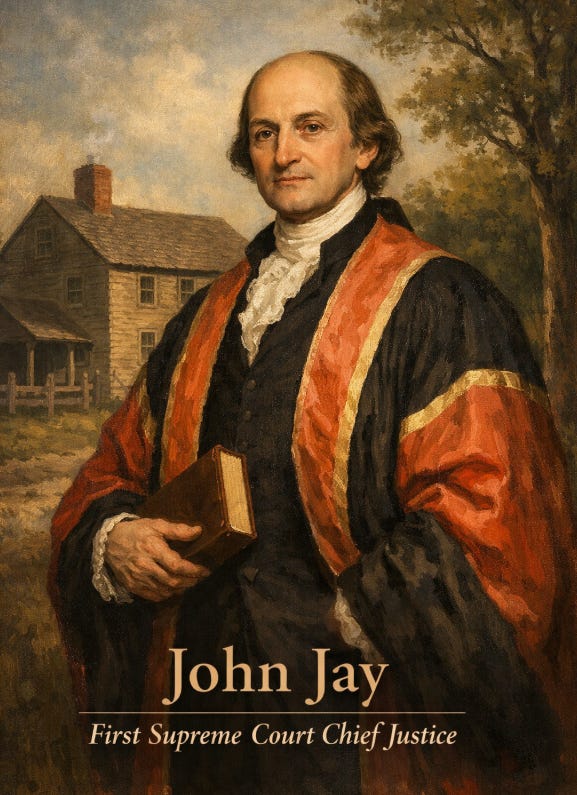
The clearest statement of this framework comes from John Jay in Federalist No. 2. Jay does not treat rights as products of the Constitution. He treats them as antecedent realities. His formulation is precise and revealing: “Nothing is more certain than the indispensable necessity of government; and it is equally undeniable that whenever and however it is instituted, the people must cede to it some of their natural rights, in order to vest it with requisite powers.” The ordering is decisive. Natural rights exist first. Government comes second. And only some rights are ceded—not all, not most, and never by implication. The Constitution is therefore a document of limited surrender, not collective self-abnegation. Anything not clearly ceded remains with the people by default.
Just as important is Jay’s use of the word “requisite.” Rights are surrendered only to the extent necessary for the limited functions of government—defense, diplomacy, adjudication, and coordination. A power that negates the conditions of liberty itself cannot be requisite. A government that claims authority over the most basic elements of private life would defeat the very justification Jay offers for its existence.
Jay’s reference to “natural rights” was not abstract. In later writings and judicial charges, he described natural rights as including life, liberty, and property, and the pursuit of happiness and safety. These were not grants from government, but moral claims derived from human nature itself. Civil government, in Jay’s view, existed to secure these rights, not to define or redistribute them. Law was legitimate only insofar as it conformed to principles of justice grounded in natural law; legislative acts that violated fundamental rights were not merely unwise, but unjust.
Under this framework, the home occupies a central position. It is where life is preserved, liberty exercised, property secured, and safety made real. Interference with the home therefore implicates the very rights government exists to protect. Absent a necessity grounded in the prevention of harm to others, such interference exceeds the authority Jay believed the people had ever ceded.
Alexander Hamilton reinforces this logic in Federalist No. 84, where he famously questions the need for a bill of rights at all. His reasoning is often misunderstood, but its implication is unmistakable. “Why declare that things shall not be done which there is no power to do?” Hamilton’s concern was not that rights were unimportant, but that enumerating them might imply that anything not listed had been surrendered. His argument rests on the assumption that large portions of human life—property, domestic living, personal security—were already beyond governmental reach. The Constitution did not need to forbid what it had never authorized.
This reasoning also explains why many of the Framers initially believed a Bill of Rights was unnecessary. Their concern was not that rights were insecure, but that they were already protected by structure. Because the federal government possessed only enumerated powers, and because none of those powers touched ordinary private life, there was nothing for many rights to be protected from. To list rights explicitly risked implying that anything not listed had been surrendered. The later adoption of the Bill of Rights did not reject this understanding; it reflected an abundance of caution. The Ninth Amendment, in particular, was designed to preserve the original natural-law framework by making explicit what had previously been assumed: that the enumeration of certain rights must not be construed to deny or disparage others retained by the people.
James Madison, though more analytic in tone, operates from the same premises. In Federalist No. 10, he explains that property arises from “the diversity in the faculties of men” and that the protection of these faculties is “the first object of government.” Property, in this account, is not a legislative artifact. It is the natural result of human action, effort, and differentiation. Government’s role is protective, not creative. In Federalist No. 51, Madison adds that justice is “the end of government.” Justice here is not whatever the legislature declares it to be; it is a moral constraint grounded in natural law. Power must be structured and restrained precisely because it cannot be trusted not to overreach into domains never delegated.
These principles are reflected structurally in the Constitution itself through the doctrine of enumeration. The federal government does not possess general authority. It may act only where power has been affirmatively granted. This enumeration is not illustrative; it is exclusive. Where no power is granted, no power exists. Nowhere in the Constitution is the federal government granted authority over the internal affairs of the home. There is no enumerated power to regulate domestic living arrangements, to supervise private dwellings, or to condition a person’s right to occupy their home on compliance with administrative regimes. The absence of such powers is not accidental. It reflects the Founders’ assumption that domestic life lay beyond the scope of federal governance altogether.
The limitation of federal power did not imply unlimited authority in the states. The Framers did not replace one sovereign with thirteen smaller ones. State governments, though closer to the people and entrusted with more local functions, were understood to be equally constrained by natural law and by the rights retained by the people themselves. John Jay’s formulation of limited cession applies to state authority as well: rights not surrendered remain with the people, not with any level of government. State power was residual—exercised where necessary to secure peace, adjudicate disputes, and prevent harm—but it was never understood as dominion over private life. The home, as the center of personal autonomy, was assumed to lie outside ordinary state governance just as it lay outside federal reach.
This understanding explains why early American constitutional thought rejected the idea that legislatures possessed unlimited authority simply because they were local. As Justice Samuel Chase observed in Calder v. Bull (1798), there are acts which legislatures cannot do, even where no express constitutional prohibition exists, because they violate fundamental principles of justice. State constitutions routinely constrained legislative power, and early courts did not hesitate to invalidate state actions that transgressed those limits. Legislatures, whether state or federal, were not sovereign over natural rights. They were trustees, bound by limits they did not create and could not dissolve.
Nowhere is this background assumption more important than in understanding the status of the home. The Federalist Papers do not debate whether the home should be regulated or governed. They do not discuss zoning, occupancy rules, or domestic oversight. This silence is not an omission; it is evidence of assumption. The home is treated as part of the retained sphere of private life—one of the conditions government exists to protect, not administer.
The Constitution itself reflects this assumption. The Third Amendment prohibits the quartering of soldiers in private homes without consent. This is not merely a historical reaction to British abuses; it is a structural declaration that the home is not an instrument of the state. If the government may not place bodies inside a dwelling even for public purposes without consent, its authority over that space is already sharply constrained. The Fourth Amendment deepens this protection by explicitly naming “houses” as objects of heightened security, securing the right of the people to be free from unreasonable searches and seizures in their homes. This language reflects a broader constitutional understanding that the home is a protected zone into which government intrusion is exceptional, not routine.
Early Supreme Court decisions confirm that this natural-law framework was not merely philosophical rhetoric, but operative constitutional understanding. In Calder v. Bull (1798), Justice Samuel Chase articulated a principle that modern constitutional law often prefers to forget: there are acts which legislatures cannot do, even in the absence of explicit constitutional prohibitions, because they violate fundamental principles of justice grounded in natural law. In Vanhorne’s Lessee v. Dorrance (1795), Justice William Paterson described the right of acquiring and possessing property as “a natural, inherent, and unalienable right.” Property, in this view, is not a conditional privilege subject to ongoing governmental permission; it is a right government exists to secure. And in Fletcher v. Peck (1810), Chief Justice Marshall recognized that once property rights vest, legislatures cannot arbitrarily destroy them, even in the name of public policy. Law is constrained by justice, not merely by procedural form.
What emerges from these sources is a coherent constitutional picture. Natural law defines the outer boundary. The Constitution operates inside that boundary. Rights are retained unless clearly ceded. Powers are delegated narrowly and instrumentally. Neither federal nor state governments were granted general authority over private domestic life. The home, in particular, stands as a protected natural-law zone—a space where liberty is lived, not merely asserted.
Regulation enters this picture only when retained rights collide: when one person’s use of their home threatens concrete harm to others. In such cases, intervention is not a denial of natural law, but its enforcement. Outside those narrow circumstances, authority was never delegated. Silence is not permission. Tradition is not legitimacy.
This first principle must be understood before any specific application can be debated. Without it, constitutional analysis degenerates into policy preference and administrative habit. With it, the structure becomes clear. The Constitution was designed to restrain power, not normalize it. And any system that treats the home as an ordinary object of governance has already departed from the natural-law foundation on which the American constitutional order was built.
This is the ground. Everything that follows depends on it.
This is the first essay in a series examining how retained natural rights and enumerated powers constrain modern governance of the home and private life.