

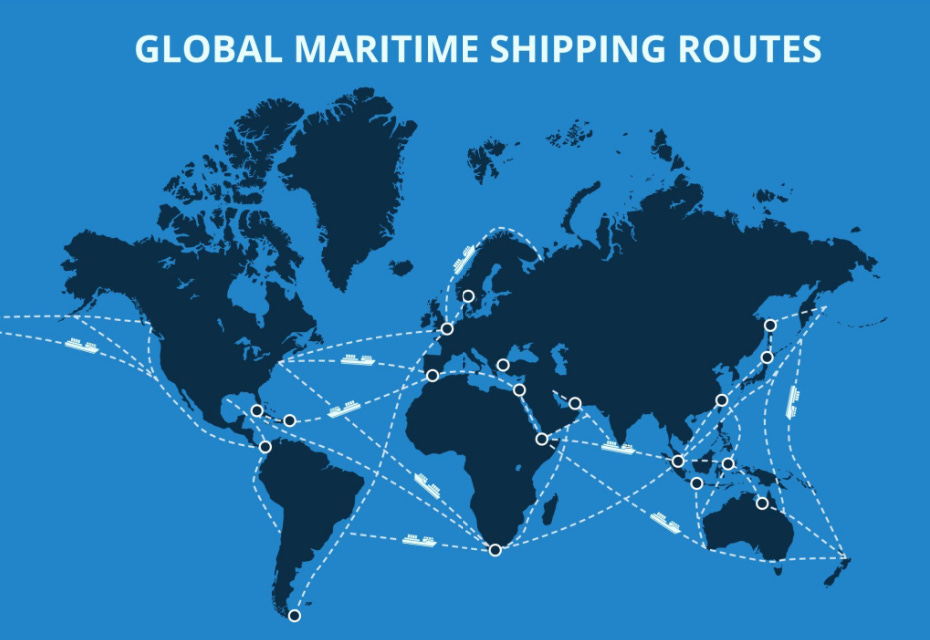
Global trade is often described as a digital phenomenon. Goods are ordered online, payments move electronically, and information travels instantly across continents. The underlying physical system that actually moves those goods receives far less attention. The modern global economy depends on a logistics architecture built around standardized container shipping, and that architecture concentrates enormous volumes of trade into a small number of routes, ports, and operational systems.
The key enabling technology is the standardized intermodal container. Since the late twentieth century, most manufactured goods moving across oceans travel inside metal containers designed to be transferred seamlessly between ships, rail systems, and trucks. This standardization reduced handling costs, accelerated port operations, and allowed global supply chains to scale rapidly. Products assembled in multiple countries can now move through a single integrated transport system with minimal friction.
The efficiency gains were transformative. Containerization allowed manufacturers to distribute production across the world, locating factories wherever labor, materials, or regulatory conditions were most advantageous. Ports evolved into high-speed transfer hubs capable of moving thousands of containers per hour. Shipping companies built vessels capable of carrying more than twenty thousand containers on a single voyage. The result was a logistics network that dramatically lowered the cost of moving goods across oceans.
Efficiency, however, produced a second structural effect. As the container system expanded, trade flows became increasingly concentrated within a limited set of corridors and infrastructure nodes. A relatively small number of maritime chokepoints now handle a large proportion of global shipping traffic. Major container flows move through passages such as the Strait of Malacca, the Suez Canal, and the Panama Canal.
Port infrastructure is similarly concentrated. A small group of megahubs process an outsized share of containerized cargo, including facilities such as the Port of Shanghai, the Port of Singapore, and the Port of Rotterdam. These ports function less as local gateways and more as central nodes within an integrated global logistics network.
Concentration is not accidental. The container shipping system rewards scale. Larger ships require deeper harbors, specialized cranes, and highly automated terminals. Ports that invest in this infrastructure become dominant hubs, while smaller facilities lose traffic. Shipping lines also prefer predictable high-volume routes, which encourages traffic to consolidate further along established corridors.
The resulting system is extremely efficient under stable conditions. Ships move along fixed schedules, ports process cargo continuously, and supply chains rely on predictable transit times. Manufacturers and retailers increasingly organize production and inventory around this steady flow of goods. Warehousing and stockpiling decline as companies rely on continuous replenishment from overseas suppliers.
The same architecture that produces efficiency also produces systemic fragility. When a system concentrates activity into a small number of nodes, disruption at those nodes can propagate rapidly across the network. The global shipping system has repeatedly demonstrated this characteristic.
Temporary closure of a single passage can halt a large share of maritime trade. Congestion at a major port can delay shipments across entire supply chains. Labor disputes, natural disasters, cyber disruptions, or geopolitical conflict affecting one major logistics hub can ripple outward through the global economy. Energy transit demonstrates a closely related vulnerability. As discussed in Energy Chokepoints and Global Vulnerability: The Strait of Hormuz, modern energy systems also depend on narrow maritime corridors through which a large share of the world’s oil must pass.
The structure of container shipping also reduces redundancy. Very large container vessels require specialized ports capable of handling their size. When disruption occurs at one of these facilities, alternative routes or substitute ports are often limited. The network therefore trades resilience for throughput.
From a system perspective, container shipping illustrates a broader pattern within modern infrastructure design. Large-scale systems frequently optimize for efficiency, cost reduction, and volume throughput. Over time these optimizations concentrate activity into fewer nodes and remove redundancy from the network. The system performs extremely well during normal operation but becomes increasingly sensitive to disruption.
Global trade therefore rests on a physical architecture that is both powerful and delicate. The standardized container system enabled globalization by drastically lowering transport costs and integrating distant production centers into a unified logistics framework. At the same time, the concentration of routes, ports, and shipping capacity created structural chokepoints through which a large share of the world’s commerce must pass.
Understanding globalization requires recognizing this physical infrastructure beneath the digital economy. The container shipping network is not simply a transportation system. It is the logistical backbone of modern trade, just as the undersea cable system forms the physical foundation of digital communication, a relationship explored in The Physical Internet: Submarine Cables and Global Communication. Together these systems reveal a common pattern: modern global networks appear distributed and resilient on the surface, yet rely in practice on a relatively small set of concentrated infrastructure nodes.