

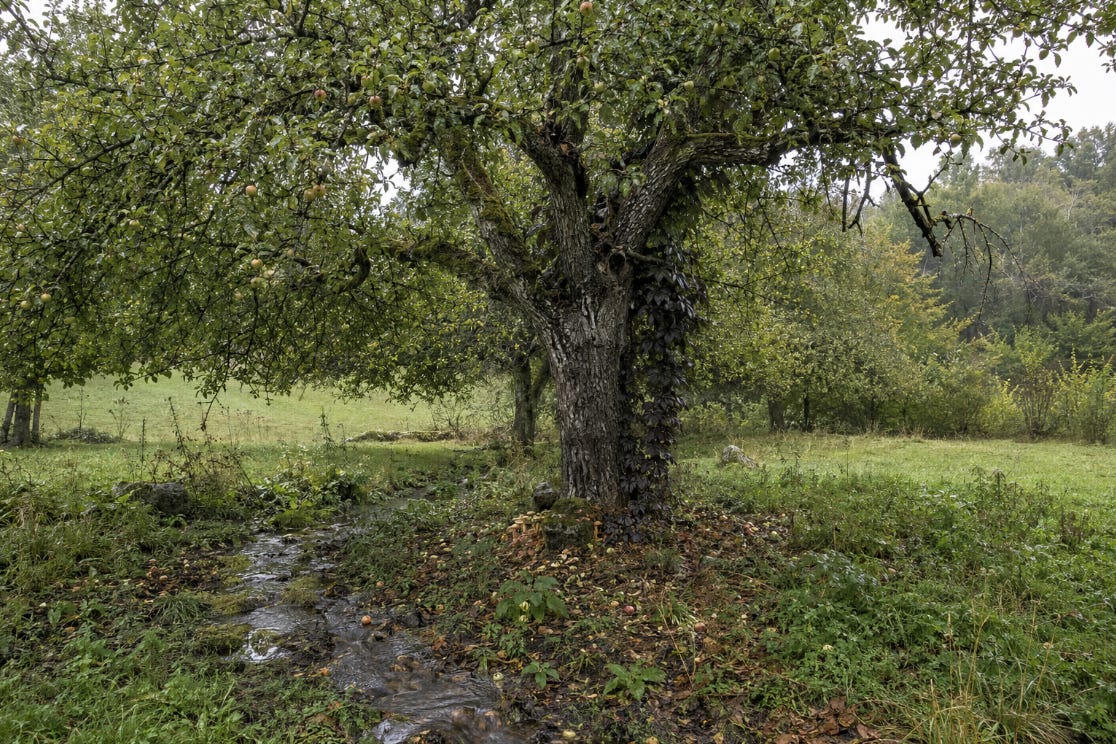
The world presents itself as an ordered system. Wounds close. Organisms regulate themselves. Seeds become the forms encoded within them. Relationships deepen through trust and fail through betrayal. Communities persist through cooperation, memory, and reciprocal duty. Across scale, coherence allows complex organization to form and remain intelligible through time.
The World Is Structural and Created But Not in the Aged, Bearded White Man Sense considered what this order permits us to infer about creation. The evidence does not establish the doctrinal God described by any particular religion. It supports a more limited conclusion: the world is structured, the structure is intelligible, and the order within it is sufficiently deep and recurrent to justify describing it as created.
What, then, does creation reveal about its Creator?
Religions answer through inherited stories, authorized texts, human attributes, and systems of obedience. Such accounts may preserve genuine perception, but they also reflect the institutions that selected, interpreted, and enforced them. The earlier evidence lies in what has been made. If a maker can be understood through the recurring characteristics of the work, creation itself must be read first.
Its structure displays a preference. Some forms of organization continue because they preserve the relationships on which they depend. Others consume those relationships and eventually fail. Truth, cooperation, repair, proportion, and reciprocal exchange support continuing order. Deception, extraction, domination, and unlimited consumption destroy their own foundations.
This preference need not resemble human emotion. The inner nature of the Creator remains beyond direct observation. Yet in a created order, recurring constraints reveal what the architecture is arranged to preserve. A system that repeatedly repairs injury, rewards accurate relationship, generates life through cooperation, and returns unchecked consumption to consequence contains a functional preference.
Naming the mechanism does not remove the direction. Selection describes how forms unable to sustain their conditions disappear. It does not alter the observation that bounded exchange, repair, and cooperation repeatedly support continuation, while unlimited consumption destroys its base. Within a created order, structural preference is the name for that stable asymmetry.
This is the structural preference for good.
The argument does not begin by defining good as whatever produces coherence. Its characteristics can be recognized independently. Truth describes reality accurately. Protection preserves vulnerable life. Reciprocity returns value rather than capturing it. Repair restores damaged function. Stewardship maintains what has been received so that it remains available to others. Cooperation allows distinct beings to combine their capacities without surrendering their identities.
Their consequences are visible. They preserve trust, reduce destructive conflict, support continuing relationship, and allow complex forms of organization to endure. Their coherence is demonstrated by what they make possible.
A living body depends upon cooperation among differentiated parts. Cells retain boundaries, perform distinct functions, exchange information, and contribute to an organism larger than themselves. The organism supplies the conditions under which its cells remain alive. Part and whole survive through relationship.
The cell membrane governs exchange. It receives what supports life, excludes what would cause injury, and releases what is no longer required. A membrane that admitted everything would cease to protect the cell. One that permitted nothing to pass would leave it isolated and dead. The boundary makes relationship possible by giving it form.
Cancer reveals the inversion. A cancerous cell abandons proportion and begins consuming without regard to the whole. It may grow quickly, but its success is false. It destroys the body sustaining it and thereby destroys the conditions of its own survival.
The pattern recurs in human systems. A household organized through trust can direct its energy toward growth, care, and shared life. A household governed by fear spends that energy on concealment, control, and emotional survival. A productive economy supports continuing exchange because value is created and circulated. An extraction economy can appear rich while it consumes accumulated resources, inherited infrastructure, fertile land, public trust, and the productive capacity of the future.
People feel this distinction in ordinary life. A place shaped by care feels different from one maintained through fear, even when both remain outwardly tidy. One is renewed from within. The other consumes energy to preserve its appearance.
The created order also contains polarity. Activity and rest, expansion and contraction, growth and decay, giving and receiving, birth and death can operate as complementary movements within a coherent whole. Each limits and completes the other.
Evil does not occupy the same structural position. Death is not itself evil. Living systems consume, compete, defend territory, and eventually return their material to the wider order. Pain can signal injury. Fear can preserve life. Predation can remain bounded within relationships that do not exhaust the field supporting them. These processes may be severe, but they still participate in continuing order.
Finite embodiment carries vulnerability. Development can fail. Replication can produce destructive mutation. Disease, accident, and injury may occur without any conscious agent choosing them. Freedom does not explain this suffering. Material forms exist within consequence, so breakdown remains possible alongside growth and repair. That describes how natural suffering can occur; it does not explain why every instance is permitted. The structural preference for good describes the direction of the created order, not the goodness or present intelligibility of every event within it.
A child or animal may suffer and die. No account of coherent creation should diminish the reality of that injury. Yet physical death and the extinction of consciousness are not the same proposition. Consciousness as Presence in a Structured World examined consciousness as coherent presence within a structured informational environment rather than as a temporary product of matter. If consciousness continues beyond bodily form, physical pain may belong to the conditions of embodiment rather than to consciousness in its enduring state. We do not know what memory or awareness continues, but death does not establish either annihilation or permanent suffering. Evil may end an embodiment. It does not follow that it can extinguish or permanently injure the being expressed through it.
Evil begins where conscious agency converts limitation into unnecessary suffering, strength into domination, need into unlimited appetite, difference into dehumanization, or vulnerability into an opportunity for exploitation. It corrupts relationships that were capable of serving life.
An Explanation of Natural Law described natural law as structural constraint: what holds together, what fails under load, and what consequences follow misalignment. Good is lawful because its recognizable characteristics remain aligned with the conditions that allow coherent life to continue.
The world is also abundant. A tree produces more seeds than are required to replace itself. Plants bear fruit that feeds lives beyond their own. Healthy soil forms through exchange among roots, fungi, microorganisms, water, air, and decaying matter. Living systems generate, circulate, reuse, and renew.
Abundance depends upon limits. A field remains productive when extraction does not exceed replenishment. Water sustains many forms of life while its circulation remains intact. Wealth supports continuing prosperity when it represents real creation and continues to move through productive relationships. Interrupt the circulation and abundance becomes scarcity. The storehouse remains full while the surrounding field goes hungry.
The structural preference is for generative abundance governed by proportion, circulation, and stewardship. Unlimited accumulation eventually injures the relationships that produced the wealth being accumulated.
Resonance expresses the same principle differently. Distinct rhythms can reinforce one another when their relationship is aligned. Their contributions remain recognizable, yet the resulting order exceeds what any isolated part could produce. Persistent incoherence dissipates energy through interference, fragmentation, and compensating force.
Trust allows people to coordinate without constant surveillance. Shared truth permits action without repeated correction for concealed information. Love, friendship, family, and community do not erase individuality. They create relationships in which distinct persons become more capable together.
Evil has no comparable generative capacity. It can reorganize, imitate, weaponize, and capture, but it cannot create the goods it consumes. Deception requires an existing expectation of truth. Betrayal requires trust. Theft requires prior production. Slavery requires living people whose agency can be appropriated. Institutional corruption requires an institution that still possesses, or at least claims, a lawful purpose. Religious inversion requires the prior human capacity for reverence, prayer, and direct relation with the Creator.
Evil arrives second. It is a misuse of freedom within an order it did not make.
The claim is tested at the level of dependency rather than timetable. If an inverted order could independently generate the trust, life, resources, and coherence it consumes, it would no longer be parasitic. Extraction that replenished its own base, domination that created rather than appropriated agency, or deception that generated the reality needed to sustain it would defeat the argument. Evil may persist for centuries. Duration does not remove its dependence upon prior goods.
Its willingness to ignore limits can produce immediate advantages. Theft is faster than production. A lie can redirect perception before truth has time to reconstruct it. Violence can impose an outcome before consent can form. Institutions willing to deceive, intimidate, and extract can defeat more principled opponents, then use accumulated wealth and authority to preserve the advantage across generations.
A structural preference for good does not promise victory in every encounter. Innocent people suffer. Predatory institutions endure. Whole societies can be organized around exploitation. Evil’s victories are real.
They are also expensive. A lie needs records altered, witnesses discredited, questions forbidden, and later lies constructed to protect the first. Extraction must keep finding new bodies, resources, or generations to consume. Coercion expands as legitimacy declines. Surveillance replaces trust. Propaganda grows louder because ordinary observation keeps contradicting the authorized account. More of the system’s energy is spent maintaining the inversion, leaving less available for the function that once justified the system.
A church may retain its sanctuary while protecting the person who harmed a child. A court may preserve every procedure while placing justice beyond reach. A government may invoke public protection while making truthful observation punishable. The form survives. The proper end has been removed.
The Corruption of Order examined this survival of form after purpose has decayed. Such institutions may remain powerful for a long time, but ceremony, jurisdiction, and wealth cannot make contradiction coherent.
The Creator’s preference for good need not appear as continuous intervention. It is present in consequence. Truth remains connected to reality. Care preserves life. Reciprocity sustains relationship. Proportion prevents one part from claiming the whole. Evil can interrupt these relationships with terrible effect, yet it never escapes its dependence upon them.
Why would a Creator whose system prefers good permit evil at all?
A world without the possibility of departure would contain no meaningful alignment. Conscious beings could perform only what their design compelled. Kindness would carry no choice. Courage would require no fear. Loyalty would face no possibility of betrayal. Love would be indistinguishable from programming.
Meaningful freedom provides the most coherent explanation for the possibility of evil. It does not explain every injury or make suffering necessary. It means that consciousness capable of genuine alignment must possess some capacity to depart from it. Otherwise moral choice would be an appearance produced inside a fully predetermined system.
Freedom allows consciousness to participate in the order it inhabits. That participation includes alignment, misunderstanding, and deliberate inversion. The same freedom that gives moral significance to good permits the choice of evil.
This does nothing to diminish the suffering of its victims. Nor does it turn injury into a lesson they were required to receive. It identifies the price inherent in meaningful agency. A created order could prevent every misuse only by constraining the capacity from which the misuse arises. Instead, freedom operates within consequence, correction, and limits that eventually reassert themselves.
Correction can be slow. A dishonest person may prosper for years before accumulated contradictions become unmanageable. An institution can transfer the costs of its conduct to people with less power. A civilization may consume its inheritance while calling liquidation prosperity. Delay does not remove the constraint. It allows contradiction to accumulate until concealment costs more than the system can bear.
Created order repeatedly uses cycles to change the conditions under which accumulated structures persist. Sleep interrupts waking activity and allows repair. Seasons govern growth, release, dormancy, and renewal. Organisms and ecosystems pass through phases in which accumulated material is broken down and returned to circulation. A cycle preserves continuity by changing the conditions under which continuity occurs.
Growth that never yielded would become exhaustion. Activity without rest would destroy capacity. Accumulation without release would obstruct renewal. Cycles limit excess, reopen movement, and prevent any phase from assuming that its supporting conditions will remain unchanged.
The age system examined in The Turning of the Age and The Sky as Clock may express the same architecture at a larger scale. If civilizational conditions move through ordered ages, a turning would change the field in which accumulated structures operate. Institutions adapted to the preceding conditions could lose inherited stability. Concealed contradictions could become harder to preserve. New forms of order could become possible.
A turning would reset conditions without suspending freedom. Evil could prepare for it, carry resources across it, and attempt to rebuild control afterward. Good would still require recognition, memory, lawful relationship, and forms capable of preserving coherence. The structural preference supplies an advantage, not an automatic outcome.
A coherent creation permits evil to organize. It does not guarantee permanence to an inverted order merely because that order has accumulated power. Cycles return dominant systems to conditions they did not create and cannot completely control.
Prayer belongs within this structure. Prayer in a Structural World described prayer as alignment and ordered intention rather than submission to an institutional intermediary. If the Creator is known through a creation that structurally prefers good, then prayer aligned with truth, protection, courage, gratitude, justice, abundance, and restoration participates consciously in the direction already expressed through creation.
Prayer cannot compel every desired outcome. Human understanding remains partial, intentions conflict, and immediate desire may depart from wider coherence. Direction still matters. Prayer for domination, injury, sacrifice, or private advantage at the expense of others adopts the method of inversion even when it uses sacred language. Prayer for truth, protection, lawful abundance, restoration, and the defeat of evil seeks an outcome consistent with the structure sustaining life.
Organized religion obscures this relationship when it places doctrine, ritual authority, or institutional permission between consciousness and the Creator. Creation precedes religion. Coherence precedes doctrine. The structural preference for good was present before any institution claimed authority to interpret it.
Good also cannot secure lasting victory by becoming more efficient at evil. Deception cannot defeat deception while creating an order founded upon truth. Domination cannot produce freedom. Dehumanization cannot restore lawful relationship. Such methods preserve the inversion while changing its beneficiaries.
Means become part of the resulting order. Truth, courage, protection, proportion, accountability, and mercy are the substance from which good builds. Remove them in pursuit of victory and there may be victory, but what wins will no longer be good.
The Creator’s preference is visible in the unequal relationship between good and evil. Good can create what evil needs. Evil cannot create what good needs. Good sustains life, trust, relationship, beauty, abundance, and intelligible order. Evil can seize these things, redirect them, and consume them, but it remains dependent upon goods originating beyond itself.
That asymmetry is decisive. Evil may prevail locally. It may dominate institutions, capture wealth, punish truth, and impose suffering across generations. It cannot become the final principle of a coherent creation because it cannot generate the coherence required for anything to continue.
The world reveals no human face and establishes no institutional creed. It reveals an originating preference expressed through structure. Freedom is permitted. Consequence remains. Boundaries preserve identity. Resonance allows distinct lives to combine their capacities. Cycles change the conditions on which accumulated power depends. Abundance arises through generation and circulation. Good creates and renews the order within which freedom has meaning. Evil survives by borrowing that order and destroying its own foundation.
The world is not arranged so that good wins every event. It is arranged so that only good can provide a future.