

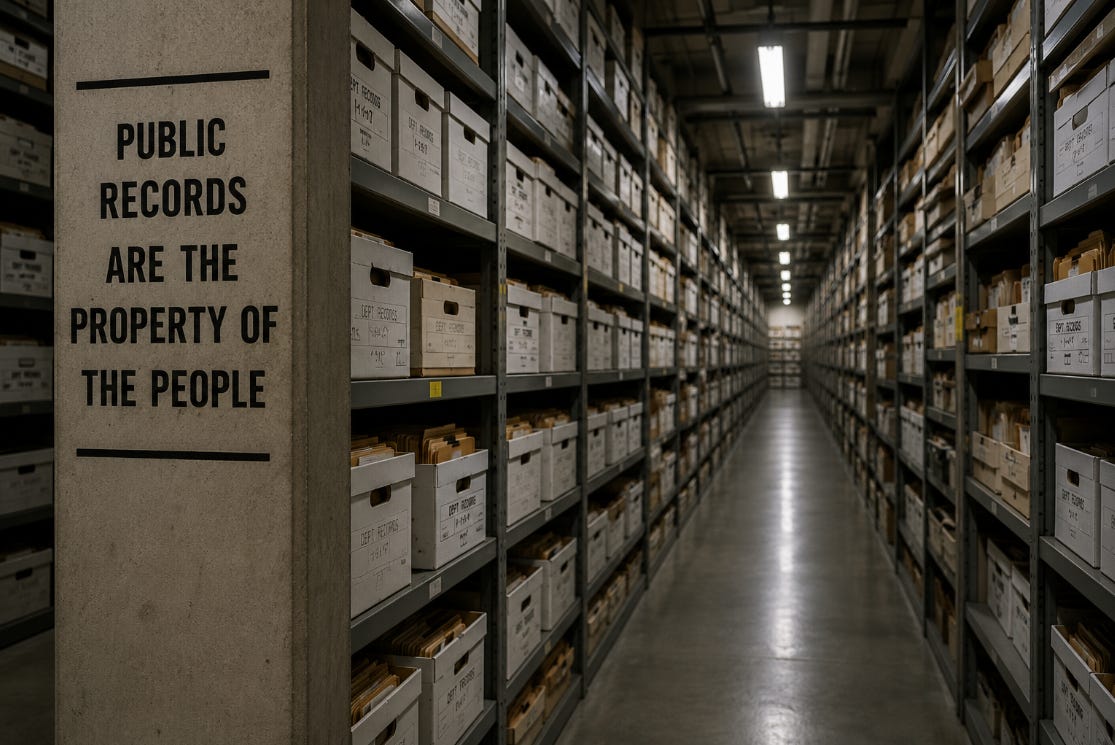
Public-records law begins with a simple proposition. Records documenting public business are held for the public and are presumptively open unless a specific legal reason requires their protection.
Oregon recognizes that right. A person may inspect the records of a public body unless an exemption applies. Those records may include paper files, emails, contracts, text messages, photographs, databases, reports, drafts, invoices, and communications with outside advisers. They may have been created by employees, elected officials, contractors, lawyers, or other people acting within the machinery of government.
The law promises access. The institution holding the records controls almost everything that determines whether access occurs.
The public body decides whether the request was properly submitted. It chooses the employees who will search, the accounts and devices they will examine, the search terms they will use, and the dates they will cover. It decides which documents are responsive, which passages will be blacked out, whether lawyers must review them, how long production will take, and how much the requester must pay before the search continues.
The institution whose conduct may be under examination therefore controls the evidence through which that conduct can be examined.
The public owns the right. Government holds the files.
Freedom of Information as Institutional Containment examined the federal Freedom of Information Act, a weak records scheme governing federal agencies. FOIA contains broad exemptions for national security, law enforcement, internal deliberations, commercial information, privacy, and other protected material. The agency holding the records applies those exemptions first. A requester who disagrees faces administrative appeals, delay, extensive redaction, and possibly federal litigation.
FOIA sometimes produces valuable evidence. It often produces it years late, surrounded by black ink and detached from any remedy. A document may confirm what occurred without changing the decision, disciplining the official, or repairing the harm.
Oregon’s Public Records Act is a separate state system, but it contains the same structural weakness. The institution controls timing, exemptions, search, review, cost, and release. The requester supplies the persistence. By the time the records arrive, the meeting has occurred, the money has been spent, the election deadline has passed, or the public controversy has moved on.
Late disclosure preserves the appearance of openness while protecting the consequence of secrecy.
The first barrier can be as small as a form.
Oregon law requires public bodies to maintain written procedures for receiving public-records requests. Such procedures can direct requests to the correct employee, identify necessary information, and help track deadlines. They acquire a different character when an intelligible written request is treated as ineffective because it did not arrive through the institution’s preferred template.
A requester may already have identified the records, relevant dates, likely custodians, desired format, and public purpose. Requiring the same information to be re-entered on another document does not necessarily improve the search. It makes institutional acceptance a condition of the right.
The form is a minor inconvenience when the institution intends to disclose the records promptly. It becomes a gate when delay or resistance already exists.
A deeper conflict arises when the request concerns the conduct of officials or employees who remain involved in administering it. No meaningful barrier may separate those people from decisions about the search, price, legal review, redaction, and release of records that disclose their own actions.
The defect does not depend upon proving motive. Deliberate obstruction, institutional self-protection, administrative convenience, and ordinary habit can produce the same result. People whose conduct is under examination should not control whether the relevant records are found, priced, withheld, or released.
An official whose actions appear in the material may know where documents are stored. That person may be asked which accounts, devices, custodians, dates, and search terms should be examined. The same official may influence whether a document is considered responsive, whether legal review is necessary, or whether the request is described as burdensome.
The problem lies in control itself.
Judges recuse themselves. Investigators do not place the subject of an inquiry in charge of collecting the evidence. Financial controls do not allow one person to hold an asset, record the transaction, and audit the books.
Public-records administration should observe the same elementary rule.
Where a request concerns alleged misconduct or disputed official action, the people whose conduct is at issue should be fenced off from control over the search and release. They may provide factual assistance when necessary. They should not decide what the public receives.
Oregon presents outside review as the safeguard. Many disputes involving local public bodies may be taken to a district attorney. Disputes involving state agencies may proceed through the Attorney General. Certain categories of records, including records treated as being in the custody of elected officials, may send the requester directly to circuit court.
On paper, these appear to be routes of enforcement. For the requester, they can become successive burdens or jurisdictional traps.
District attorneys are elected prosecutors. Their offices investigate crime, try cases, advise within their statutory responsibilities, and manage local criminal dockets. They are not specialist records tribunals staffed by electronic-search experts, records administrators, neutral hearing officers, and an appellate body developing consistent statewide decisions.
The division of authority itself can become an obstacle. A requester may believe that a district attorney or the Attorney General can review a denial, fee decision, or waiver refusal, only to be told that the particular custodian, category of record, or status of an official places the dispute outside that office’s jurisdiction.
The merits are not reached through administrative review.
The requester is left with two choices: accept the public body’s decision or begin a civil action. A dispute over a modest fee, incomplete search, delayed response, or narrow redaction can become private litigation before any neutral specialist has examined it.
At that point, statutory access depends upon the citizen’s ability to sue. The requester must find a lawyer, pay a filing fee, prepare a civil action, enter a general court docket, and wait.
The possibility of recovering fees after victory does not solve the problem. The requester must first obtain counsel, carry the case, survive the expense and delay, and prevail. A favorable judgment may arrive after the records have lost their practical value.
Repayment after litigation is not access when the information matters.
Courts are also poorly suited to administer ordinary records disputes. These cases often turn on email archives, retention systems, metadata, mobile devices, duplicate files, search syntax, redaction software, fee calculations, and the separation of protected from releasable information. They require speed, technical familiarity, and consistent statewide practice.
A circuit judge may resolve one case competently. That does not make a general civil court the right institution to manage routine access to government records. Courts are formal, slow, and expensive because they are designed to decide lawsuits.
Oregon should stop turning ordinary records disputes into lawsuits.
Fees provide another method of control.
Public bodies may charge for locating, compiling, reviewing, redacting, and producing records. Oregon law does not permit a public body to charge for attorney time spent determining how the Public Records Act applies. It does, however, permit charges for attorney time spent reviewing records, redacting material, and segregating exempt from nonexempt information. Processing may stop until the requester pays an estimate or receives a waiver.
The invoice arrives before the records.
Much of this structure reflects the paper era. Employees once searched filing cabinets, removed folders, stood at copying machines, assembled pages, and mailed packages. Large requests consumed paper, toner, postage, and many hours of physical handling.
Most government records are now born digital. Emails, contracts, messages, spreadsheets, agendas, reports, photographs, and drafts already sit in electronic systems. They can be searched, copied, deduplicated, filtered, redacted, and transmitted without material copying expense.
Electronic production still requires work. A large request may involve several custodians, multiple systems, genuine privacy concerns, and careful human review. The disappearance of photocopying costs does not make disclosure free in every case.
It makes many current charges harder to justify.
Modern software can search large email collections quickly. Digital tools can identify duplicates, track deadlines, apply repeated redactions, and organize potentially responsive files. Artificial intelligence can assist with classification, responsiveness screening, segregation, and preparation for final human review. It cannot replace legal judgment, but it can reduce the amount of expensive professional time spent reading the same categories of material repeatedly.
Technology should lower the cost of transparency.
The present system can produce the opposite result. A public body that has failed to organize its records, modernize its systems, train staff, or acquire effective search tools may take longer to answer a request. The requester is then charged for the institution’s failure to maintain an efficient records system.
Attorney-review charges create a similar barrier. The public body decides that attorney review is required, chooses or employs the lawyer, determines the volume of material sent for review, and bills the requester for the resulting work of reviewing, redacting, and segregating records.
The statutory distinction between legal analysis and chargeable review work is real. It does not remove the practical problem. A requester may still face substantial legal-review charges before receiving records that already belong to the public.
The citizen pays for the government’s chosen method of preparing public records for release.
That cost should ordinarily belong to government. Public bodies are not commercial archives selling research services. Maintaining records in a searchable, reviewable, and disclosable form is part of the cost of exercising public authority.
Fee waivers do not cure the conflict. The public body holding the records usually makes the first decision whether disclosure serves the general public strongly enough to justify reducing the price. The institution therefore decides both what access will cost and whether public examination of its own conduct deserves a discount.
That decision should not remain final in the hands of an interested institution.
Oregon’s Public Records Advocate and the Public Records Advisory Council have documented many of these defects. Their reports and surveys have identified inconsistent fee practices, high attorney charges, uneven waiver decisions, inadequate staffing, fragmented technology, ineffective review, and the prohibitive burden of forcing ordinary requesters into court. They have also recognized the value of centralized tracking, modern email search, digital redaction, clearer cost rules, and better-designed disclosure systems.
Oregon already knows what is wrong.
The state has held meetings, commissioned surveys, published reports, studied fee reform, proposed legislation, and recommended more training and better technology. The public body still controls the original request. The requester still carries the burden of persistence. District attorneys and the Attorney General remain limited or unsuitable as statewide specialist reviewers. Court remains the endpoint when everything else fails.
This is the condition examined in Policy Failure and Feedback Breakdown. A functioning system changes when results diverge from its stated purpose. That requires the consequences of failure to reach the institution capable of correcting it.
Here, the citizen bears delay, legal expense, uncertainty, lost political opportunity, and the inability to examine public conduct while the information still matters. Government absorbs correspondence, criticism, another report, another training proposal, and another reform bill that may not pass.
The imbalance weakens the feedback that would ordinarily produce correction. Public harm continues while the institutional cost remains manageable. Reports document recurring defects without altering who controls the records, the fees, or the first decision.
The failure is no longer diagnostic. Oregon has described the problem repeatedly. It has not transferred control away from the institutions whose control permits the problem to continue.
Training, guidance, model forms, mediation, and new software may improve administration. None resolves the central conflict. The public body still interprets the request, supervises the search, claims the exemptions, sets the price, and decides whether disclosure serves the public interest.
Restoration requires a neutral decision-maker.
Oregon should revise its Public Records Act and place enforcement in the hands of an independent, neutral, and adequately staffed public-records commission. The existing Office of the Public Records Advocate provides an institutional starting point. An effective commission would need technical capacity, statewide jurisdiction, and binding authority over state and local public bodies.
It would decide disputes rather than merely mediate them.
A requester challenging delay, denial, excessive redaction, an inadequate search, an unreasonable fee, or refusal of a waiver could petition the commission. The commission could inspect disputed records, identify necessary custodians, test search methods, require additional searches, decide exemptions, review redactions, reduce fees, grant waivers, and order production.
Its authority would cover the entire disclosure process.
When the request concerned particular officials, those officials would be removed from control over the search and release. Neutral personnel answerable to the commission would supervise the work.
Commission decisions would be binding. Most appeals could go to a neutral expert panel independent of the first decision-maker. The details of appointment and composition would require careful drafting. The essential point does not.
Public-records disputes should be decided by people who understand public records and have no institutional interest in the outcome.
Judicial review should be confined to claims that the commission exceeded its authority, violated mandatory procedures, denied basic fairness, or acted contrary to a constitutional requirement. Courts should not routinely retry questions about search adequacy, exemptions, redactions, fees, and waivers.
A statewide commission would also create a body of consistent public decisions. Officials and requesters would know how recurring exemptions, search duties, costs, waivers, conflicts, and deadlines had been resolved. Public bodies could no longer repeat doubtful interpretations against isolated citizens unfamiliar with earlier disputes.
The fee structure should change with the enforcement structure.
Routine electronic production should be free or subject to a low statutory cap. Government should bear the normal cost of maintaining searchable records. Attorney-review fees should not be passed to requesters. Public-interest waivers should rest on objective standards, with disputed decisions made by the commission.
Large estimates should be itemized. A public body should identify the systems to be searched, expected volume, personnel involved, hourly rates, proposed review method, and the reason cheaper technology cannot perform the work.
Failure to modernize should not increase the public’s bill.
The commission could provide shared search, redaction, and production tools for smaller public bodies that cannot build their own systems. Centralized technology would lower costs, improve consistency, and allow new tools to be adopted statewide.
Some requests will remain difficult. Some records contain protected personal information. Some databases are poorly designed. Some searches are legitimately large. Exemptions sometimes require close judgment, and public employees have other work to perform.
Difficult cases do not justify allowing the institution under examination to control every ordinary one.
A restored Public Records Act would divide responsibility according to the underlying right. Public bodies would maintain and identify their records. Neutral specialists would resolve disputes. Officials whose conduct was under scrutiny would not supervise disclosure. Legitimate public-interest requests would not be defeated by an invoice. Delay would carry consequences.
The Inversion of Oregon’s Initiative Power identified a closely related failure. The initiative power belongs constitutionally to the people, yet state and local institutions control the procedural route through which citizens must exercise it. Public records belong to the public, yet government controls the route through which citizens must obtain them.
In both systems, the right remains visible in law while administration decides whether it can be used.
The initiative process requires neutral control because political officials should not decide whether citizen legislation directed at their own institutions reaches the ballot. Public-records administration requires the same correction because a government body should not remain the final judge of access to records that may expose its own failures.
Oregon’s Public Records Act contains a right of access. It entrusts that right to the institutions from which access is sought, permits them to price the process according to their own practices, routes review through offices without sufficient independence or specialization, and leaves many citizens with a lawsuit they cannot afford.
The public is told that the records are public.
The citizen must still overcome the government to obtain them.
Restoration begins by ending that contradiction. Control must pass to an independent commission with the authority and expertise to make disclosure prompt, affordable, consistent, and binding.
The records already belong to the public.
The law should stop requiring the public to fight their custodians for possession.